
Electric bus fleets are considered key to the transportation revolution, but everyday reality paints a different picture. Operators struggle with reduced range, software problems, and long downtimes. At the same time, safety risks are increasing because modern vehicles are constantly networked, and there are suspicions that Chinese manufacturers have remote access to their systems. There is also a fire risk, which can cause significant damage, especially in depots. Therefore, the e-strategy of many municipalities increasingly appears to be an experiment at the expense of passengers.
Remote Access as a Security Vulnerability – When the Manufacturer Can Ride Along in the Electric Bus
An internal test in Norway revealed a critical detail: Yutong electric buses are reportedly accessible via an electronic SIM card. In extreme cases, vehicles could be remotely controlled or even stopped by accessing the software. Furthermore, the manufacturer is said to be able to remotely access comprehensive diagnostic data. Such functions raise a security concern because they make bus operation dependent on external software control.
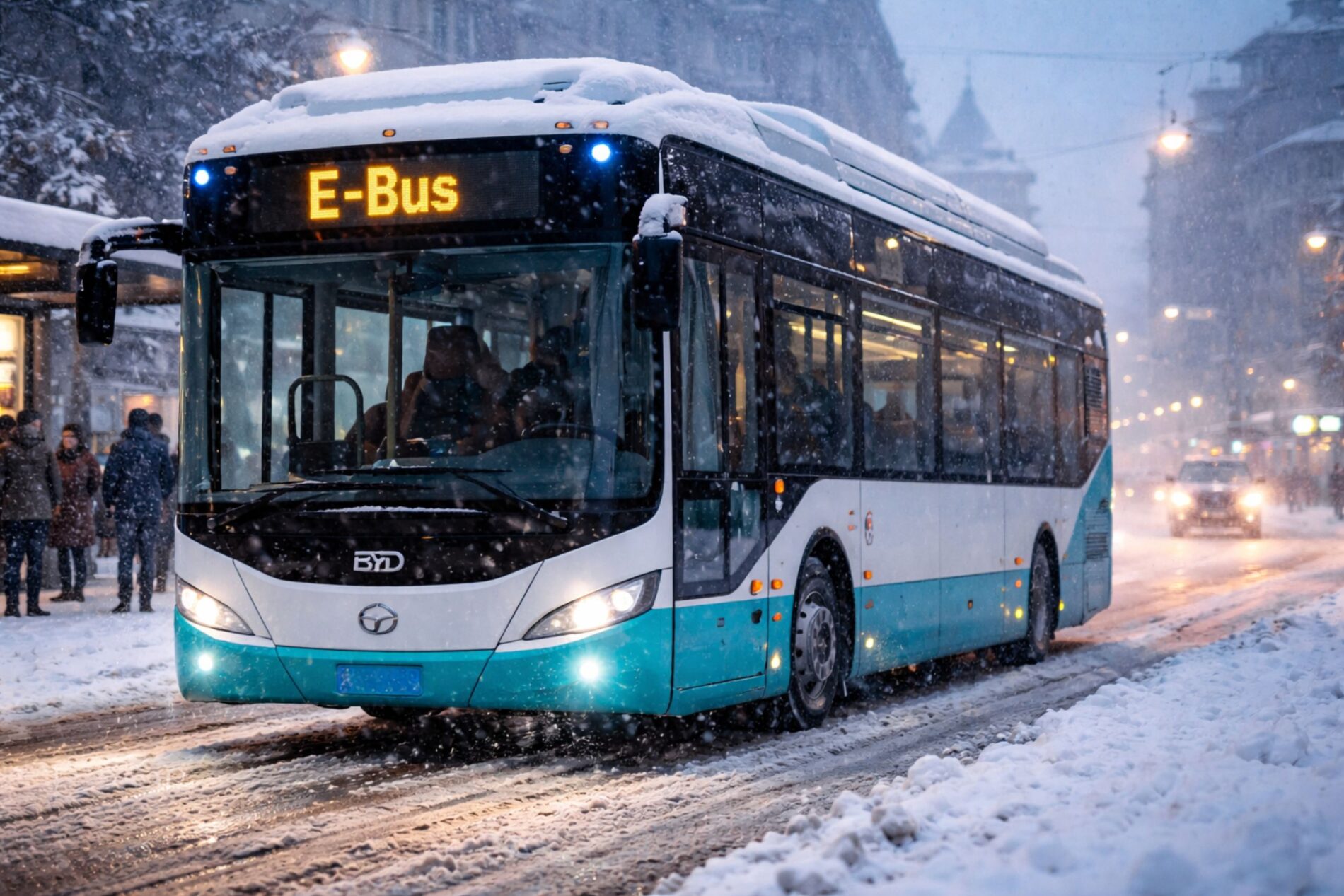
The discussion didn’t remain confined to Norway but also reached Great Britain. There, authorities, together with the National Cyber Security Centre, are examining the issue of remote access to Chinese electric buses. This demonstrates that London considers remote access capabilities not as a theoretical possibility, but as a real risk in public transport. At the same time, the issue gained momentum in Germany because Deutsche Bahn placed a large order for electric buses with the Chinese manufacturer BYD.
Cold, Range, Downtime – When Winter Disrupts the Bus Schedule
Electric buses almost inevitably suffer from a technical weakness: batteries noticeably lose performance in cold weather. Lithium-ion cells operate optimally within a moderate temperature range, while low temperatures reduce capacity and discharge rate. This can drastically reduce the range, even though heating, lighting, and auxiliary systems draw more energy. A drop of up to a third in range can occur at temperatures as low as minus ten degrees Celsius.
The practical implications of this were evident in Switzerland in January, when passengers in Schaffhausen and Bern found themselves in significantly colder buses. Operators reduced heating output to ensure the vehicles could complete their routes. The situation was similarly critical in the Heidelberg area, where many newly acquired electric buses were out of service for extended periods due to cold weather. Such weather phases are not exceptional occurrences, but rather a predictable stress test.
Inclines, software, structural problems – when technology capitulates in regular service
Besides range, many fleets are affected by software issues, as electric drives are heavily dependent on thermal management. On routes with inclines, overheating can halt operations even though the timetable continues. In Innsbruck, passengers on a MAN electric bus repeatedly had to disembark because a section of the route was too steep. Only after the passengers continued on foot could the journey resume.
Berlin also experienced how quickly an electric bus fleet can be depleted when recurring problems arise. In December, around 70 “2.2” models from the manufacturer Ebusco were temporarily out of service, while the BVG (Berlin Transport Authority) owns only a few hundred electric buses in total. The cause was fine cracks in the bodywork; moreover, many vehicles were later found to be beyond repair. To stabilize operations, BVG had to lease buses, demonstrating its reliance on short-term emergency solutions.
Fire and Depot Risk – When an Incident Blocks Infrastructure
Another risk factor lies in the energy storage system, as battery fires are considered difficult to control. If a cell experiences thermal runaway, the event can be self-sustaining. Conventional firefighting methods are no longer sufficient in such cases. Therefore, individual incidents quickly lead to total losses and lengthy shutdowns, while depots then face particularly costly downtime. In Hanover, a major fire at the ÜSTRA depot in Mittelfeld completely destroyed eight buses, including, according to reports, five electric buses, and the building itself was also severely damaged. In Stuttgart, 25 vehicles were lost at the SSB depot in Gaisburg. Investigators located the source of the fire in the area of a charging electric bus. Munich reacted immediately, with MVG temporarily taking eight eCitaro electric buses out of service until the situation could be assessed. Paris also took action after two electric buses caught fire within a month. As a result, the transport authority temporarily removed 149 electric buses from service.
Ultimately, a look at procurement reveals the direction things are heading, as several municipalities are pulling the emergency brake due to financial constraints. Dortmund is planning to revert to diesel buses for cost reasons. Solingen procured new diesel buses because, from the operator’s perspective, full electrification is not financially viable. This puts cost at the forefront, and many e-bus plans lose their political luster when faced with a budget review. (KOB)