
An Italian soil study from 2022 provides the technical core of the debate surrounding solar farms on agricultural land: after just seven years of ground-mounted photovoltaics, researchers discovered significantly depleted soils beneath the modules. This calls into question the widespread assumption that farmland can be easily cleared and returned to agricultural use after 30 to 40 years of solar operation. Consequently, in the U.S. state of Michigan, potato farmers are warning against the development of new solar farms on high-quality soils. The immediate concern centers on potatoes—which grow underground—and their potential to absorb plastic or metal residues. This would impact not only growers but also processors, retailers, and consumers. In a worst-case scenario, fertile land for food production could be permanently lost. (sciencesfiles: 22.05.26)
Soil Study Reveals Depleted Soils Beneath Solar Panels
The study was conducted by Maria Cristina Moscatelli, Rosita Marabottini, Luisa Massaccesi, and Sara Marinari. The researchers examined a solar park in the Lazio region of Italy, near Montalto di Castro. At the time, the facility had been in operation for only seven years. Nevertheless, clear differences emerged between the soil beneath the modules, the gaps between the rows, and an adjacent field.
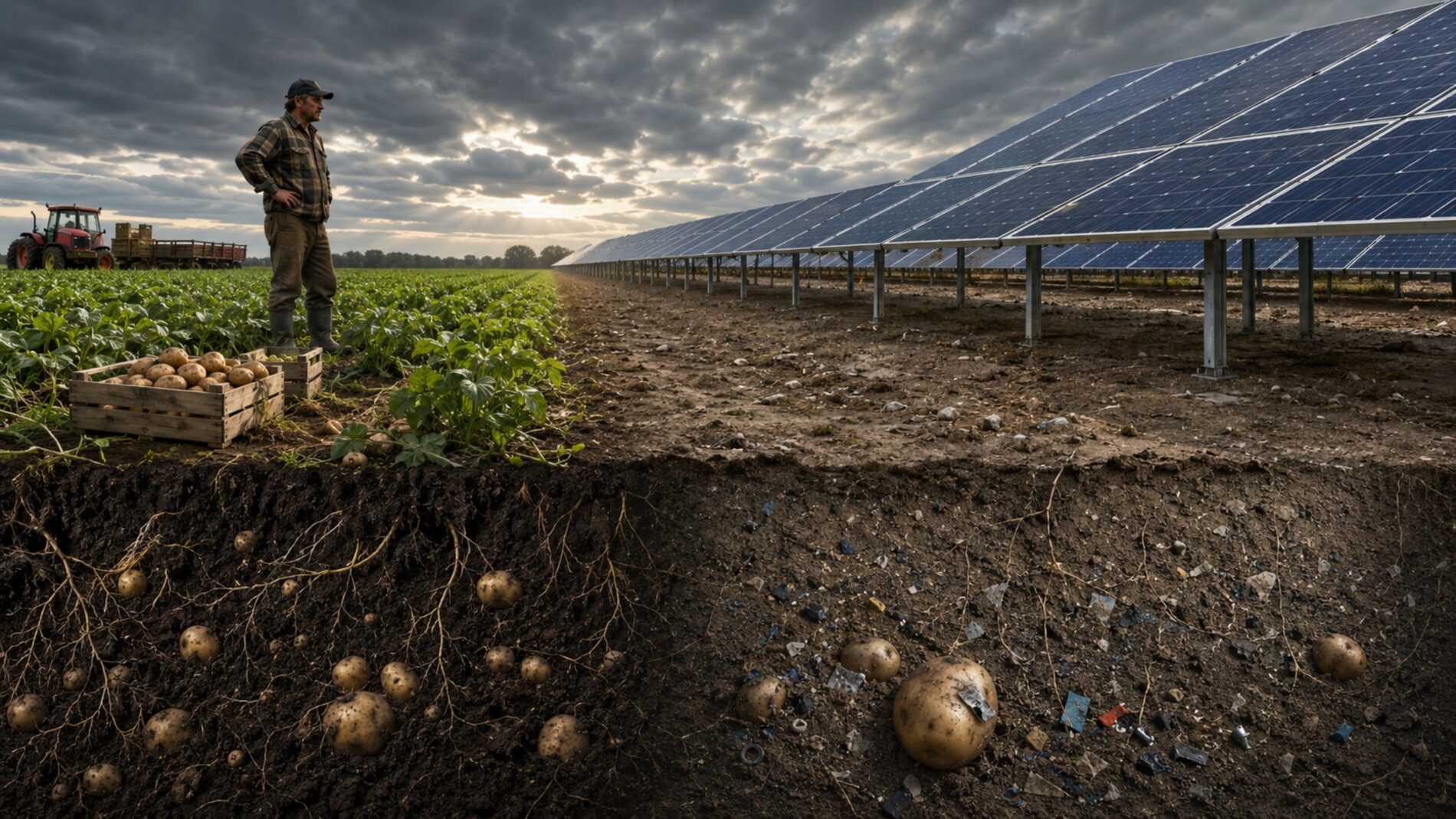
The loss of organic matter in the soil is of particular concern. This includes plant residues, dead roots, humus components, and other carbon-rich substances that maintain soil fertility. They store water, bind nutrients, and nourish microorganisms. According to the study, this organic content was 61 percent lower beneath the solar panels. Consequently, the soil loses precisely those substances that make arable land productive, nutrient-rich, and resilient to drought.
Agricultural Land Loses More Than Just Yield
The study describes not merely a short-term loss of yield; it reveals changes to the very foundations of soil fertility. Microbial activity beneath the modules was significantly reduced. As a result, the decomposition of organic matter slows down. Furthermore, fewer nutrients are available to plants.
At a depth of 20 centimeters, the researchers also detected elevated electrical conductivity. This indicates increased salinity in the soil. Such a change can further degrade soil quality. Therefore, the subsequent removal of the technical infrastructure is not sufficient. Future agricultural use depends on whether the soil can regain its biological functionality.
Michigan Warns of Risks to Potato Crops
The warning issued by Michigan takes on particular weight in light of these findings. Potatoes grow directly in the soil; consequently, residues left behind by former solar farms can pose a particularly severe threat to this crop. Small fragments of metal or plastic do not merely pose a theoretical risk to the harvest; they can become embedded in the tubers, thereby contaminating the food chain.
Potato farmers are therefore calling for alternative locations for solar farms. Priority should be given to rooftops, brownfield sites, and land with limited agricultural potential. This approach would allow for electricity generation without sacrificing high-quality soils. Agricultural lands with high productive capacity serve a different, vital purpose: they ensure food security, support processing infrastructure, and generate regional economic value.
Dismantling Pledges Are No Substitute for Soil Safety
Many solar projects are predicated on the promise that the installations will be removed after several decades. While this promise sounds simple, it falls short of addressing the full scope of the issue. Solar modules and mounting racks may disappear relatively quickly, but soil damage persists much longer. Residual cables, plastic shards, metal fragments, and compacted soil layers can remain behind. Therefore, what must be demonstrated is the land’s ability to regain its future productive capacity—not merely the dismantling of the technical equipment.
Compounding this issue is the unresolved challenge of disposing of old solar panels. By 2050, global estimates project that approximately 80 million tons of panel waste will have accumulated. To date, high-quality recycling options remain limited and costly. Consequently, there is a growing risk that this supposedly “clean” energy source will ultimately leave behind a legacy of new environmental hazards. For the agricultural sector, therefore, only one strict standard applies: fertile soil must not be permanently lost for the sake of a temporary energy project.