
Skysails Power GmbH has filed for insolvency. The Hamburg-based company developed so-called kite power plants, designed to generate electricity from strong high-altitude winds. After a crucial financing round failed to materialize, the Hamburg District Court opened preliminary insolvency proceedings. Despite government subsidies, technical successes, and some sales, the business model proved economically unsustainable. The collapse affects not only Skysails but also the entire approach to harnessing renewable energy using novel energy technologies, high-altitude winds, and airborne wind energy. (taz: 21.12.25)
Kite Power Plants at the Heart of the Company’s Strategy
Skysails didn’t build conventional wind turbines, but rather specialized kite power plants. These are installations in which automatically controlled kites fly on tethers at altitudes of several hundred meters. There, they harness strong and relatively constant winds. The resulting traction is transferred via a winch to a ground station, which drives a generator and produces electrical energy.
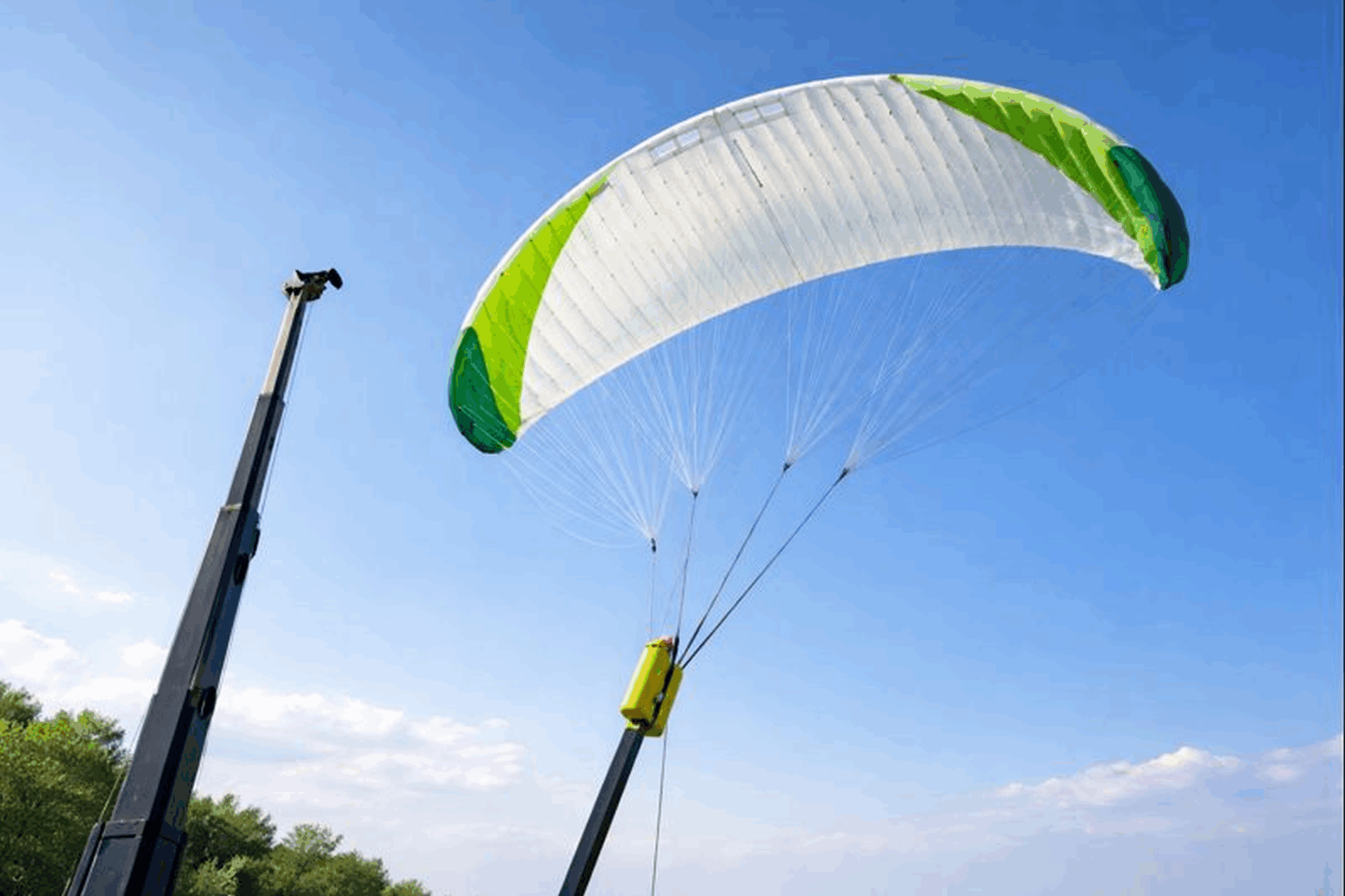
The best-known project was the “SkyPower100” research facility in Klixbüll, North Frisia. This facility had a nominal electrical output of 100 kilowatts and primarily served for technical testing. Later systems from the “Kyo” product line were specified by Skysails with a maximum output of up to 450 kilowatts. The expected annual yield was up to 1,780 megawatt-hours, depending on location and wind conditions. This placed the systems in the range of small wind turbines, but with significantly reduced material usage.
Electricity Generation in a Recurring Cycle
Energy generation in kite power plants occurs in clearly defined phases. During the power phase, the kite pulls the tether from the ground station, causing the generator to produce electricity. Once the maximum tether length is reached, the retrieval phase begins. The kite is brought into a position with low traction, while the generator acts as a motor, retracting the tether.
According to the company, this retrieval process requires only a fraction of the energy previously generated. This ratio was intended to ensure the economic viability of the kite power plants and made the technology attractive to funding bodies. At the same time, the complex control system increased the technical requirements and operating costs, which later had a negative economic impact.
Locations, Sales, and Market Experience
Skysails most recently employed 124 people. In addition to its headquarters in Hamburg, the company operated a production facility in Seevetal and a research and testing site in Klixbüll. There, the systems were tested under real grid conditions. According to publicly available information, however, only a few systems were actually sold.
At least one sale to Mauritius is considered confirmed. Industry sources speak of a total of around five systems built and delivered. A large-scale industrial production ramp-up did not occur. Although high-altitude winds are considered energy-rich and airborne wind energy is technically feasible, a commercial breakthrough failed to materialize. Other providers of comparable energy technologies share this experience.
Government Funding and High Expectations
Between 2018 and 2022, Skysails received approximately €1.73 million in federal funding for the “SkyPower100” project. The state of Schleswig-Holstein, the city of Hamburg, and the municipality of Klixbüll also supported the project. The goal was to bring innovative renewable energy technologies to market maturity and establish new forms of electricity generation.
With the funding, expectations for economic success rose. However, the transition from the demonstration phase to a stable market failed. While development costs continued to accrue, significant revenues failed to materialize.
Insolvency as the Economic Endpoint
The insolvency was triggered by the failure of investor negotiations. An ongoing financing round could not be completed in time. Skysails had already accumulated substantial losses prior to this. In 2023 alone, the deficit amounted to €8.5 million, while the accumulated losses totaled almost €30 million. Although the company still spoke of orders worth tens of millions of euros, these were insufficient to secure short-term liquidity.
Now, a provisional insolvency administrator is examining whether parts of the company, patents, or the technology of the kite-powered wind turbines can be salvaged. Technically, the concept of airborne wind power remains interesting. However, the Skysails project has failed economically for the time being.