
Germany is experiencing its second consecutive decline in wind power generation, despite continued increases in installed capacity. At the end of 2023, approximately 68.9 GW of installed capacity was available, generating around 142 TWh. By the end of 2024, capacity had climbed to approximately 72.4 GW, but production fell to around 138 TWh. At the end of 2025, capacity continued to grow to around 77.9 GW, yet generation dropped to 132.6 TWh, thus solidifying the decline. (faz: 08.02.26)
Decline Despite Expansion – Why More Gigawatts Don’t Mean More Electricity
The main driver lies in the availability of wind, as onshore winds remained too weak for many hours in 2024 and 2025. 50Hertz stated for 2025: “In 2025, there was only an average, lukewarm breeze, especially onshore; under normal circumstances, the wind yield would have been significantly higher due to the expansion of wind power capacity.” As a result, even new installations often fall short of expectations, and the statistics skew the overall picture despite increased capacity. Furthermore, the importance of reserves and flexibility is growing because fluctuations in yield have a greater impact on the market.
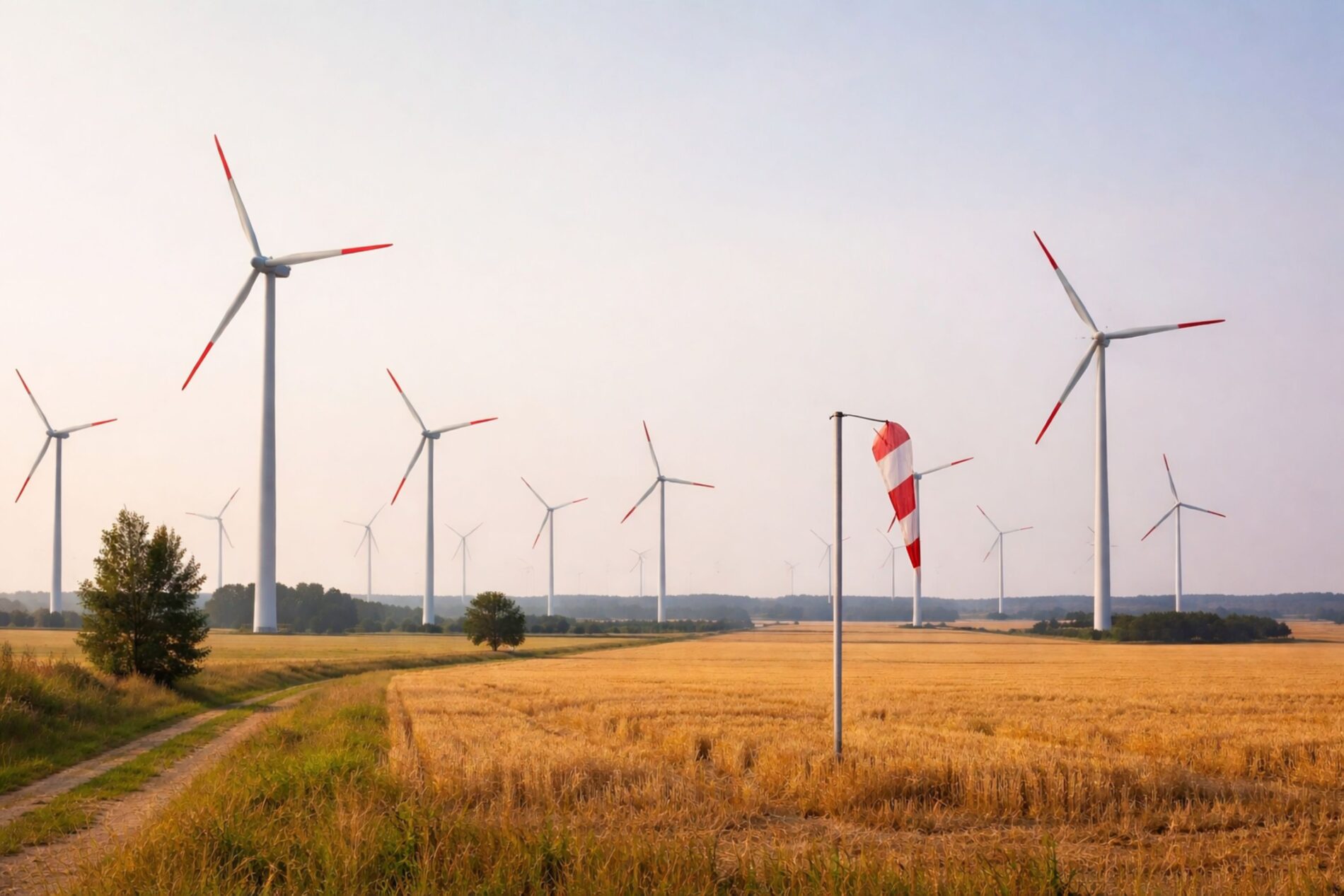
Offshore wind power dampens such fluctuations because these sea areas often provide more consistent power generation, but its share remains limited. In 2025, the North Sea contributed around 20.8 TWh and the Baltic Sea around 5.4 TWh. This means that offshore wind power provides roughly one-fifth of the total wind energy output, while onshore wind power dominates the overall result. Nevertheless, offshore wind cannot compensate for a widespread lull in wind power generation inland, and the annual figure remains susceptible to fluctuations.
The North Sea is becoming a strategic focus – but grids determine its effectiveness
Policymakers are focusing on the North Sea as a scalable power plant region because it allows for the concentration of large amounts of power. As early as 2023, the bordering states agreed to develop it into a “green power plant for Europe” with a target of up to 300 GW by 2050. At the end of January, several countries reaffirmed this commitment in Hamburg, aiming to make the North Sea the “world’s largest hub” for clean energy. At the same time, they agreed on up to 100 GW of cross-border interconnection to prevent electricity from being held up by national bottlenecks.
This is precisely where the bottleneck lies, because without cables and converters, the capacity remains on paper. TenneT Germany CEO Tim Meyerjürgens said: “Europe now has the opportunity to unlock the full potential of the North Sea as a green power plant.” This opportunity depends on infrastructure and speed, because delays directly diminish the benefits of the wind farms. Furthermore, a further decline in annual generation increases the pressure to no longer treat grid expansion and system reserves as secondary issues.
The government is getting involved, projects are underway – but the weather remains the key factor
Germany is acquiring a 25.1 percent stake in TenneT Germany, with the federal government investing around €3.3 billion through the KfW development bank. This brings greater national control over the transmission grid, which aligns with the offshore wind strategy. At the same time, the federal government already holds shares in 50Hertz, giving the Baltic Sea region additional political weight. Ultimately, however, only the electricity fed into the grid matters, because installed capacity alone does not guarantee supply.
On the generation side, new steps are on the horizon, including projects beyond German waters. Windanker is scheduled to go online in the second half of the year, while Gennaker, a particularly large offshore wind farm, will follow from 2028. Furthermore, Bornholm Energy Island, with its Energinet project, is intended to provide access to wind power outside German waters, expanding the available options. Nevertheless, the fundamental principle remains sobering: if the wind remains weak, generation can decline again, even with continued growth in capacity. The past two years have made it clear: installed capacity does not linearly correlate with yield. This will be particularly relevant for offshore installations in the coming years, as wind farms will compete for wind power.