
In Germany, there are more than 28,000 onshore wind turbines, and with the age of many of these installations, a previously unresolved wave of waste disposal is looming. Many older wind turbines have lost their feed-in tariffs since 2020. Since new turbines at the same location generate significantly higher yields, replacement is more profitable for many operators than continued operation. This is precisely where the waste problem begins, because dismantling not only generates massive amounts of material, but above all, a component that is difficult to recycle: the rotor blade. To date, there is no comprehensive and economically viable recycling system for these components made of glass and carbon fiber reinforced composites. The consequences range from expensive interim solutions and landfills to illegal dumping both domestically and abroad. Based on data from the German Environment Agency (UBA), the Bundestag anticipates up to 20,000 tons of rotor blade waste per year in Germany this decade, and even up to 50,000 tons in the 2030s.
Rotor blades of old wind turbines are the real waste problem
Rotor blades are considered the biggest disposal problem in the wind energy sector because they consist of complex and tightly bonded composite materials. These materials include synthetic resins, balsa wood, and glass or carbon fibers, with the fiber composite component accounting for at least 70 percent of the rotor’s weight. In some cases, metals, coatings, and even lead are added as a balancing compound. This construction makes the components lightweight and strong, but it also makes clean separation at the end of their service life difficult. This is precisely why the German Federal Environment Agency describes old rotor blades as a particular recycling challenge, the fate of which often remains unclear.
In addition to the environmental impact, there is the health aspect of the problem. Thermal treatment doesn’t simply eliminate composite materials without consequences; depending on the process, problematic emissions from resins and coatings can occur. The danger of toxicologically relevant fibers and particles is even more clearly documented in the context of dismantling and recycling. The German Bundestag refers to findings by the German Federal Environment Agency (UBA) indicating that such fibers can be generated during shredding processes, and that there are currently no emission limits for carbon fibers in the workplace or in the environment. Therefore, incineration or thermal recycling is not a clean solution, but often merely a technically tolerated stopgap measure, especially since many toxic residues remain in the ash or slag.
Illegal Dumping Reveals the System’s Weakness
Where legal recycling remains expensive, technically challenging, or regionally limited, the risk of resorting to illegal methods increases. The case of the Czech Republic illustrates this perfectly. Investigations are underway there into waste from Germany that was apparently illegally transported to the neighboring country and dumped there. Such incidents not only affect the waste management industry but also undermine the credibility of the energy transition. A recycling deficit thus becomes a cross-border environmental problem.
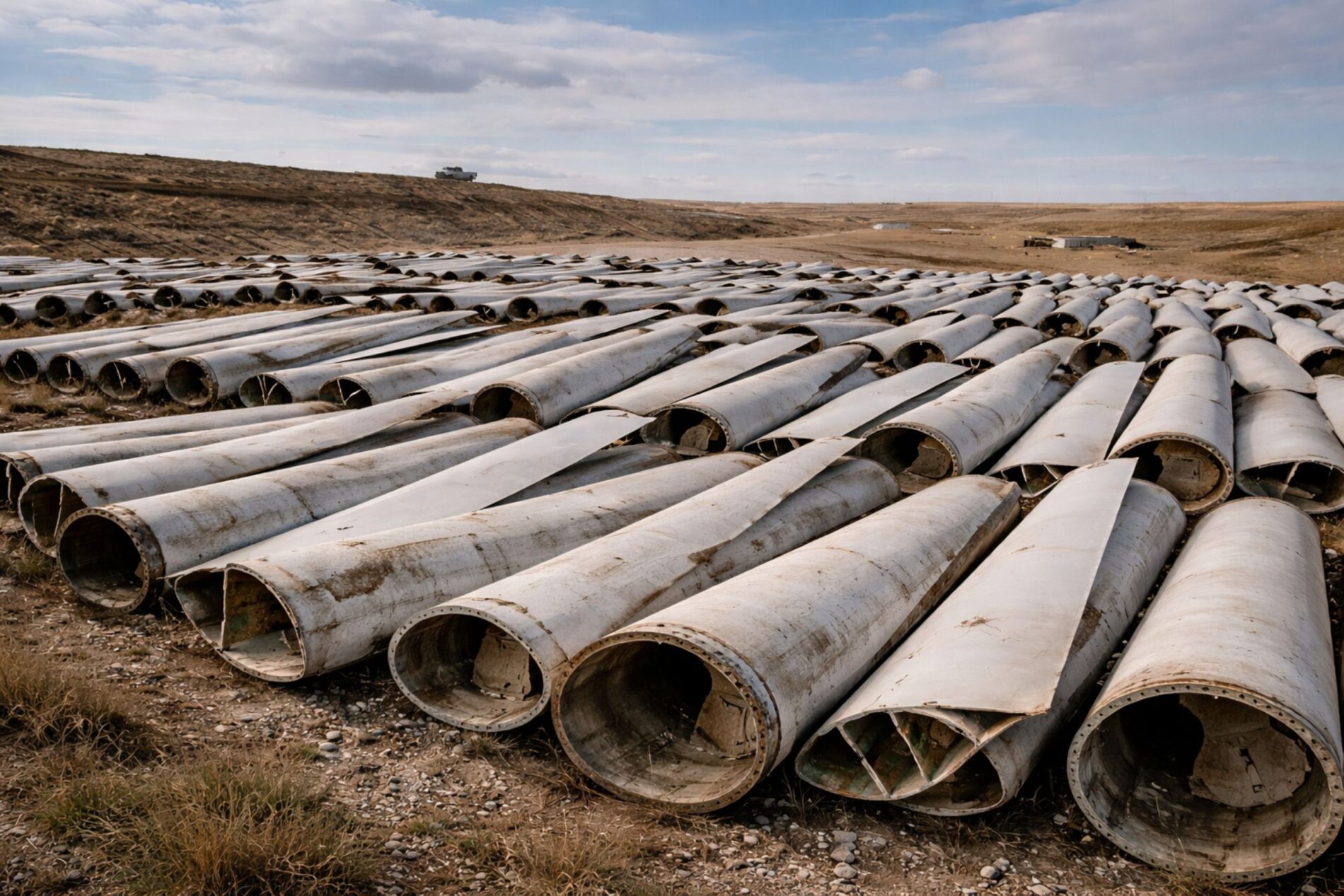
The problem is also clearly visible in the USA, but on an even larger scale. In addition to legal landfills containing rotor blades, there have recently been cases of illegally stored wind turbine parts. In early 2026, it became public that more than 3,000 rotor blades and parts had been improperly dumped at sites near Sweetwater, Texas. Furthermore, action was taken against a company in Iowa for illegally storing rotor blades for an extended period. The images of such storage sites clearly show where this trend leads when recycling processes are lacking and controls are implemented too late. The waste problem of wind power is therefore not in the tower or in the foundation, but in the rotor blade.
Manufacturers react late to a long-suppressed problem
The industry is now working on more easily recyclable materials and new processes. Manufacturers aim to develop fully recyclable rotor blades for new wind turbines. While this shows progress, it hardly helps the growing stock of old blades. As long as decommissioned rotor blades are burned, landfilled, or illegally moved, a key weakness of wind power remains. The energy transition is thus facing a waste problem that was long ignored and is now returning with full force. (KOB)