
Battery storage systems are considered an indispensable component of Germany’s energy transition. They are being registered with grid operators on a massive scale, but most are not being built. The reasons are manifold, the consequences precarious. (focus, 02.12.2025)
Example of a solar park in Zerbst
In November 2025, a massive solar park covering 41 hectares was opened in Zerbst, Saxony-Anhalt. It includes a battery storage system. The Norwegian operator, Statkraft, estimates the capacity of the 88 lithium-ion batteries to be sufficient to power 14,000 households. This successful project is part of the so-called “battery storage tsunami” that experts are currently observing in Germany.
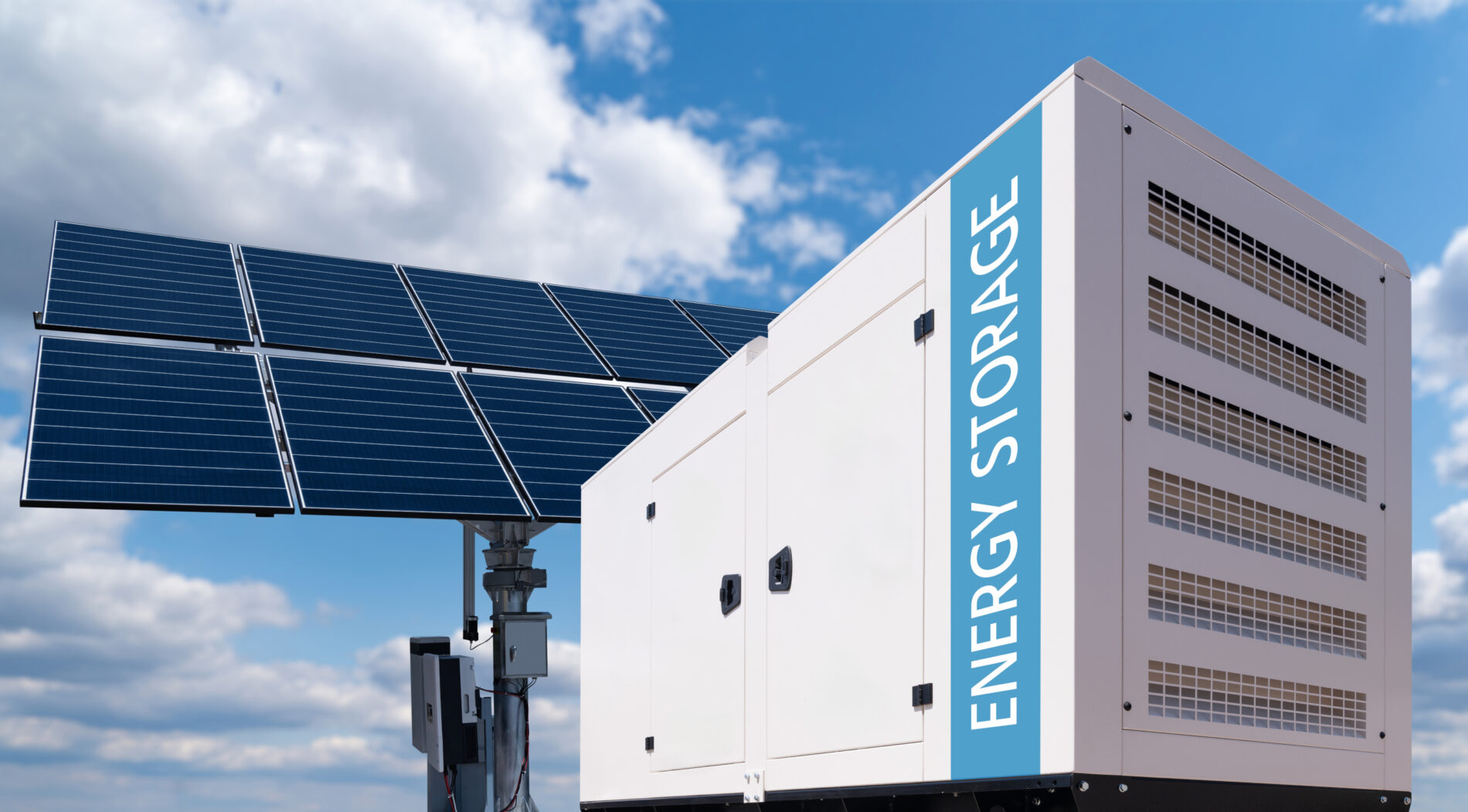
Storage systems are part of solar parks and wind farms, but they also exist as standalone projects. They have become affordable due to the drop in battery prices. It’s now possible to make good money with them by feeding solar power generated during the day into the grid in the evening when wholesale prices are high. Wind farms sometimes produce a lot of electricity during the day, and sometimes even on stormy nights, which their storage systems then release during periods of low wind. This is how the energy transition is supposed to work. Since solar and wind power are available unevenly, the grid needs storage.
Large discrepancy between existing and registered storage capacity
At the end of 2024, the Federal Network Agency estimated Germany’s storage capacity at 3.2 gigawatt-hours with a total capacity of 2.3 gigawatts, supplied by 921 larger and countless smaller battery storage systems. However, at that time, there were already registrations for 10,000 projects. Their total capacity is projected to be 400 gigawatts, with a storage capacity of 661 gigawatt-hours.
Amprion CEO Christoph Müller posted in November 2025 that there are likely many more applications for significantly more capacity since then. It may even be double the previous year’s figure. Amprion is a grid operator and one of the companies suffering from the battery storage boom. Grid operators are legally obligated to process applications and connect projects that are actually implemented. They must check applications according to their date of receipt. This is time-consuming and often not worthwhile simply because investors register storage projects just to secure approval should they ever be realized.
Whether this will actually happen is often unknown to them, as these are projects in the distant future. Project developers have plenty of time after approval to secure financing, because the flood of applications is now hitting a bottleneck in processing capacity. Therefore, projects applied for in 2025 are unlikely to receive approval before 2030 at the earliest. This leads to “phantom storage” or “zombie projects,” as the industry calls them: They are only applied for to keep the possibility of implementation open.
For some projects, financing remains completely unclear, and for others, a fixed location has yet to be determined. This leads to applications for multiple sites simultaneously. Some stakeholders are even trading in connection permits, while never intending to build a storage facility themselves.
How can this dilemma be resolved?
Experts are sounding the alarm and calling for legislative changes. As of the end of 2025, applicants are under no obligation to actually implement a registered project, while grid operators are required to review it (see above). Registered “phantom storage” projects are therefore delaying approvals for serious projects, which is becoming a serious problem for the energy transition. Amprion CEO Müller cites a ratio of approximately 1:3 between realistic and fictitious permit applications.
Grid operators are therefore calling on policymakers to end the “first-come, first-served” principle (the fastest applicant receives the permit first) and possibly introduce a substantial permit fee to deter opportunists. The Federal Network Agency, the responsible authority, has so far refused to comply with this demand, as it lacks the confidence to distinguish between sensible and speculative projects. The industry, however, is calling for a transparent and uniform solution for all applicants, and thus a legally sound one. They have found a receptive audience in Federal Minister for Economic Affairs Katharina Reiche (CDU), who, in line with proposals from the Federal Council, is working to remove battery storage systems from the Power Plant Grid Connection Ordinance (KraftNav) in the short term (still in 2025). From 2026 onward, the Ministry of Economic Affairs and Energy, under Reiche’s leadership, intends to work on a new regulation that will grant permits primarily based on quality and grid serviceability.
Meanwhile, the overburdened grid operators are responding to the flood of applications with their own strategies. Amprion has independently set a processing fee: a hefty €50,000. Christoph Müller now reports that reputable project developers are indeed paying this sum, which they consider “not a significant amount.” However, 65 percent of all applicants are also withdrawing their applications. These were clearly the speculators described above. This example could set a precedent.