
In the Hofgeismar district, the Reinhardswald wind farm project faces another major intervention in nature and infrastructure. The transport of the 75-meter-long rotor blades will now take place via a newly established route to the forest near Gottsbüren, as the originally planned delivery route is no longer accessible for heavy transport due to the reduced weight limit on the Weser bridge in Hann. Münden. However, the new route will require the felling of additional trees, extensive pruning of shrubs, widening of roads, and the temporary removal of two sculptures. This new intervention comes at a time when the project is already under considerable pressure due to the unapproved paving of forest roads. Nevertheless, the operator remains committed to commissioning the wind farm this summer. (hna: 04.03.26)
The new transport route brings new disruptions
The focus is no longer solely on how the rotor blades will reach the forest. The crucial question is what further interventions in nature will be necessary along the route. According to the regional government, five trees will have to be felled, and shrubs and coppice shoots will also have to be cut back so that the specialized transport vehicles can even navigate the route.
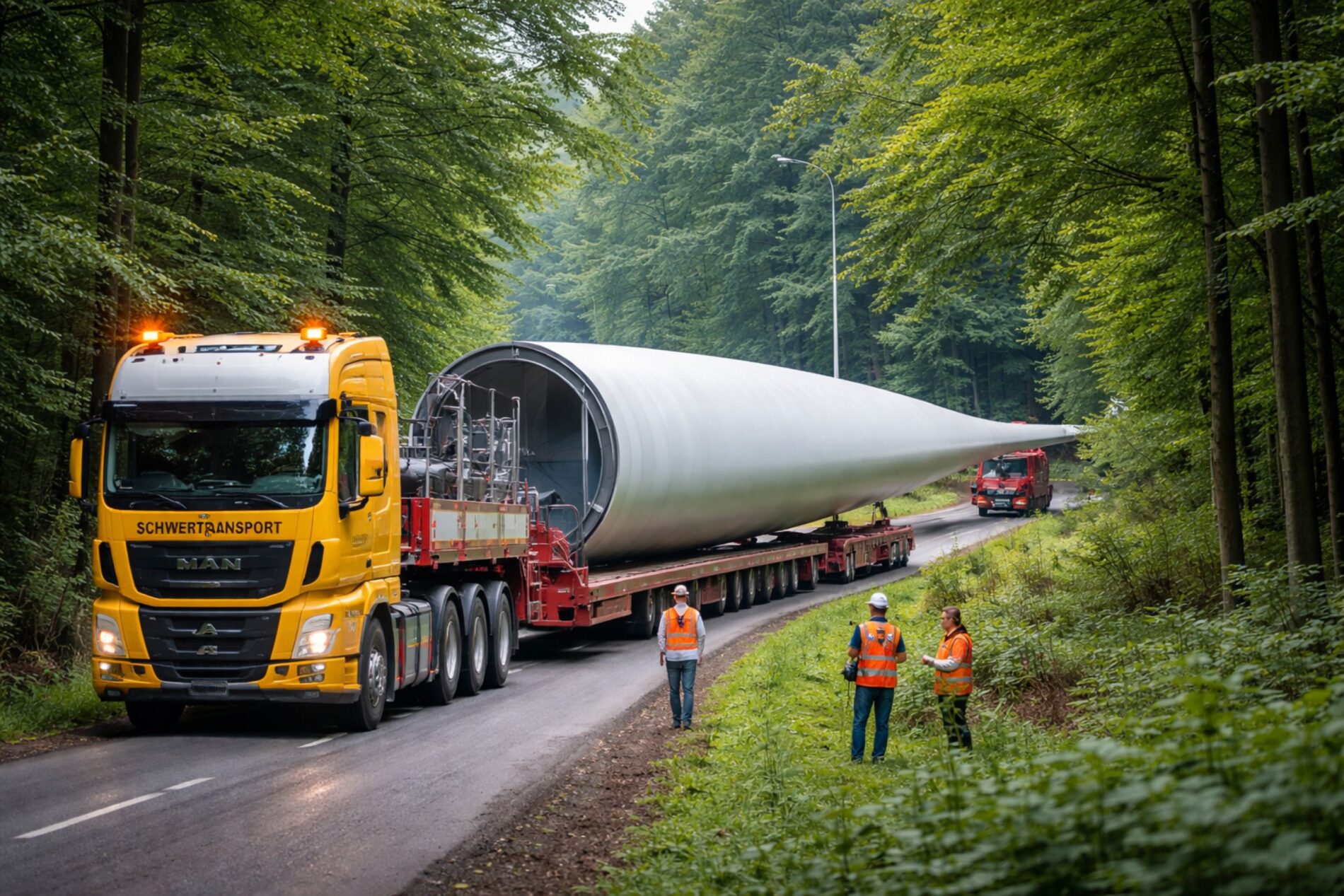
In addition, there will be structural modifications to the roadway. At several points, widenings will be constructed using natural stone gravel or aluminum panels to allow the extra-long transport vehicles to navigate narrow sections and curves. Furthermore, the bison statue on Beberbecker Allee and the wild boar statue at the Forstscheid parking lot will be temporarily removed. The artworks will be stored and later reinstalled, but this process demonstrates how far the project’s requirements now extend into the surrounding area.
The forest has already been altered more significantly than originally planned
This latest intervention is particularly controversial because the Reinhardswald wind farm was already criticized in 2025 for a different measure. At that time, the operator began paving sections of the forest roads, even though, according to the regional council, final approval had not yet been granted. Initial approval for the access roads had only allowed for graveling, partial widening, and the widening of curves. The company only applied for permission to temporarily pave approximately 1.3 hectares in May 2025. Nevertheless, according to the authorities, work began as early as September 12th.
The regional council therefore initiated administrative proceedings. A fine of up to €50,000 is possible, while the authority simultaneously stated that the application was likely to be approved after an initial review. This is precisely where the criticism begins. If a limited intervention is initially requested and more extensive changes follow later, critics naturally question whether projects are deliberately presented as less ambitious beforehand in order to lower the approval hurdle. The situation in the Reinhardswald forest fuels precisely this suspicion.
Authorities see no habitat potential, but doubts remain
Even with the current rotor blade transport, the authorities cite assessments related to species protection. The affected trees were examined for cavities and crevices before being felled. The regional council stated: “Yes, the trees to be felled were examined for cavities and crevices before felling. No such structures with habitat potential were found.” At the same time, it came to light that the treetops were not even fully visible during the examination. This reinforces skepticism, especially in an ecologically sensitive forest.
The conflict surrounding the Reinhardswald forest therefore extends far beyond individual transports. Although the Hessian Administrative Court rejected an urgent application by the municipality of Wesertal against the ongoing construction work at the end of December 2025, this does not change the fact that the picture is becoming increasingly clear of a project whose interventions are gradually expanding beyond the originally planned scope. First, additional asphalt surfaces in the forest, now further felling and modifications for the rotor blade transport. The Reinhardswald forest is not experiencing a single, isolated intervention, but rather a continuous expansion of the construction site logic. This is precisely what makes the project so politically and ecologically explosive.