
On windy days, the continental European power grid regularly experiences significant frequency drops shortly after 10 p.m. The likely cause is the simultaneous throttling of numerous wind turbines in Germany, which are only permitted to operate at reduced capacity after this time due to nighttime noise regulations. On March 24, 2026, the grid frequency dropped by 0.193 Hertz within 62 seconds, which, theoretically, corresponded to a loss of 3.2 gigawatts of generation capacity. Since the available primary control reserve in Europe is currently 3.45 gigawatts, there was little reserve available during this period. Experts do not currently foresee an immediate threat to grid stability; however, the system becomes significantly more susceptible to additional disturbances during such moments. (taz: 29.03.26)
A recurring pattern draws attention to the nighttime shutdown of wind turbines
The most striking aspect is the temporal regularity of the phenomenon. The deviations don’t occur randomly, but rather precisely at the time when stricter regulations under the Technical Instructions on Noise Protection (TA Lärm) apply to many wind turbines. This strengthens the suspicion that the nighttime reduction of wind power plays a key role. At the same time, it’s important to note that the article does not present this connection as conclusively proven, but rather describes it as a plausible explanation.
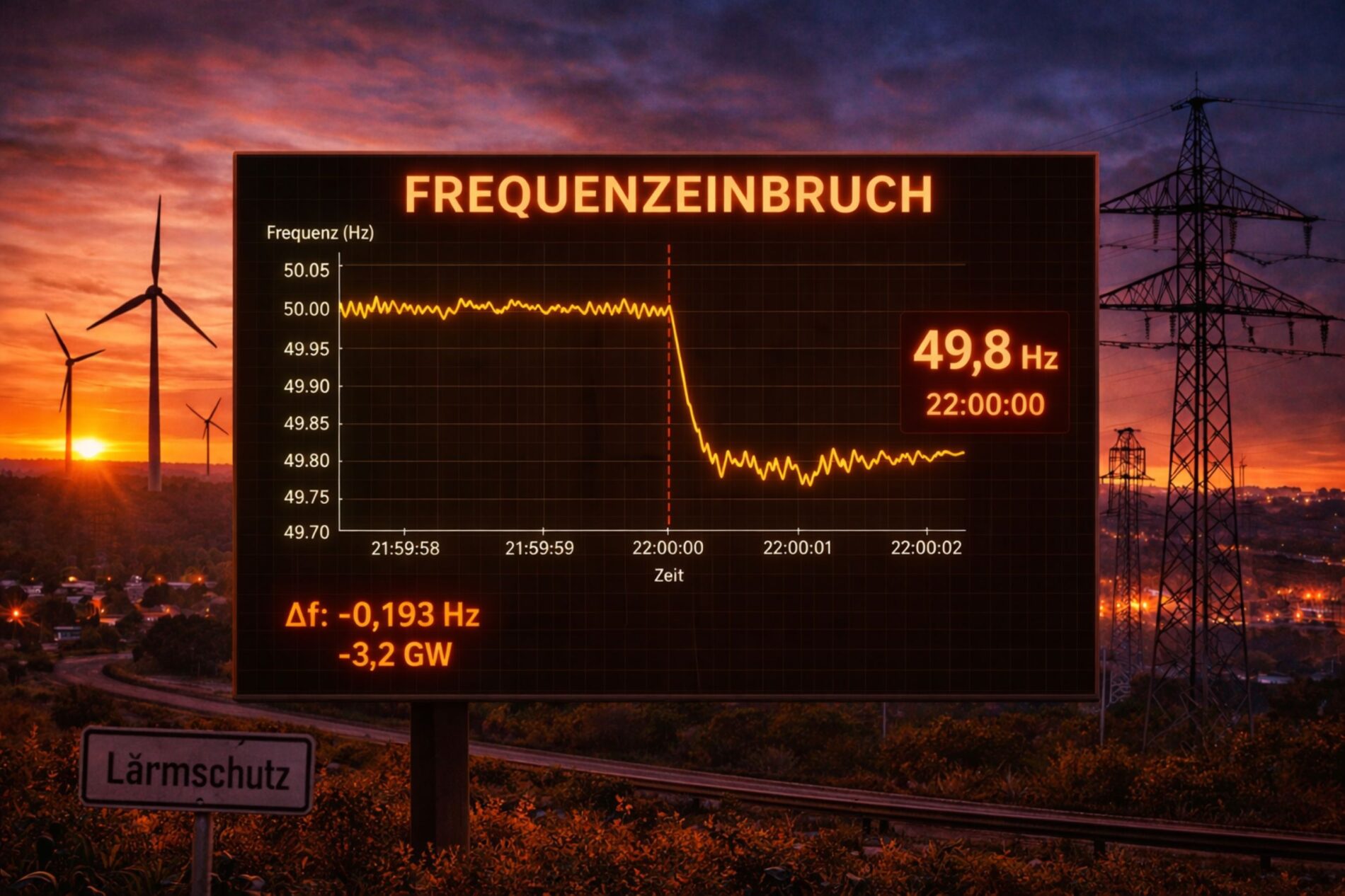
The magnitude of this phenomenon makes it relevant to the energy sector. Under ideal operating conditions, the grid frequency is 50 Hertz. If it drops below 49.8 Hertz, stability enters a critical range. While the observed dips have so far remained above this threshold, they nevertheless demonstrate how severely a synchronous power drop can strain the interconnected grid within a short period.
Grid operators see this not as a coincidence, but as a systematic event
Transmission system operators and other electricity grid experts have now publicly identified the pattern. Ulf Kasper of Amprion speaks of a “deterministic frequency deviation.” He uses this term to describe an event that does not occur randomly, but rather follows a recognizable pattern. This classification is precisely what distinguishes the phenomenon from ordinary fluctuations in grid operation.
While frequency jumps are more frequent on the European electricity grid during full hours due to the numerous switching operations that take place at the end of billing intervals, an additional factor comes into play in the case of the 10 p.m. event. According to Amprion, the power outages are “particularly pronounced” during strong winds, which is why wind power is considered the primary cause, not only in terms of timing but also objectively. However, the industry itself states that it does not have precise figures on the number of affected installations, so the explanation remains credible but not fully quantified.
The situation only becomes critical in the event of a second disruption
On its own, the 10 p.m. dip in power output does not trigger a blackout. This is precisely what the grid operators emphasize when they state that there is currently “no immediate threat to grid stability.” The problem lies elsewhere: If a large power plant or a critical transmission line also fails in the same minute, the scope for countermeasures shrinks considerably. Consentec Managing Director Christoph Maurer puts it succinctly: “This is not problematic in itself, but the system is weakened at such a moment.”
The obvious solution is technically manageable. If the affected plants were not simultaneously, but rather ramped down over approximately 15 minutes, the European power system could absorb the power drop much more effectively. The Federal Network Agency is therefore also considering, according to its own statements, “binding, harmonized ramp requirements.” These are clear rules for the speed of curtailment. The real risk, therefore, lies not in the wind power itself, but in a control architecture that forces many plants to move in the same direction at exactly the same time.