
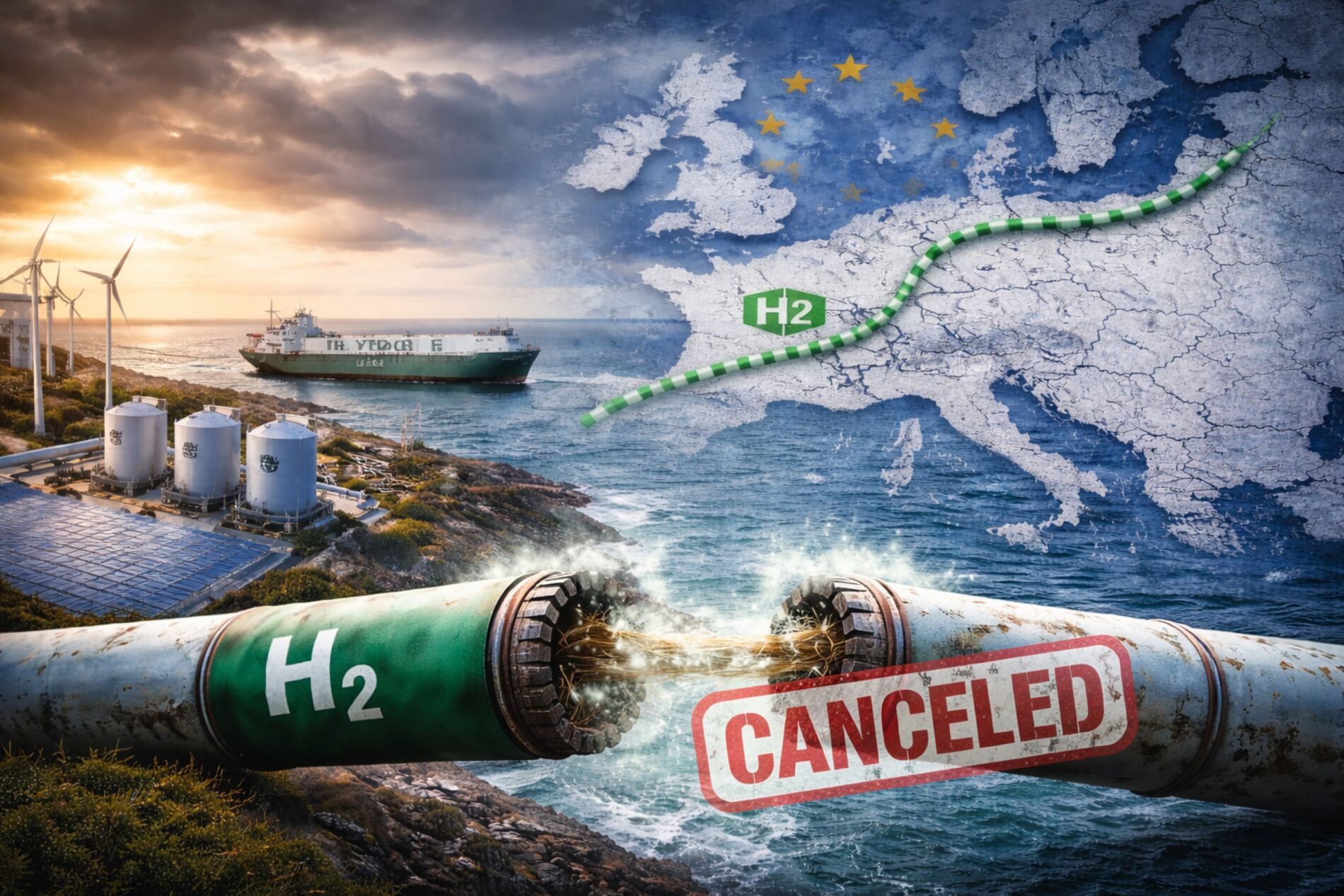
In the port city of Sines on Portugal’s Atlantic coast, large quantities of green hydrogen were supposed to be produced using cheap solar power and exported to Europe, but these export plans have effectively frozen. Around five years ago, then-Prime Minister António Costa promised a “green hydrogen future” for the site, while international consortia were tasked with preparing transport by ship and pipeline. Under the project name “Green Flamingo,” the vision included €3.5 billion, approximately 5,000 jobs, and a European export market. In 2024, the government at the time collapsed due to corruption allegations, including those related to the hydrogen project, which shattered confidence in the timeline and scale of the project. Today, the consequences are evident in the hard facts: less investment, reduced capacity, and still no industrial production. (dw: 27.02.26)
Export plans shrink to mere remnants
The cuts first affect the scale of the project, as a consortium reduced its planned output from 90 to ten megawatts. This equates to only around 1,000 tons of hydrogen per year, effectively eliminating widespread export activity. At the same time, the investment volume in this project segment plummeted from €162 million to €42 million, and several sub-projects lost their economic viability. Multiple partners withdrew or halted projects, and the once-planned, interconnected infrastructure collapsed. What remains is a single site that continues to plan, but no longer as a major European supplier.
Even more serious is the loss of time, as several plants should have been delivering long ago. Instead, primarily research and testing facilities are currently operating, while industrial hydrogen production remains elusive. “So far, no hydrogen is being produced on an industrial scale,” says Diogo Santos of the Instituto Superior Técnico in Lisbon. “It will probably be another ten years before that happens,” he adds, saying, “We are only just beginning.”
Change of course in Lisbon – domestic demand only, not exports
The current right-liberal government under Prime Minister Luís Montenegro is focusing on domestic customers, which is why exports have disappeared as an immediate goal. “The export plans from back then were probably a bit too ambitious,” says Filipe de Vasconcelos Fernandes of the Portuguese hydrogen association AP2H2. At the same time, Portugal has industries waiting for green hydrogen, such as cement plants and fertilizer manufacturers. These sectors consume a lot of energy and emit a lot of CO₂, which is why green hydrogen would be particularly effective there. Sines will thus remain a “Hydrogen Valley” in the EU sense, albeit on a significantly smaller scale than originally announced.
Ammonia Takes Over the Export Role
Because hydrogen is difficult to transport, ammonia is once again coming into focus. Santos says Sines should produce ammonia using green hydrogen instead of gray hydrogen from natural gas, and this product should be exported to other EU countries. Ammonia is easier to transport than hydrogen, and it is also suitable for fertilizer production. The deep-sea port of Sines reinforces this approach, as large ships can directly access ports like Rotterdam or Hamburg. This gives Europe an alternative, while the original export plans for hydrogen no longer represent a viable supply chain in the foreseeable future.
In Sines, the energy company Galp is planning a 100-megawatt hydrogen catalysis plant at a refinery, scheduled to start operation in the second half of 2026. Galp aims to replace around 20 percent of the gray hydrogen currently used, thereby reducing local emissions. “This contributes to the decarbonization of Europe,” says João Peças Lopes from the University of Porto. However, it remains just one component, as a single plant cannot replace a scaled-up export infrastructure.
Environmentalists criticize export plans
The environmental organization Zero considers long transport routes the wrong approach and therefore views the withdrawal from exports positively. “Transporting hydrogen over long distances is nonsense,” says Acácio Pires. “Rather, green hydrogen should be used where it is produced.” Short distances reduce costs and losses, while long-distance transport creates new dependencies. The result is a sobering picture: Sines remains an important location, but the large-scale export plans are considered practically a failure, and ammonia fills the gap.