
The last concrete development project in Berlin’s CleanTech Business Park Marzahn has failed because a conflict over species protection involving the strictly protected European green toad legally struck down the building permit, even though, according to the proceedings, the toad itself was never actually sighted on the construction site. The trigger was a lawsuit filed by nature conservation associations against the permit after a dispute over a protective fence around the building plot escalated. The court demanded a mapping survey according to species protection standards and deemed a widespread presence of the toad in the area possible, as the data was not sufficiently reliable in the judges’ view. The consequences are immediate: Berlin loses the battery project of Moll-Batterien GmbH, which would have created approximately 120 jobs. The roughly 300-hectare industrial park remains without a tenant. The factory will now be built in Bavaria. (berliner-zeitung: 27.02.26)
Toad without proof – suspicion replaces sighting
The crucial detail lies in the details: According to the legal proceedings, there was no documented sighting of the strictly protected species on the construction site in question. The dispute continued nonetheless because species protection law considers not only sightings but also plausible habitats and potential migration corridors. Thus, a nature conservation issue became a location question with immediate economic consequences.
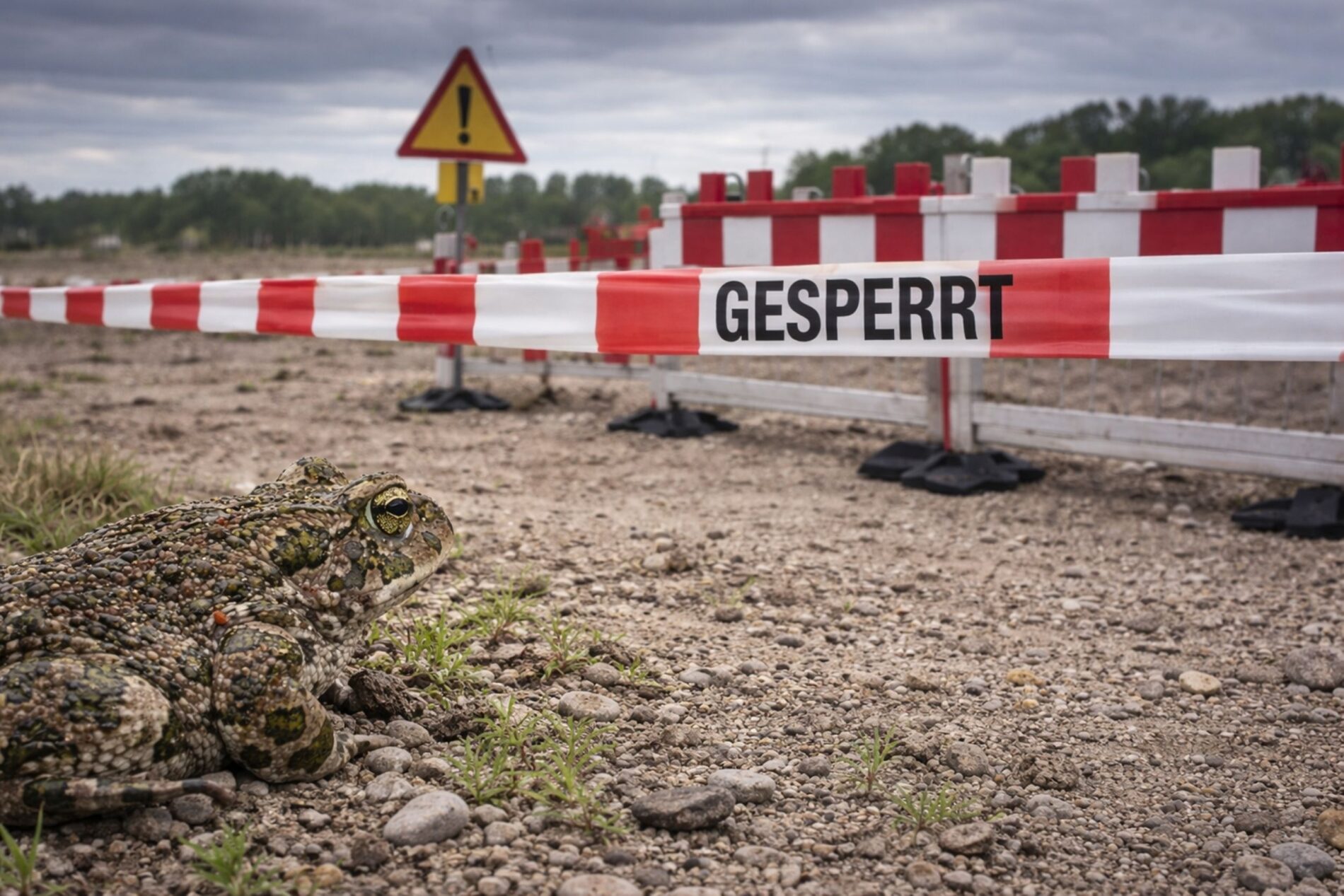
The dispute began at the protective fence intended to keep amphibians away from the construction site. The state-owned operating company WISTA relied on this solution and initially won in court. However, the proceedings were not concluded because associations subsequently challenged the building permit in principle.
Mapping as the sticking point – no data, no planning certainty
The State Working Group for Nature Conservation (Landesarbeitsgemeinschaft Naturschutz e.V.) sued against the permit, supported by a “service institution for Berlin nature conservation associations” funded by the state of Berlin. The court determined that a mapping project meeting species protection standards was lacking. The permit was jeopardized because, without a reliable survey, neither the extent nor the risk of the amphibian population could be accurately assessed.
Thus, the focus shifted from the construction site itself to the uncertainty. For investors, a clear timeline is crucial, and permits must be valid. A project can collapse in such situations, as unforeseen delays drive up costs and jeopardize the planned financing.
The State Working Group for Nature Conservation (Landesarbeitsgemeinschaft Naturschutz e.V.) filed a lawsuit against the permit, supported by a “service institution for Berlin nature conservation associations” funded by the state of Berlin. The court found that a mapping project meeting species protection standards was lacking.
Marzahn loses its last project – Lichtenfels gains momentum
Project developer Peter Urban summed up the frustration in one sentence: “I would have loved to realize this innovative battery project in Berlin, but we stood no chance against the ‘toad’ (a derogatory term for the project).” The statement is somewhat exaggerated, but it accurately describes the situation. The project is going to Bavaria because Berlin could no longer stabilize the permitting and risk profile.
This is a major blow for the CleanTech Park. Following an inquiry by Left Party representative Kristian Ronneburg to the Berlin Senate, the site still hasn’t secured a single tenant. The park’s credibility continues to wane, especially since its former flagship tenant, HH2E, has also gone bankrupt. The debate surrounding the project remains a symbol of a location that ultimately ends up empty.
Bavaria sets the example, Berlin is left with a void
Production at Moll Batteries GmbH is slated to begin in Lichtenfels, Bavaria, as early as 2026. The plan involves collaboration with Coburg University of Applied Sciences and the Bavarian Center for Battery Technology. Around €90 million is earmarked for the project, and up to 120 jobs are expected, as Bavaria is integrating and accelerating the project as an industrial component.
Bavaria’s Minister of Economic Affairs, Hubert Aiwanger, called the project “a true milestone for Bavaria.” In Berlin, the contrast is stark. The CleanTech Park remains stalled because a conflict over species protection, stemming from a lack of data security, has made any development risky from a planning perspective for years. The toad appears in the assessment as a blocking factor, even though no reliable evidence of its presence at the construction site has been documented.