
Three major grid disturbances resulting in overvoltage damage have occurred within the span of four months: in July, numerous households in Aspach-Rietenau were affected, while in August, an incident in Apfelstetten caused an estimated 600,000 euros in damages. In October, another disturbance—this time in Schleswig-Holstein—led to significant property damage and a widespread power outage, leaving up to 40,000 households without electricity at times. Reports of damage to heating systems, electrical appliances, and electronic control units were particularly frequent. In Aspach, those affected are currently in a dispute with the grid operator, Syna, regarding compensation; many fear they will be left to cover substantial repair costs themselves. These incidents draw attention to an often-overlooked aspect of supply security: damage caused by faulty grid voltage.
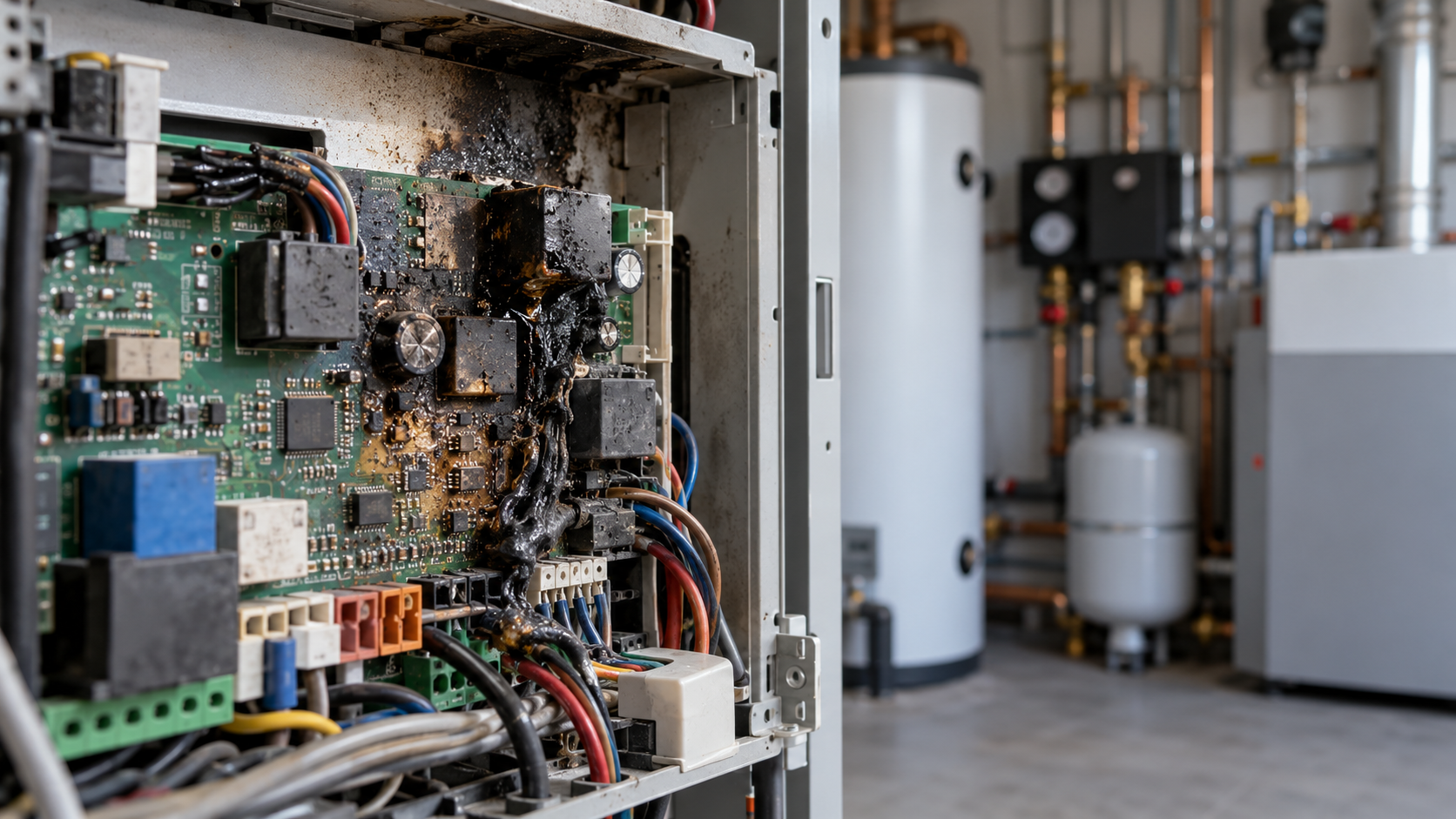
Image: AI-generated
Power Surge in July – Affected Residents in Aspach Face Potential Out-of-Pocket Costs
In mid-July, a technical malfunction during work on the power grid damaged numerous appliances and devices in Rietenau, a district of Aspach. Residents reported hearing a loud bang, followed by lights suddenly flaring up brightly. Afterward, heating control systems, kitchen appliances, and other electrical equipment ceased to function. According to estimates by local residents, several dozen households were affected. In one building, for instance, a control circuit board for a heating system was scorched. A municipal heat pump located at a property on Brunnengässle was also damaged.
Three months later, those affected are primarily concerned with the settlement of their claims. Many consider the compensation offered to be far too low; in some cases, repair costs amount to several thousand euros. The utility company, Syna, has directed claimants to its liability insurer. Consequently, several residents are considering legal action. The municipal administration has also requested that the company consider an ex-gratia settlement. It remains unclear whether all legitimate claims will be met, leaving those affected at risk of having to cover a portion of the costs themselves.
August: 360 volts from the wall socket cause at least 600,000 euros in damages
On August 21, a similar incident occurred in the Apfelstetten district of Münsingen. A technical fault at a Netze BW transformer station led to a massive voltage surge. Instead of the standard 230 volts, residents measured approximately 360 volts at their wall sockets. At least 50 of the 209 affected households reported damages, which included heating control systems, photovoltaic installations, EV charging stations (wallboxes), as well as refrigerators and freezers. By early September, those affected estimated the total damage to be at least 600,000 euros—with one owner alone anticipating costs of around 40,000 euros.
The economic consequences extended well beyond damaged household appliances, as modern heating systems and electrical installations contain expensive electronic components. Consequently, repairs in the event of a failure can reach five-figure sums. Netze BW described such malfunctions as extremely rare, pointing to existing protective systems. However, those affected are required to provide individual proof of their losses. The grid operator has announced that it will review each claim on a case-by-case basis; therefore, the estimated 600,000 euros does not necessarily correspond to the final compensation amount.
October: Overvoltage affects up to 40,000 households in Schleswig-Holstein
On October 18, another major grid disturbance occurred in the western part of Schleswig-Holstein. A short circuit within the 110,000-volt network operated by SH Netz triggered an overvoltage, causing several transformer stations to shut down. As a result, up to 40,000 households temporarily lost their power supply. In Friedrichstadt, a surge arrester caught fire. Subsequently, residents reported damage to heating systems, electricity meters, dishwashers, and household electrical installations. According to initial estimates, between 100 and 150 households in Albersdorf alone may have sustained property damage.
The consequences were particularly severe in Bunsoh, in the district of Dithmarschen, where an electrical panel in a thatched-roof house caught fire. The building was destroyed, with damages estimated at approximately 500,000 euros. The precise technical cause of the fire and potential claims for compensation will require separate assessment. Residents in other municipalities also reported significant damage to electrical equipment. As a result, SH Netz has established a formal process for reporting such damage. Decisions regarding potential compensation will be made on an individual, case-by-case basis.
Federal Network Agency does not maintain comprehensive annual statistics on overvoltage damage
The three incidents that occurred in July, August, and October raise the question of whether such grid disturbances are becoming more frequent. However, the published statistics do not provide a definitive answer. The Federal Network Agency (Bundesnetzagentur) tracks power interruptions lasting longer than three minutes on an annual basis; for 2024, grid operators reported a total of 164,645 such supply interruptions. Short-term voltage surges that result in damage to equipment, however, are not captured as a distinct, nationwide category of damage statistics. While the agency has published studies on power quality, these do not allow for the derivation of a current, total annual figure for comparable damage events.
The insurance industry offers another point of reference. According to the German Insurance Association (GDV), home contents and residential building insurers recorded approximately 180,000 claims related to lightning strikes and overvoltage in 2025. Total compensation payments amounted to 310 million euros, with an average cost of around 1,760 euros per claim. It should be noted, however, that these statistics primarily cover damage linked to lightning strikes and the resulting overvoltages; therefore, they do not provide insight into the annual frequency of grid-related technical disturbances, such as those that occurred in Aspach or Apfelstetten.
Number of claims is falling—but individual repairs are becoming increasingly expensive
At first glance, the insurance statistics appear to contradict the assumption of a general upward trend, as the number of recorded lightning and overvoltage claims fell from approximately 220,000 in 2024 to about 180,000 in 2025—a decrease of 40,000. At the same time, however, the average cost per claim rose by approximately eleven percent, reaching a new record high. The insurance association attributes this development, in part, to the increasing technical complexity of building infrastructure. Sophisticated heating control systems and various electronic installations, in particular, can significantly drive up repair costs.
Consequently, the focus has shifted not only to the frequency of such incidents but, more importantly, to the financial scale of individual events. Even a brief power surge or voltage disturbance can damage numerous expensive components simultaneously. While the Federal Court of Justice confirmed as early as 2014 that grid operators could potentially be held liable—regardless of fault—under the Product Liability Act, affected parties must still prove that the requirements for such claims are met. Furthermore, the Act stipulates a deductible of 500 euros for property damage. Other legal grounds for claims may allow for more comprehensive compensation. For those affected in Aspach, the crucial question remains whether they will be fully compensated for the actual damages they have incurred. While these three incidents do not yet constitute a clear upward trend, they do highlight the significant economic consequences that individual grid disturbances can entail.
Author: Blackout News
Sources: Backnanger Kreizeitung (23.10.26) – NDR (21.10.26) – SWR (01.09.26) – Gesamtverband der Versicherer (30.07.26)