
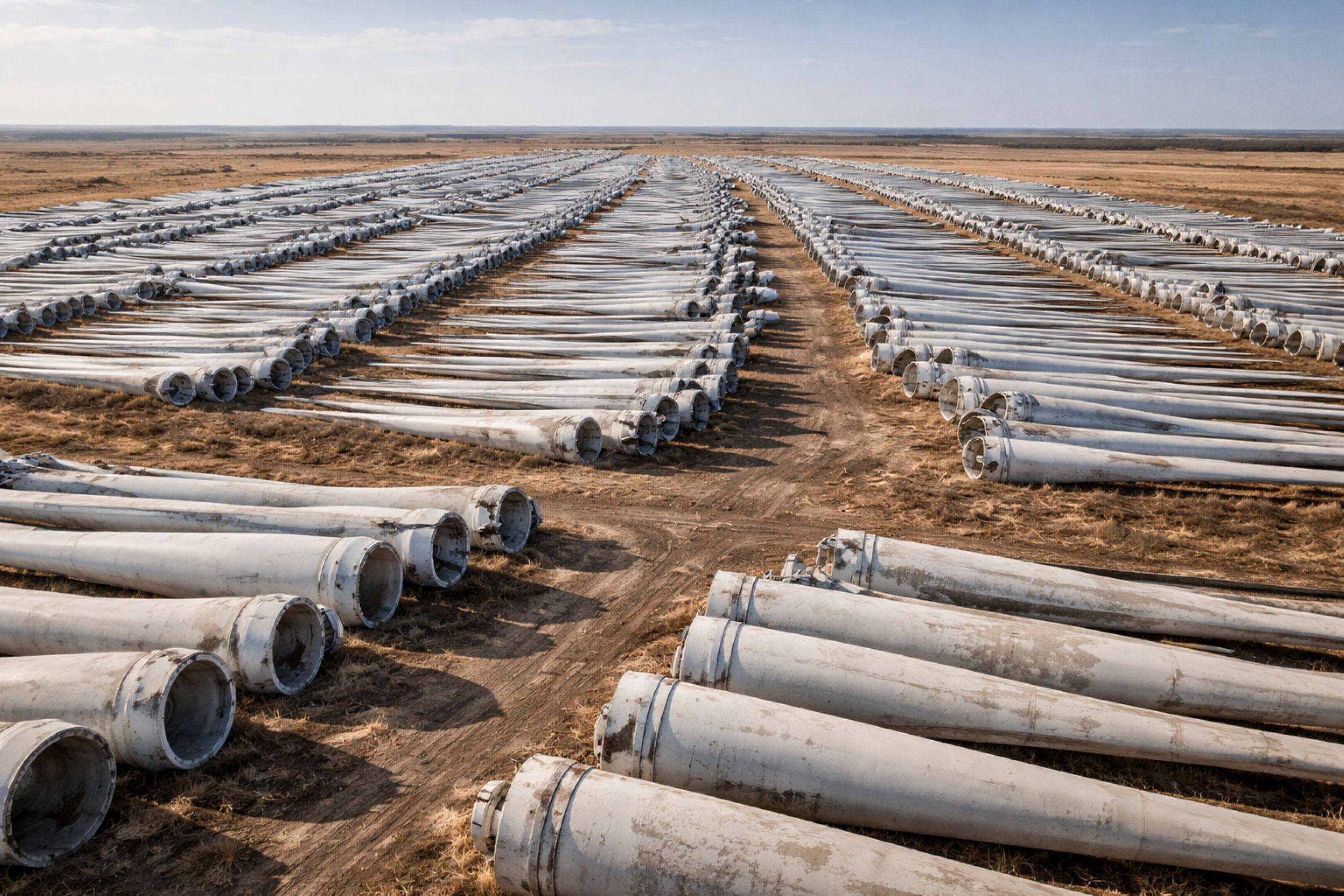
A massive waste disposal problem from the wind industry has escalated in the city of Sweetwater in Nolan County, Texas. In February, Attorney General Ken Paxton filed a lawsuit against Global Fiberglass Solutions and affiliated companies. According to authorities, more than 3,000 wind turbine blades, along with other materials from decommissioned turbines, were stored on two city-owned sites. The crucial charge is illegal storage, as the company was supposed to dismantle, transport, and recycle the components. Instead, a large pile of waste accumulated over the years, some of which dates back to 2017. Authorities consider this an environmental and legal problem with significant consequences for the city, its residents, and the landscape. (cfact: 03.03.26)
Criminal proceedings over illegal storage of wind turbine blades
Sweetwater is located about 40 miles west of Abilene. The region is considered the center of Texas’ wind power expansion. Thousands of turbines dot the landscape there. This makes the disposal scandal particularly significant. A town that has profited from the expansion of wind energy is now grappling with its legacy.
Paxton announced a decisive approach. He stated, “The illegal dumping of wind turbine waste harms our country and will never be permitted under my watch.” He also criticized companies for hiding behind the label of a green industry. However, laws and environmental regulations apply regardless of political narratives.
The City of Sweetwater Files Criminal Charges
The city administration is also taking action. City Manager Bryon Sheridan announced at a press conference on February 26 that four individuals have been charged in connection with the dumped materials. The city aims to send a clear message: anyone who simply dumps industrial waste will face criminal charges.
The pile of waste consists primarily of large rotor blades and composite materials. Such components are difficult to recycle. Therefore, storage sites for decommissioned wind turbine blades are being established in many places. In the case of Sweetwater, however, the issue is not an approved interim solution, but rather the allegation of illegal storage over several years. This is precisely the core of the Texas lawsuit.
Similar problems exist in other US states
The case in Texas is not an isolated incident. In Grand Meadow, Minnesota, 111 wind turbine blades lay scattered across a site for several years. Residents reported seeing feral animals in the cavities of the damaged parts. Many also cited a risk to children playing on the large components.
The waste originated in 2020 during the modernization of a wind farm in Mower County. However, the operator, NextEra Energy, was unable to find a company to recycle the fiberglass blades. As a result, the debris remained untouched. It wasn’t until October 2024 that the parts were removed from the site, after the state energy regulator ordered their removal.
Recycling problems are driving up waste volumes
The core of the problem lies in the design of modern rotor blades. They are made of fiberglass, carbon fiber, and epoxy resin. These materials are extremely strong. At the same time, they make recycling considerably more difficult. As a result, many decommissioned components end up in landfills in the Great Plains.
Experts anticipate a sharp increase in waste volumes. By 2050, over 133 million tons of material from decommissioned wind turbines could accumulate worldwide. Even today, several thousand rotor blades are taken out of service annually in the USA. With the expansion of wind energy, the amount of old wind turbine blades is also growing, for which disposal solutions are often limited.
Solar power plants are also causing growing waste problems
In addition to wind energy, the solar industry is also generating increasing amounts of waste. The US Environmental Protection Agency expects up to one million tons of decommissioned solar modules by 2030. These contain lead, cadmium, and other heavy metals. If such substances enter the soil or groundwater, long-term environmental problems arise.
This shifts the energy policy debate. Electricity production from renewable sources remains important. At the same time, the disposal of the technology is moving more into focus. The conflict surrounding Sweetwater therefore highlights a structural problem. The expansion of modern energy facilities generates materials whose disposal often only becomes apparent years later.