
Offshore wind farms in the North Sea could measurably alter currents regionally and, in some cases, over large areas by 2050, particularly in the German Bight. This is shown by long-term simulations from the Helmholtz Centre Hereon, published in Nature Communications Earth & Environment. The impetus for these simulations is a politically driven expansion scenario that projects a more than tenfold increase in offshore wind power capacity in the North Sea by 2050. In this scenario, rotors and foundations simultaneously influence both the wind field and the tidal current, causing peak surface currents to weaken and potentially shifting in direction and frequency. The model identifies large wind farm clusters as a key risk factor, as the effects can spread beyond individual parks. The main consequences affect forecasts for shipping, coastal protection, and offshore operations; sediment transport and mixing could also alter marine processes.
Currents are changing – the pattern extends beyond wind farms
The team at the Helmholtz Centre Hereon simulated the long-term hydrodynamic consequences of a realistic expansion pathway up to 2050, but not just for air or water separately. Instead, the research group led by geophysicist Dr. Nils Christiansen combined both levels in a coupled model. This is precisely the crux of the matter, because offshore installations change the atmosphere above the sea while simultaneously altering the movement of water.
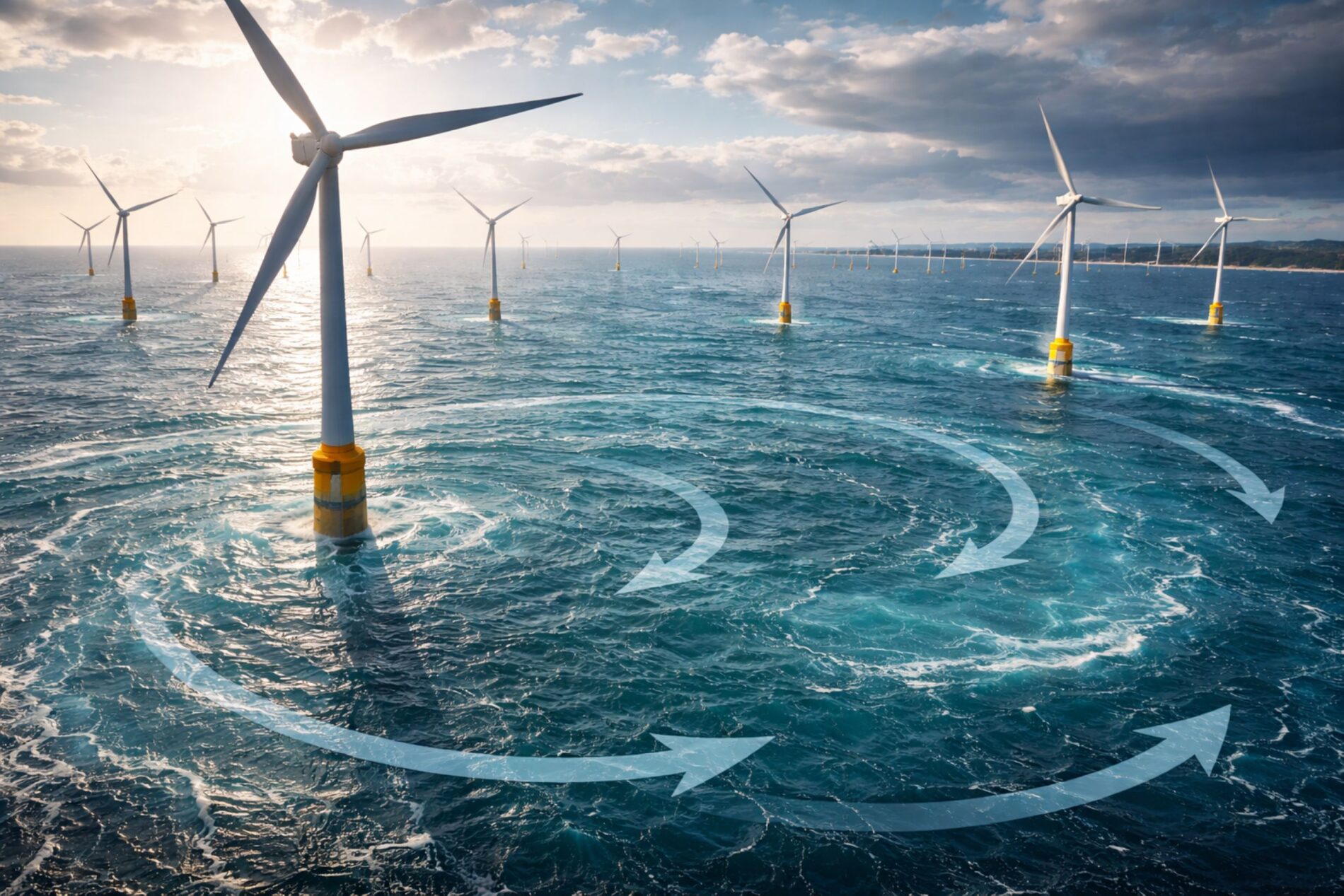
According to the study, the simulations reveal a “new, finely structured flow pattern.” Christiansen explains: “Our simulations depict a new, finely structured flow pattern that is not only observable within the wind farms but can also spread across the North Sea – with a reduction in surface velocities of up to 20 percent in an expansion scenario for 2050.” This means the effects are not limited to local areas; the dynamics can extend regionally.
Why Rotors and Foundations Shift Tidal Flows
Rotors extract kinetic energy from the wind, and they also generate wake effects behind each wind farm. In these areas, the wind speed decreases, and the turbulence changes. This affects the sea surface, altering the momentum the wind imparts to the water.
Underwater, the foundations also play a role. Monopiles or jacket structures act as obstacles in the tidal current, thus locally slowing down the tidal flow. At the same time, they create vortices and turbulence, which reorganizes the movement around the structures. Technically, the flow resistance increases, and the water shifts laterally.
Consequences for Sediments, Mixing, and Ecosystems
A slowdown of up to 20% is not merely a cosmetic measurement, but rather shifts processes within the system. Currents transport sediments, mix water layers, and distribute nutrients. When these transport patterns are disrupted, habitats and food chains are sensitively affected.
If mixing changes, temperature and salinity gradients can shift, and oxygen distribution can also change. In shallow shelf seas like the North Sea, vertical mixing controls many biological processes. Therefore, even a systematic, recurring change can send out ecological signals.
Navigation, oil spill scenarios, coastal protection: Models must catch up
Current models are incorporated into navigation systems and also support oil spill scenarios, coastal protection planning, fisheries decisions, and offshore construction projects. When wind farm clusters alter hydrodynamics, forecasts must take these interventions into account; otherwise, uncertainties in practice increase. This becomes particularly critical where currents are crucial for route planning, drift forecasts, and construction windows.
The study also puts the results into context. It’s not about alarmism, as the absolute changes are within the range of natural fluctuations. However, they occur systematically and accumulate with increasing installed capacity. This combination is precisely what makes them relevant for planning and operation.
Planning as a Leverage: Distances, Locations, and Tidal Conditions
The simulation suggests that these effects can be controlled. Turbine spacing, site selection, and local tidal conditions are crucial, while the orientation relative to the main current direction also plays a role. Greater distances reduce the superposition of turbulence, thus decreasing the additional mixing of the water.
Christiansen emphasizes the dual mandate of expansion and risk understanding: “Offshore wind energy is an important component of the energy transition and decarbonization. At the same time, we must understand how different types of offshore installations and turbine sizes affect the North Sea. Only then can we provide society and the economy with sound information and develop measures to minimize potential risks early on.” This makes it clear: Expansion is considered feasible, but it requires planning that considers marine dynamics as a contributing factor. (KOB)