
The discussion about electromobility often seems more advanced in metropolitan areas than the market actually is. This is because rural areas, not cities, are the dominant region for private owners. The decisive factor is less enthusiasm for electric cars and more the practicalities of everyday charging – which often depends on owning a property with a garage or dedicated parking space. (welt: 11.02.26)
Private electric car owners drive where charging is readily available
The HUK “E-Barometer” highlights the social and structural imbalance. Less than 20 percent of electric car owners rent, while around three-quarters own their homes. A further eight percent live in condominiums, and many electric cars are parked under cover in carports or garages.
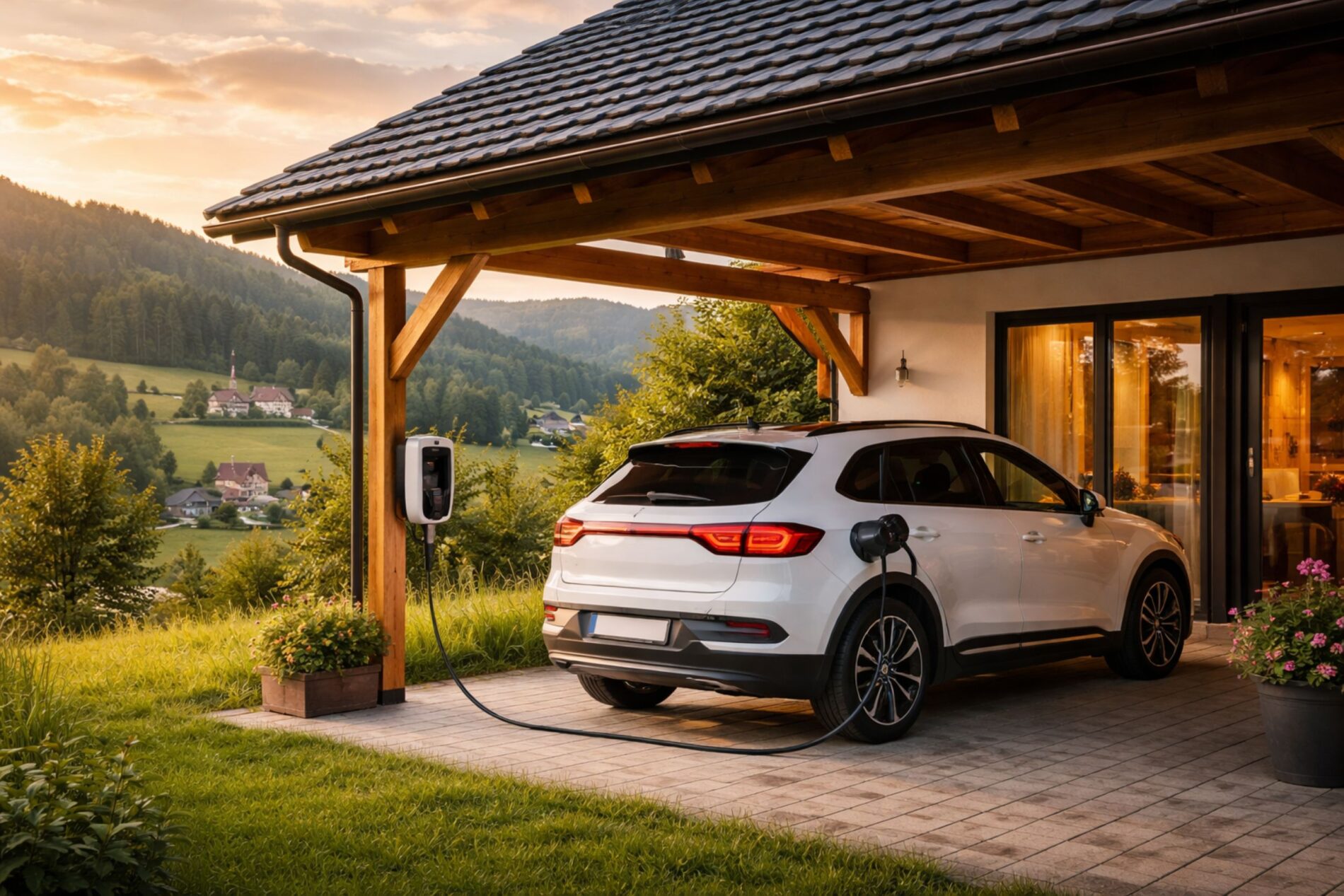
This makes the switch easier for homeowners because the wallbox stabilizes the charging process. Those who plug in in the evening start the next morning fully charged, and yet the effort involved in charging remains minimal. Furthermore, self-generated solar power often reduces running costs. Renters rarely have complete control over this process because parking spaces are lacking or permits and costs prevent them from getting connected. In cities, this particularly affects those who park on the street, because without a dedicated parking space, charging at expensive public stations is often the only option. Afterwards, they have to move their car because blocking parking is penalized or the space is needed. And then the next round begins: the often lengthy search for an available parking space, which wastes time and makes everyday electric driving unattractive.
Commercial and leasing provide volume, private customers create the bottleneck
Those who only look at new registrations quickly overlook the distribution of roles in the market. Around two-thirds of new cars are registered commercially, only about one-third privately. Therefore, growth is often driven by fleets, leasing, and company cars, while private customers catch up more slowly.
This skews public perception because commercial decisions follow different logics. Fleet managers calculate based on residual values, taxes, and operating lifetimes, and they change vehicles more frequently. Private customers, on the other hand, are focused on purchase price, electricity costs, and everyday practicality. It is precisely at these points that the decision is made whether an electric car is even a viable option.
Self-Registrations – When Statistics Look Like Demand
Another distortion is caused by self-registrations by manufacturers and dealers. Vehicles are registered to manufacturers or dealers, for example, as demonstrators, day registrations, or for internal inventory. This inflates registration figures but does not automatically reflect genuine end-customer demand. These registrations distort the statistics and suggest a demand that doesn’t actually exist.
This effect is particularly noticeable with battery-electric vehicles. Between January and October 2025, 102,520 BEV registrations were attributed to manufacturers and car dealers, representing 23.6 percent of the 434,627 new BEVs. Such magnitudes explain why the market appears stronger in statistics than many private buyers experience it.
Cities support electric cars, but their numbers are declining
Especially in large cities, there’s a wide gap between support and reality. Many residents support electric cars, yet private ownership remains low. The reason lies in charging: public charging stations are often too infrequent, too slow, or require moving the vehicle.
This is also reflected in the conversion rates. According to HUK data, the nationwide conversion rate of private customers from combustion engine vehicles to electric cars is 5.5 percent, reaching 6.3 percent in the fourth quarter of 2025. Many large cities still remain below the average, with only Düsseldorf meeting it. Leipzig and Dresden lag significantly behind.
Why rural regions dominate – homeownership as an entry ticket
The dominance of rural areas is no coincidence, but rather a structural issue. Regions with many owner-occupied homes have more dedicated parking spaces, more garages, and therefore more private charging points. Furthermore, the prevalence of electric cars correlates with wealth, as affluent rural districts are more likely to own multiple vehicles.
This encourages the second-car effect. An electric car handles short trips, while the long-distance car remains at home. This reduces the importance of range while increasing convenience. However, those living in cities without a dedicated parking space often face higher charging costs and a loss of time – and this is precisely what’s dampening private demand.
Price remains the primary factor – but it’s of little use without a parking space
In the HUK survey, cost-effectiveness dominates. 62 percent demand an electric car that is no more expensive than a combustion engine vehicle, and 47 percent expect similar running costs. Charging infrastructure comes in second, even though it represents the biggest hurdle in cities.
This creates a double barrier: First, the price has to be right, and then the charging system has to work. Subsidies can make purchasing an electric car easier, but without their own property with a garage or dedicated parking space, everyday life remains complicated for many renters. As long as this doesn’t change, electric mobility in the private market will continue to grow primarily in areas where a power outlet is already included in the rent.