
In the North Sea, particularly in the German Bight, recent studies from 2026 show that offshore wind farms significantly alter natural currents, thereby shifting sediment deposition over large areas. Researchers at the Helmholtz Centre Hereon analyzed measurement data and model calculations. They found that the foundations of the turbines influence the transport of fine-grained material and organic carbon. This is triggered by the redirection of currents by the structures. The consequences extend beyond individual locations, affecting the seabed, habitats, and key biogeochemical cycles. The change in carbon storage within the sediment is particularly critical.
Studies reveal large-scale sediment redistribution
The recent publication in Communications Earth & Environment provides concrete figures, but they primarily illustrate the scale of the impact. Offshore wind farms displace approximately 1.1 million tons of fine sediment annually on the North Sea shelf. This redistribution affects not only the immediate vicinity of the installations but also more distant regions.
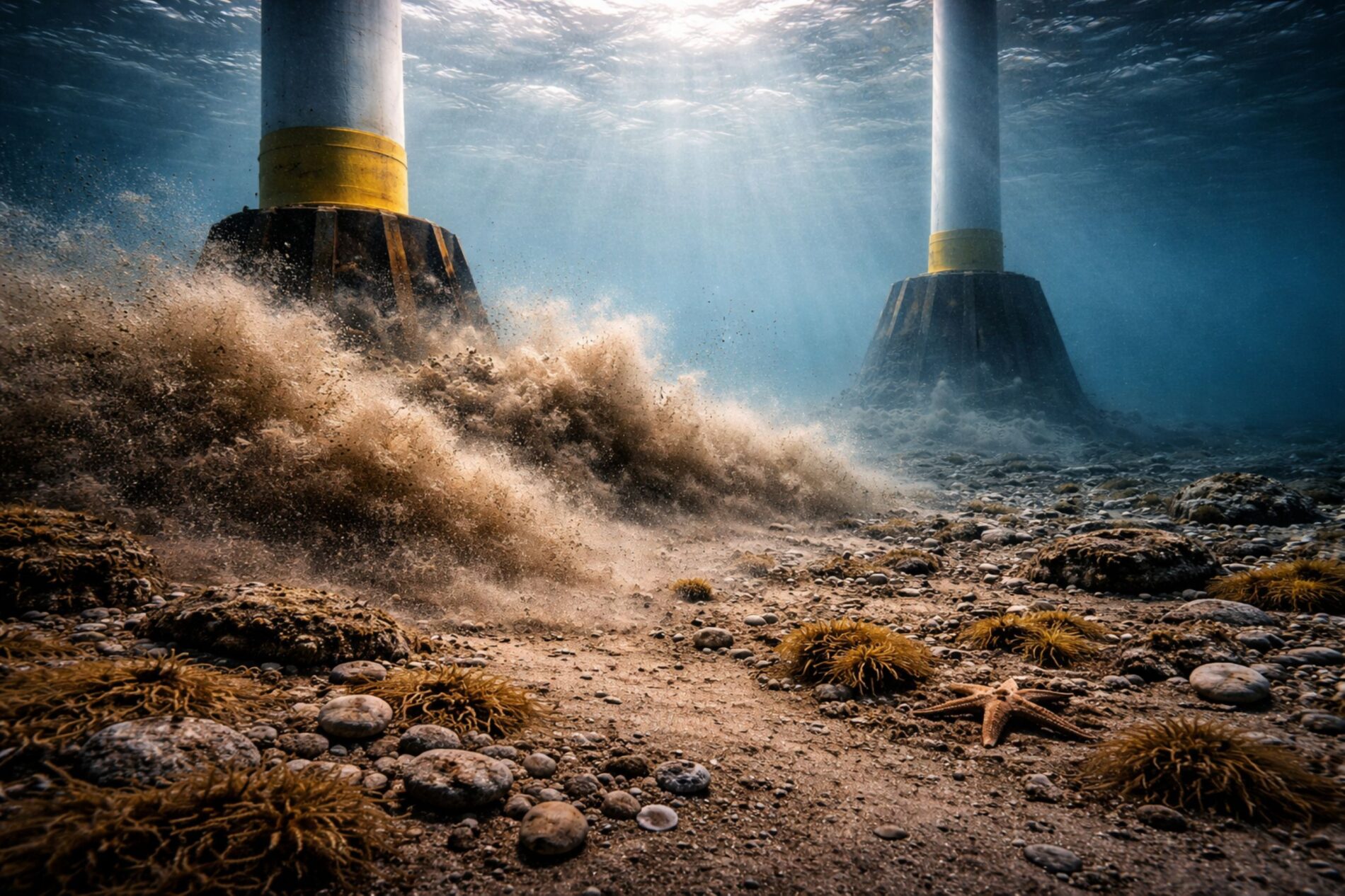
At the same time, organic carbon is displaced, whereas it normally remains bound in the sediment. The researchers emphasize that this alters the distribution of nutrients and energy within the ecosystem. This affects the entire food chain. Particularly relevant is the fact that these processes are permanent and intensify with each new wind farm.
Current Changes as the Key Trigger
A second study shows that offshore wind farms significantly reduce current speeds locally. In some areas, researchers measure changes of up to 20 percent. This slowdown directly influences where sediments settle or are resuspended.
As a result, new depositional zones are formed, while other areas lose material. This displacement alters the structure of the seabed. Simultaneously, these processes interfere with the natural dynamics of the North Sea. The interactions between currents, sediment, and seabed topography become more complex and harder to predict.
Impacts on Ecosystems and the Carbon Cycle
Sediments play a crucial role in the ocean, but this role is being altered by human activity. They store organic material and provide habitats for many species. When sedimentation shifts, these conditions change fundamentally.
Some species lose their habitat, while others expand their range. This shifts the species composition. At the same time, carbon storage in the seabed changes. The study shows that offshore wind farms redistribute approximately 0.006 million tons of organic carbon annually. This corresponds to about 1.5 percent of the natural input from rivers.
Expansion Further Amplifies the Effects
The expansion plans for offshore wind energy significantly increase the relevance of these findings. Large capacities are already installed, while further projects are being prepared. With each additional wind farm, the impact on currents and sediment transport increases.
The researchers point out that the North Sea is a sensitive system. Changes do not occur in isolation but are interconnected. Therefore, they call for more precise models and long-term observations. Only in this way can the consequences for ecosystems and carbon cycles be reliably assessed. (KOB)