
Germany will enter the new economic year in spring 2026 with weak prospects. According to their joint forecast, leading economic institutes now expect growth of only 0.6 percent, down from their autumn prediction of 1.3 percent. At the same time, they anticipate an inflation rate of 2.8 percent and an unemployment rate of 6.4 percent. The primary trigger for this renewed downward revision is significantly higher energy prices following the Iran-Iraq War. Simultaneously, weak foreign trade, declining competitiveness, and persistent uncertainty are slowing the German economy. For businesses and consumers, this means that the recovery is losing momentum, while prices and employment risks remain high. (ifo: 01.04.26)
Growth Remains Weak Despite Government Intervention
The latest economic forecasts do not predict an acute recession, but rather a recovery at a very low level. While the institutes anticipate some stimulus from new debt for defense, infrastructure, and climate protection, this is insufficient to offset the weakness in industry and exports. Domestic demand is being primarily supported, while foreign trade is barely progressing. Thus, Germany remains dependent on costly government stimulus, even though the underlying structural problems persist.
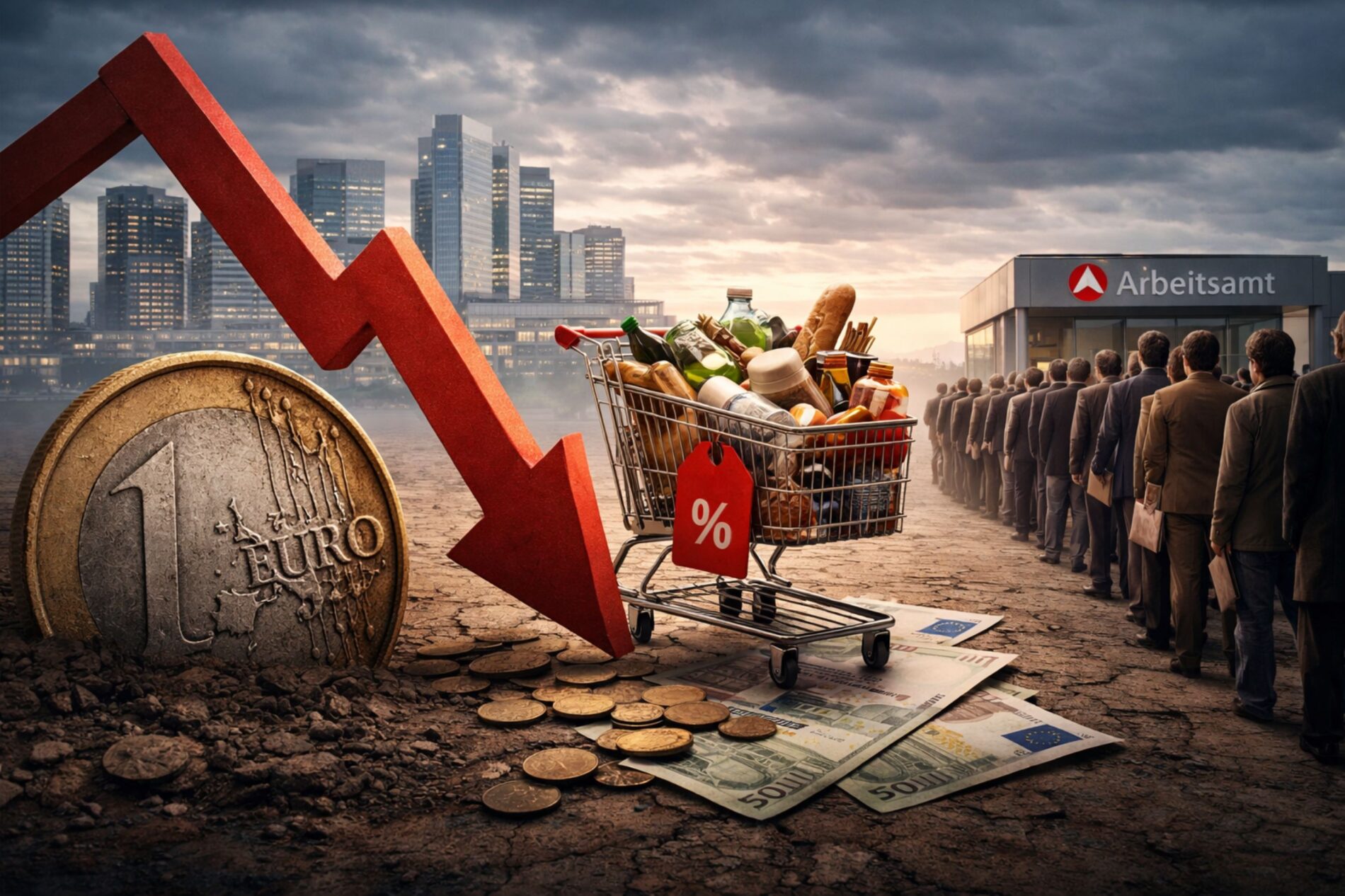
In addition, there is a finding that extends far beyond the current year. The institutes anticipate that the growth potential of the German economy could fall to zero by the end of the decade. They cite the decline in the working-age population and a decrease in average working hours as reasons. This is particularly concerning because an economy with barely any growth potential can only expand to a limited extent, even in a strong economy. The new forecast thus appears not just as a snapshot in time, but as a warning signal for Germany as a business location.
Inflation erodes purchasing power – energy remains expensive
The simultaneous price pressure is especially critical. The institutes expect an inflation rate of 2.8 percent for 2026 and 2.9 percent for 2027. This means that inflation is significantly higher than previously anticipated. The main driver is the increased energy prices, which are no longer limited to gas stations and heating bills. They also impact many other goods and services because companies pass on their higher costs.
For private households, this means less financial leeway, even though the economy is still formally growing. Higher prices dampen consumption, while uncertainty stifles investment. This combination is particularly hard on Germany, as the country is simultaneously suffering from a weak industrial sector and sluggish foreign demand. The ifo Institute had already pointed out in March that the energy price shock could significantly weaken the recovery, depending on how the conflict unfolds. The joint economic forecast now presented confirms this risk in an even more pronounced form.
The Labor Market Is Losing Strength
The weakness is also evident in the labor market. The institutes expect a slight decline in employment of around 100,000 people in 2026. At the same time, the unemployment rate is projected to rise to 6.4 percent before falling slightly again in 2027. This aligns with the latest data from the Federal Employment Agency, which, while reporting a seasonal decrease in unemployment in March, explicitly described it as a spring upturn without any significant momentum. The number of job vacancies also remains low.
Politically, this intensifies the debate about the economic course. Chancellor Friedrich Merz is under pressure because, while the institutes acknowledge the supportive effect of fiscal policy, they simultaneously demand a clear growth policy that removes regulatory barriers to private investment. They reject short-term price caps for energy. Instead, they advocate targeted social relief and structural reforms. The bleak picture presented in the new economic forecasts therefore arises not only from poor figures, but from the combination of expensive energy, weak growth and unresolved location problems.