
Following the ban on Russian gas, Europe is restructuring its gas supply, but this course of action is driving Germany and the EU into renewed dependence on expensive US LNG. According to the Federal Ministry for Economic Affairs and Energy, Germany sourced 96 percent of its LNG from the US last year. Within the European Economic Area, almost 40 percent of all gas imports come from the United States, while its share of LNG imports is around 60 percent. Studies by the Ecologic Institute, the Clingendael Institute, and the Norwegian Institute of International Affairs therefore warn that by 2030 the EU could source up to 80 percent of its LNG from the US.
Dependence on US LNG – Why Gas Is Once Again a Power Struggle
This development provides short-term alternatives, but it merely shifts the risk. Europe becomes more dependent on a supplier that can control prices and volumes politically and economically. Furthermore, LNG remains more expensive than pipeline gas because liquefaction, transport, and regasification add up costs. At the same time, Europe competes with Asia on the global market, which is why price spikes have a more rapid impact.
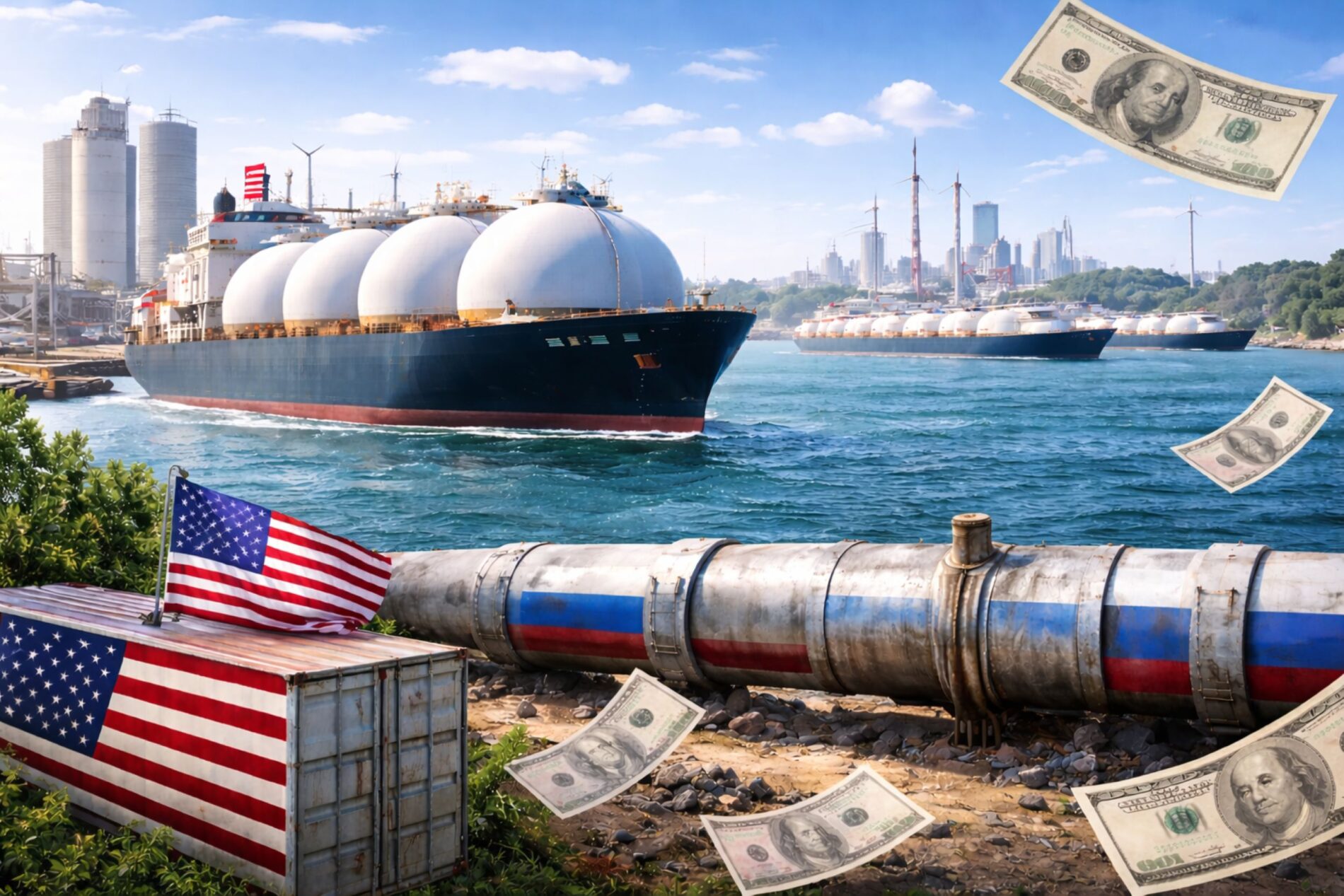
For Germany, this increases the risk of new cost shocks, while industry and municipal utilities remain under procurement pressure. Spot market deliveries react immediately to crises. This appears flexible, but can become expensive in winter. This is precisely why the new dependency is not only geopolitically but also economically relevant.
US shares are growing rapidly – a structural concentration risk is looming
Import shares show how quickly the balance is shifting. If Germany sources almost all of its LNG from the US, a de facto one-way street is created. At the EU level, the US share is also growing, and with it, the concentration risk. A single political conflict, a strike at terminals, or export prioritization in the US can have consequences for prices and supply in Europe.
Added to this is the planning uncertainty, because Europe often procures LNG through short-term contracts. While long-term commitments can secure volumes, they also cement price and supply structures. In both cases, Europe remains vulnerable. The dependency is becoming entrenched, while alternatives scale only slowly.
The Trump Factor and US Domestic Politics – Reliability Remains Fragile
Under the presidency of Donald Trump, the US side has become difficult to predict from a European perspective. Decisions regarding trade, sanctions, or export policy can change rapidly. Even without formal export bans, signals are enough to move markets because traders factor in expectations. This is precisely where the problem lies: Europe’s supply depends not only on molecules but also on the political climate.
Domestic political debates in the US can also slow down or increase the cost of LNG exports, for example, concerning permits, environmental regulations, or port infrastructure. Europe shares this uncertainty. This is all the more true if the EU actually sources up to 80 percent of its LNG from the US by 2030.
The Pricing Logic of LNG – Infrastructure Remains a Cost Driver
LNG involves additional value creation stages, which is why its price is higher compared to conventional pipeline gas. Liquefaction plants require energy and capital. Transport across oceans ties up tanker capacity. This is followed by regasification and grid injection, and there are also costs for terminals, storage facilities, and grid connections.
Germany has rapidly developed its new LNG infrastructure, but it remains expensive to operate and finance. As usage increases, pricing becomes increasingly dependent on global freight rates, terminal capacity, and global market scarcity. Meanwhile, a cold snap or a disruption in an export region can immediately trigger price fluctuations.
Consequences for Germany – Location Policy Becomes Energy Policy
High and volatile gas prices hit energy-intensive industries first. Chemicals, glass, metals, and parts of the basic materials industry are sensitive to procurement costs. This impacts production, investment, and competitiveness. At the same time, risks increase for municipal utilities because they have to stabilize procurement and customer prices while the market reacts erratically during crises.
Gas remains a key heating energy source for households, which is why price spikes are immediately apparent. Government relief can mitigate the impact, but it shifts costs to households and budgets. This transforms the LNG price issue into a social and fiscal one.
Take diversification seriously to prevent the next dependency from becoming permanent
Europe needs more than just replacing a dominant supplier. It needs genuine diversification of supplier countries, contract types, and energy sources. This also includes structurally reducing demand, for example, through efficiency improvements, electrification, and the expansion of renewable energies. The lower the gas demand, the less vulnerable it is to price manipulation.
Government relief can mitigate the impact, but it also shifts costs to households and budgets. As long as Europe grows increasingly dependent on expensive US LNG following the ban on Russian gas, the strategic situation remains tense. This risks a misguided path: less Russia, but a new concentration risk. The crucial question, therefore, is not whether LNG is available, but how much dependence Europe is willing to sustain in the long term. (KOB)