
The discount retailer KiK is scaling back its store expansion and will close around 300 branches across Europe by the end of 2026, while opening only 75 new locations. In Germany, the number of stores will decrease by 135 to approximately 2,200, and across Europe by 225 to just over 4,000. The main reason for this is overly dense expansion, with some stores located less than a kilometer apart, which is why the company is now concentrating its network on profitable locations. Some closures have already taken place, and more will follow in the coming months. According to management, no layoffs are planned for the approximately 32,000 employees, 19,000 of whom are in Germany. Nevertheless, this move demonstrates how much pressure has intensified in brick-and-mortar retail due to the ongoing slump in consumer spending, heightened price sensitivity, and increasing competition. (welt: 24.03.26)
KiK adjusts its previous expansion strategy
The discount retailer is deliberately reducing its store network because previous growth has not yielded the desired results due to the slump in consumer spending. CEO and CFO Christian Kümmel said: “We are streamlining our portfolio for profitability.” At the same time, he admitted that additional stores had not automatically led to a corresponding increase in customers.
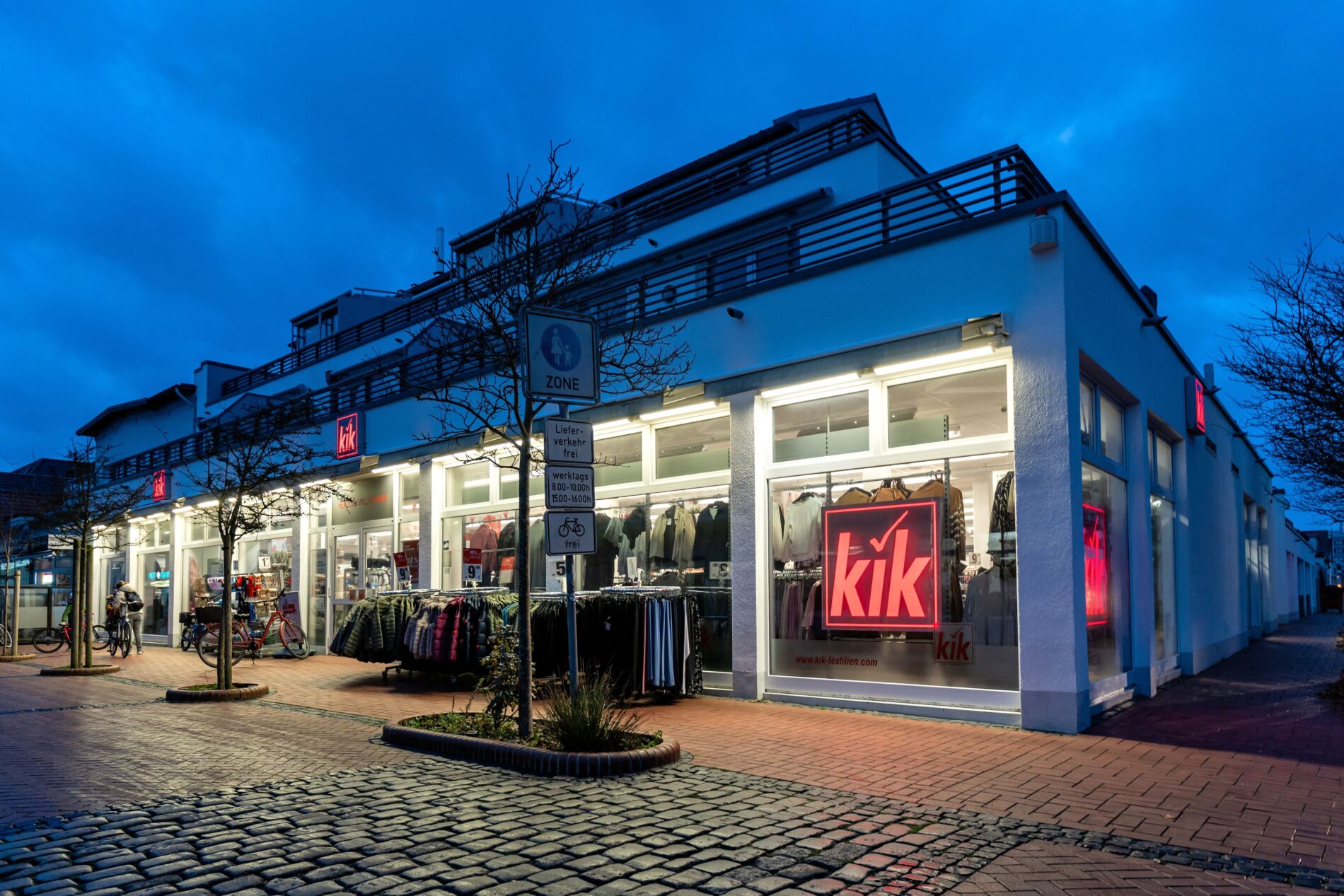
The high density of some locations proved particularly problematic. In some cases, several branches were located close to one another, leading to intense competition. Kümmel put it this way: “We expanded too densely. We’re reducing that.” According to the company, however, all remaining branches are profitable.
Many details remain unclear
A complete overview of the affected locations is not yet available. Furthermore, numerous employees have apparently not yet been informed about the specific closures. This is causing uncertainty, especially in stores that have already closed or are about to close.
Nevertheless, the company has announced its intention to transfer employees from affected stores to other branches or find alternative solutions. Layoffs are not planned. At the same time, KiK is not ruling out further network streamlining in the coming years, meaning this current round of closures does not necessarily mark the end of the cost-cutting measures.
Competitive pressure and sluggish consumer spending are impacting business
The retailer had already announced in September 2025 that it would eliminate unprofitable locations to strengthen its competitiveness. The first stores closed by the end of the year. What’s new is primarily the scale of the restructuring, because previously, while around 100 stores were regularly closed each year, more new locations were usually added at the same time.
The company is sticking to its business model. Around 60 percent of its product range consists of textiles, while the remainder comprises household goods, decorative items, and other non-food products. Kümmel emphasizes, “Our loyal customer base is growing.” At the same time, KiK is clearly noticing that many customers are postponing purchases, canceling them, or paying closer attention to prices. Added to this is the increasing competition from Woolworth, NKD, and Action, as well as from platforms like Shein and Temu.
Store Closures Reflect Trend in Retail
The discounter’s withdrawal is not an isolated event, but rather part of a broader trend in German retail. While online retail continues to gain market share, brick-and-mortar stores are suffering from weak consumer confidence and declining customer traffic. As a result, the number of stores in Germany is expected to fall below 300,000 this year. At the end of 2015, the figure was still around 372,000.
The financial situation of many retailers has also worsened. According to Allianz Trade, the number of insolvencies in the sector reached its highest level in ten years in 2025, with 2,571 cases. The company, founded in 1994, operates in 14 European countries and generated approximately €2.4 billion in revenue in 2024. At the same time, the group is reorganizing its management, with Ulrich Hanfeld slated to succeed Patrick Zahn on June 1st.