
Japan’s debt has been considered a special case for years. Despite its extreme national debt, many investors long failed to see the country as an immediate threat. The reason was simple: interest rates remained ultra-low. The Bank of Japan kept the money market cheap. This very model is now beginning to crumble, increasing the risk to the global financial system.
The International Monetary Fund estimates Japan’s gross national debt for 2025 at around 248.3 percent of its gross domestic product. This places Japan among the most indebted industrialized nations in the world. At the same time, the country has been a key supplier of cheap capital for many years. This combination is explosive. Because when such a highly indebted nation has to emerge from the era of cheap money, the consequences will not be limited to Japan.
The Bank of Japan has ended the era of zero interest rates
In March 2024, the Bank of Japan made a historic policy shift. It ended its negative interest rate policy and simultaneously abandoned its years-long control of yields on Japanese government bonds. At the end of July 2024, it further raised the key interest rate to around 0.25 percent. More steps followed later. This fundamentally changed the situation in the financial markets.
What sounds technical has had an enormous impact. For decades, market participants in Japan could refinance themselves almost free of charge. This cheap money didn’t just flow into the domestic economy. It was invested worldwide. This gave rise to a mechanism that long fueled international capital markets: the yen carry trade.
The yen carry trade was an invisible driver of the bull market
In the yen carry trade, investors borrow money in yen at low interest rates. They then invest this capital in higher-yielding assets abroad. These can be US Treasury bonds, stocks, corporate bonds, or other speculative positions. As long as the yen remains weak and interest rates in Japan are low, this model works. It often generates returns with minimal effort.
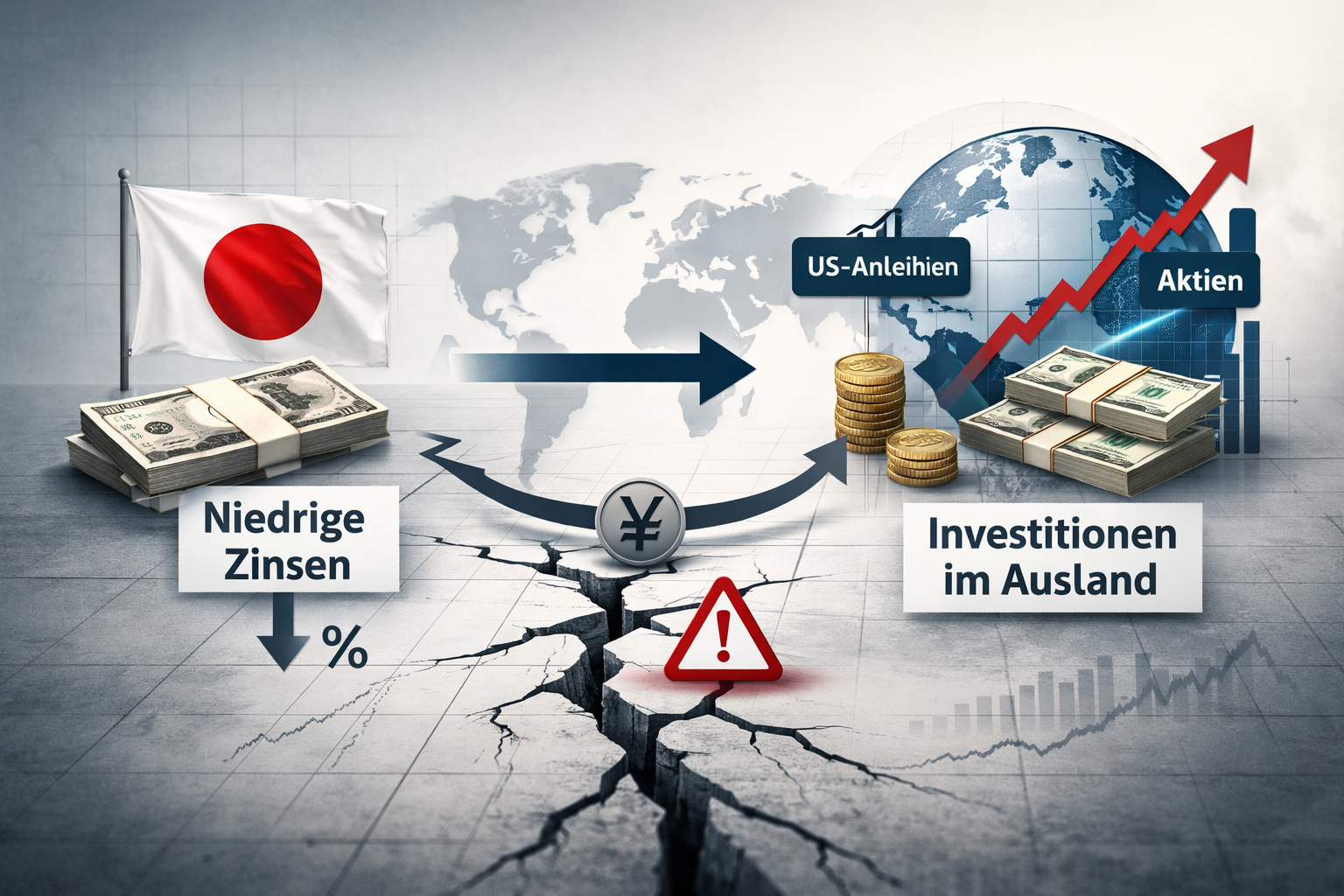
This is precisely where the problem lies. As soon as interest rates rise in Japan or the yen appreciates, these trades come under pressure. Positions then have to be closed. Capital flows back. What was a liquidity engine for years quickly becomes a burden on the markets.
The Bank for International Settlements describes in its analyses that a pronounced yen-financed carry trade had re-emerged since 2022. Reuters reported in August 2024 that the abrupt unwinding of such positions had already triggered massive market turbulence. At the time, there was even talk of a global sell-off, partly triggered by the unwinding of yen-financed bets.
Why Japan’s debt is now becoming more dangerous
Japan’s debt was already enormous. What’s new, however, is the environment. Higher interest rates increase financing costs with a delay. This hits a country with such a high level of debt particularly hard. While the IMF expects some stabilization in the short term, it also warns that the high level of public debt will persist and is likely to rise again in the medium term. Reasons include rising interest payments and increasing healthcare and long-term care costs in an aging society.
This creates a twofold risk. First, the interest rate turnaround in Japan could alter global capital flows. Second, it increases pressure on the Japanese national budget itself. If both developments coincide, the risk to bonds, currencies, and stock markets increases simultaneously.
Germany would also be affected
For Germany, this isn’t some distant Asian story. Disruptions in the global bond and currency markets also affect the German market. If yields rise worldwide, credit-dependent companies come under pressure. At the same time, greater exchange rate fluctuations can burden foreign trade. If there is a broad reduction in risk on international stock exchanges, German stocks are usually dragged down as well.
There’s another factor to consider. German banks, insurers, and funds are closely intertwined with international capital markets. If liquidity suddenly becomes scarce or large market participants have to unwind positions, this will not be without consequences for Europe. Especially during a period of weak growth, an external financial shock can further exacerbate the situation.
The danger is still underestimated in the markets
Many investors focus on the USA, China, or geopolitical crises. Japan is less frequently in the spotlight. This could prove to be a mistake. For decades, the country has been a quiet anchor of stability in the global financial system. Cheap money from Japan helped to support asset prices worldwide. If this mechanism fails or reverses, it could trigger shockwaves.
Japan’s debt is therefore not just a national problem. Combined with the central bank’s interest rate hike, it is becoming a global risk factor. The big question is no longer whether the situation will change. It is how violently the markets will react when cheap yen suddenly becomes scarcer capital.