
The escalation of the conflict with Iran exacerbated Germany’s energy crisis in early March 2026. At the heart of the conflict was the Strait of Hormuz, one of the world’s most important energy routes. Tankers were attacked, insurers slowed down shipments, and many ships were diverted to longer routes. This drove up oil and gas prices on the global market, while households, commuters, and businesses in Germany faced higher costs for transportation, heating, and electricity. The conflict acted as an additional price driver, but high taxes and political regulations had already been burdening the energy market for years. An analysis by the Institute for Conservative Economic Policy shows how the government could provide relief to consumers.
Conflict in the Persian Gulf Drives Up Fuel Prices and Inflation
While Germany imports only a limited portion of its oil directly from the Middle East, it is heavily dependent on the global market. Roughly one-fifth to one-quarter of globally traded oil passes through the Strait of Hormuz, meaning disruptions there immediately impact prices. On March 6, 2026, the average price of E5 gasoline in Germany was €2.00 per liter, while diesel averaged €2.07. Compared to the 2025 annual average, this represents an increase of 14.4 percent for gasoline and 27.5 percent for diesel.
Analysts expect further price spikes if the situation escalates. A two-week blockade could drive Brent crude up to $90 to $100 per barrel, while gasoline would rise to €2.30 and diesel to €2.20. A longer disruption could even push prices to $120 to $140. If the conflict drags on until the end of 2026, Brent could exceed $150. At the same time, inflation in Germany would also rise significantly.
High taxes further keep fuel prices high
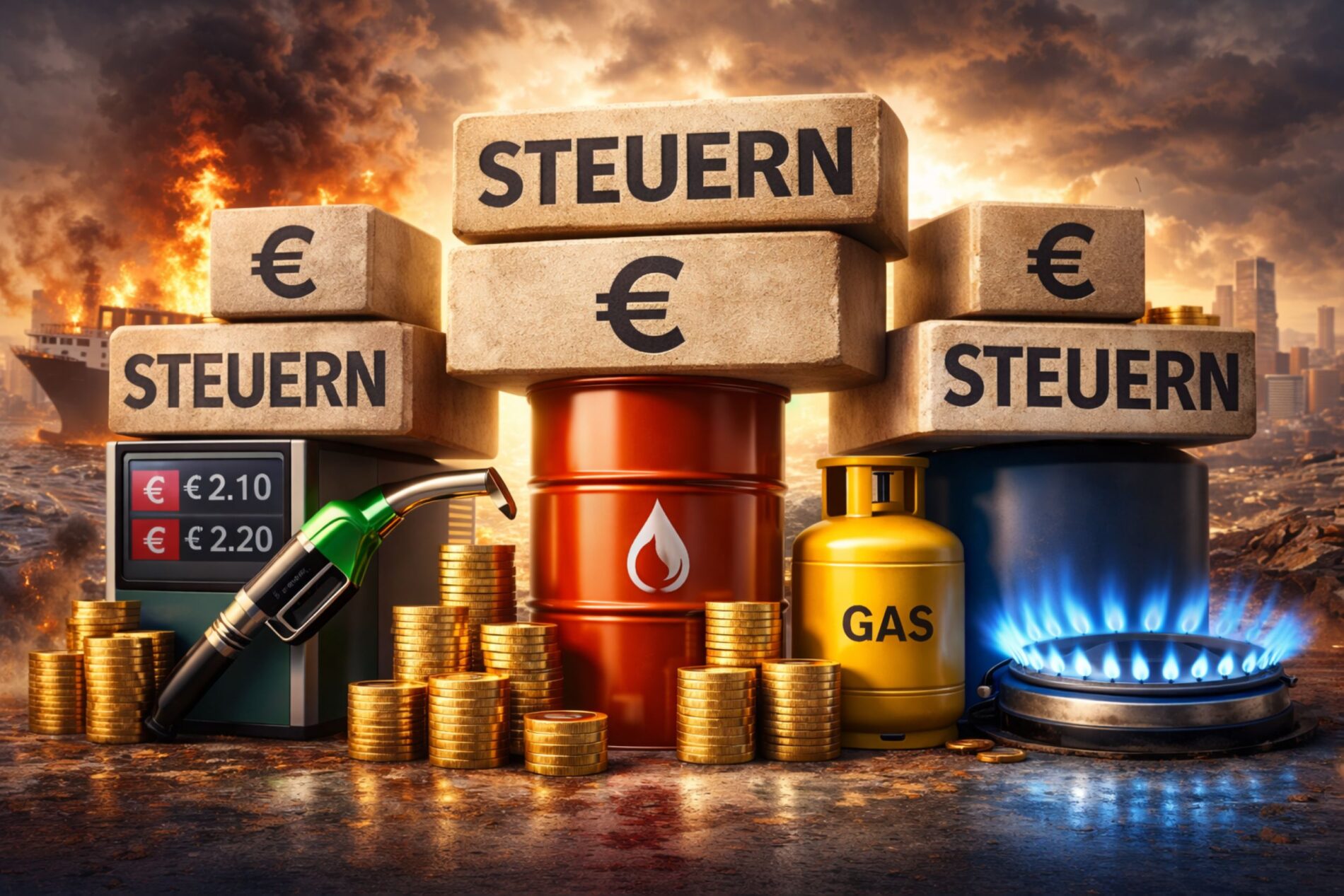
A substantial portion of the fuel price is not determined by the crude oil market, but by government levies. For Super E10, around 65.4 cents are energy tax, about 15.7 cents are the CO₂ tax, and around 31 cents are value-added tax. Thus, taxes and levies account for almost 58 percent of the final price. The government share is also very high for diesel, although the energy tax is somewhat lower.
Theoretically, a noticeable reduction in taxes would therefore be possible. If the CO₂ tax, energy tax, and value-added tax were to decrease, Super E10 could fall from approximately €1.94 to around €1.28 per liter. Diesel could simultaneously drop from about €2.01 to around €1.51. Therefore, monitoring potential price gouging at gas stations is also coming into sharper focus.
Heating costs continue to rise – oil and gas are becoming more expensive
The situation remains tense when it comes to heating. While gas and oil heating systems will formally remain possible, key cost drivers persist. The EU requires zero-emission buildings from 2030 onward, and new gas heating systems will also be required to be partially operated with expensive green gases. At the same time, CO₂ pricing is further increasing the cost of fossil fuels.
The price trend clearly illustrates the burden. Between 2019 and 2025, gas prices for commercial customers rose from 4.55 to 9.48 cents per kilowatt-hour. Industrial customers paid 6.75 cents per liter instead of 2.86, while households’ prices climbed from 6.65 to 12.40 cents. Heating oil prices rose by around 49 percent between 2020 and 2025. If a prolonged disruption of the sea route occurs in addition to the Middle East conflict, European gas prices are likely to rise further.
Low storage levels and expensive electricity are exacerbating the situation
The risks are increasing because German gas storage facilities were only about 20.9 percent full at the beginning of March 2026. If procurement costs continue to rise, this will directly affect households and businesses. At the same time, tax cuts could reduce the price of gas for households from around 12.40 cents to about 9.63 cents per kilowatt-hour. For heating oil, a decrease from around 92.32 cents to 58.44 cents per liter would be theoretically possible.
The same trend is evident for electricity. Between 2019 and 2025, the price for commercial customers rose from 22.22 to 28.75 cents per kilowatt-hour. Industrial companies paid 19.09 cents instead of the previous 15.98 cents, while household electricity climbed to 42.46 cents. The reasons for this are considered to be rising CO₂ costs, high grid fees, and the phase-out of nuclear power. According to calculations, restarting decommissioned nuclear power plants could significantly lower these prices, thus noticeably relieving the burden on industry, small and medium-sized enterprises and private consumers.