
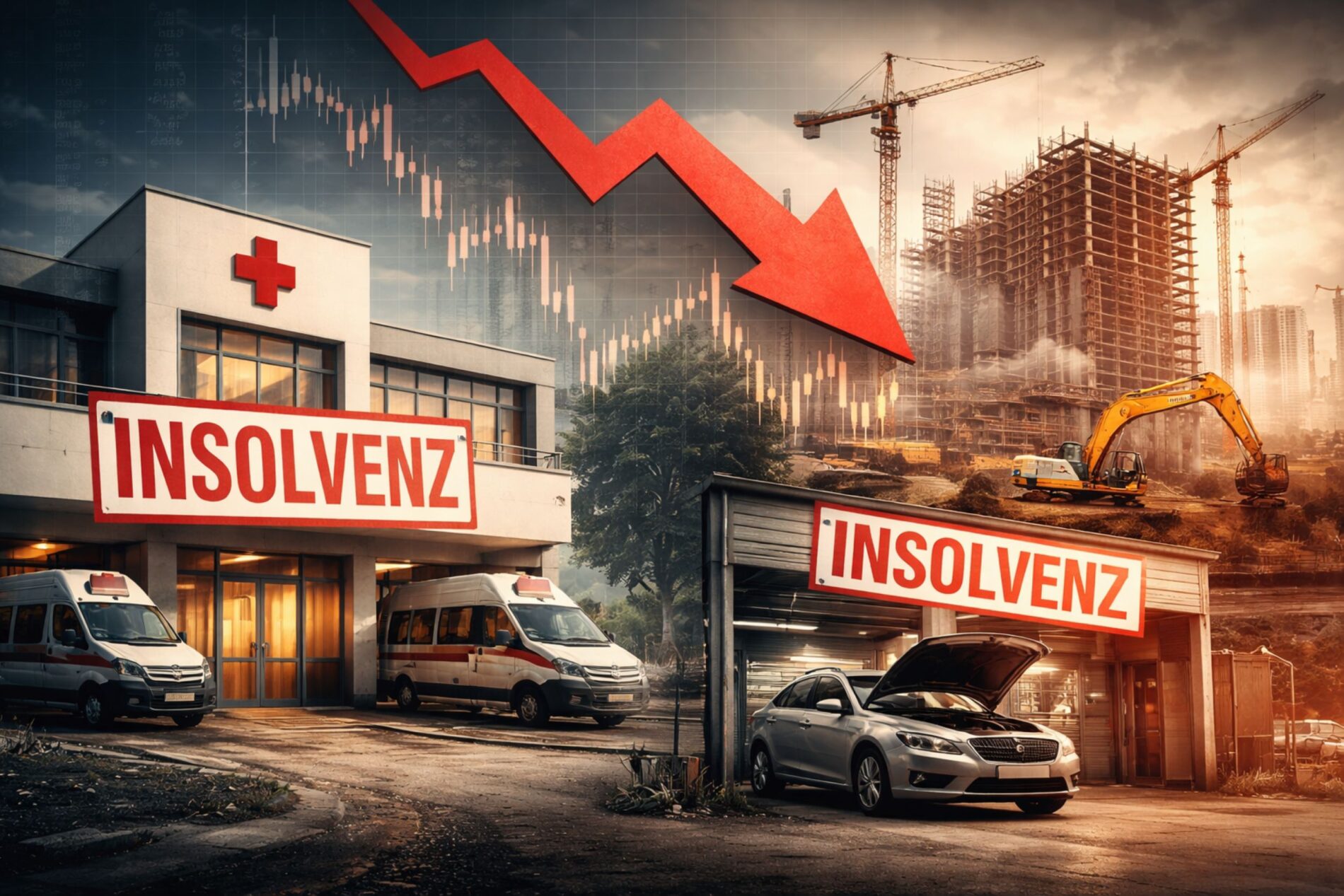
In the Allianz Trade study, a company is considered a large corporation once it reaches at least €50 million in annual revenue. In 2025, Germany reached a record high for these large-scale insolvencies, with 94 companies going bankrupt. Hospitals, the automotive industry, and construction were particularly affected. This represents an increase of eight percent compared to 2024 and is also the highest figure since the analysis began in 2015. (handelsblatt: 05.02.26)
Germany is driving the global wave of bankruptcies among large companies
The number of major insolvencies also increased worldwide, with 475 large companies filing for insolvency. This equates to one major insolvency every 18 hours, and Germany accounts for roughly one-fifth of these cases. This makes Germany one of the drivers of the current trend, although the causes vary depending on the industry.
“When things go wrong, they often go very wrong,” said Milo Bogaerts, CEO of Allianz Trade in Germany, Austria, and Switzerland. He also emphasized: “We have been seeing a significant increase in large-scale insolvencies for the past four years, reaching their highest level since 2015 in 2025 – both globally and in Germany.” This statement puts the record figures into perspective and reveals the long-term trend behind them.
Hospitals, automotive industry, and construction: These sectors are particularly hard hit
The focus was on the service sector, where the study identified 14 large-scale insolvencies. Nine of these were hospitals and nursing homes, and it is precisely in these sectors that cost increases can quickly become an existential threat. The automotive industry followed with twelve cases, while the chemical and metal industries each recorded eleven large-scale insolvencies.
The construction industry also stood out, with ten major bankruptcies. Furthermore, the retail sector remains a persistent problem, once again leading the way with nine large-scale insolvencies. This distribution shows how widespread the pressure in the market has become, even though individual sectors stand out.
Domino effect in supply chains puts smaller companies under pressure
For many businesses, the danger doesn’t end with the insolvency of a major customer; it’s only just beginning. When a large customer goes bust, supply chains can become unstable, and outstanding receivables quickly become a risk. “The problematic aspect of many large insolvencies is the potential domino effect on supply chains,” said Maxime Lemerle, Head of Insolvency Analysis at Allianz Trade.
Smaller companies are particularly vulnerable because they are often heavily dependent on a few major customers. If one of these customers is lost, revenue immediately collapses, and at the same time, many partners tighten their payment terms. As a result, a single large insolvency can spread like a shockwave through entire supply networks, even though the affected companies themselves appear sound.
Globally, losses are increasing, but Germany sees a decrease in revenue
Globally, the economic damage increased, as the total revenue of insolvent large companies rose by twelve percent to €208 billion. The largest insolvencies occurred in the USA and China, and these two countries accounted for 17 of the 20 largest bankruptcies by revenue. Thus, the biggest losses are concentrated in a few markets, even though insolvencies are increasing worldwide.
In Germany, however, a counter-trend is evident in revenue, as the total revenue of the large companies affected in 2025 fell significantly. It dropped by around a third, from almost €18 billion in the record year of 2024 to approximately €12 billion. Bogaerts puts this into perspective: “While there were significantly more large insolvencies in Germany in 2025, the resulting losses for suppliers declined after reaching a peak in 2024,” says Bogaerts. Nevertheless, the figure remains high and is at its second-highest level since 2015, which is why the issue remains critical for companies and suppliers.