
At the beginning of 2026, Germany faces a social shift whose dynamics are accelerating significantly: poverty is moving into the middle class, following the loss of approximately 120,300 jobs in the industrial sector alone in 2025. The automotive and manufacturing industries are particularly affected, while high operating costs, weak export markets, and a persistently weak economy are encouraging production relocations and factory closures. At the same time, municipalities are under pressure due to declining tax revenues, social security systems are losing financial stability, and more and more households are reaching their economic limits. The consequences range from increasing debt to structural cutbacks in cities and regions that were previously considered economically robust.
Poverty in Germany as a Consequence of Deindustrialization
Job losses in industry mark more than just a cyclical downturn; they fundamentally alter the economic foundations of entire regions. Well-paid, unionized jobs are disappearing, while new employment often arises in the service sector, offering lower incomes. This reduces purchasing power in Germany, placing additional strain on local businesses and exacerbating downward economic effects.
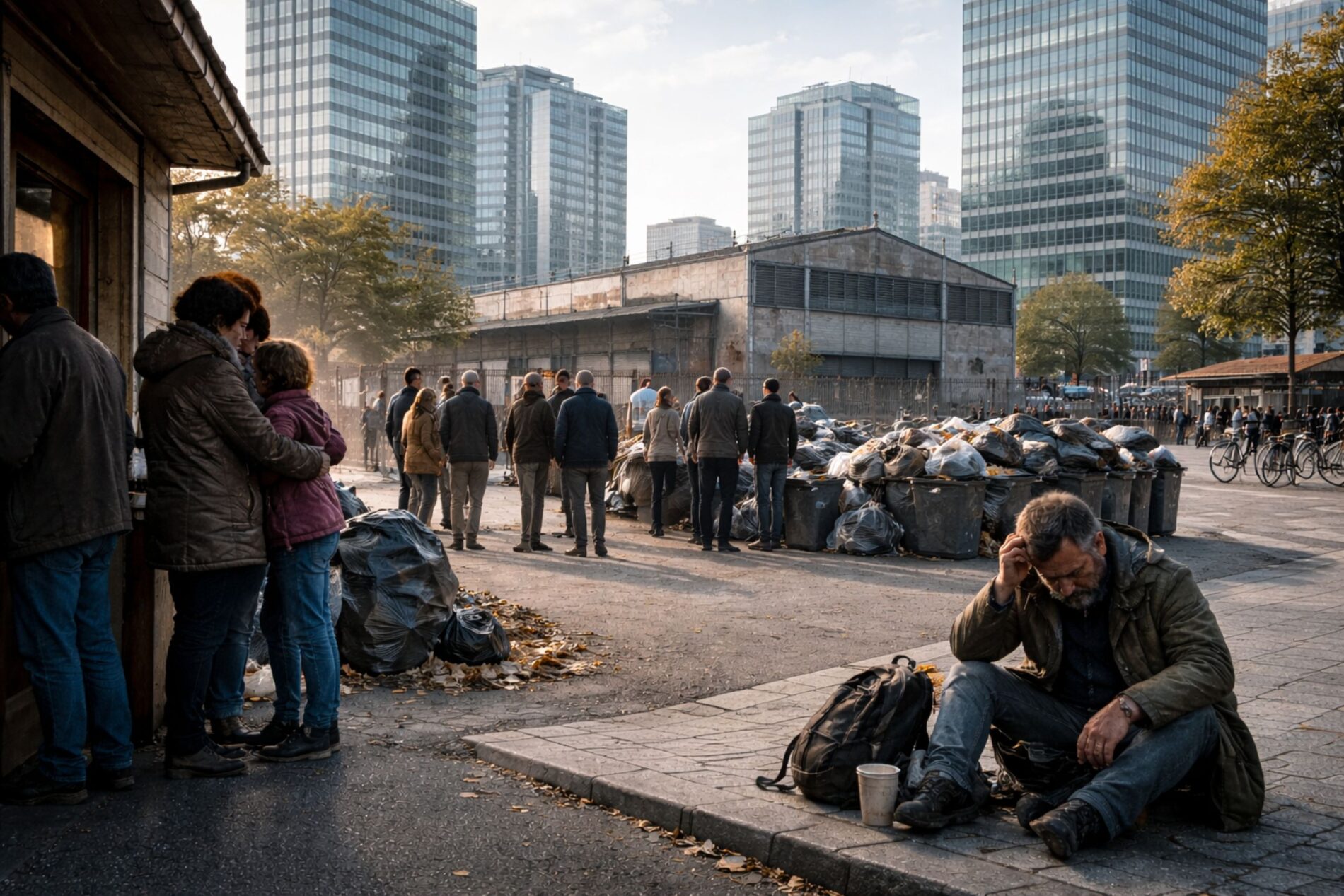
At the same time, Germany is gradually losing industrial value creation because companies are relocating production capacities abroad or holding back investments. This development hits suppliers and medium-sized businesses particularly hard, which is why job losses often continue with a time lag. The social impact therefore doesn’t unfold abruptly, but rather creeps slowly into the everyday lives of many employees.
Municipal budgets are losing their room for maneuver
Cities and towns feel the economic weakness directly, because with every industrial job lost, business tax revenues decrease. Simultaneously, spending on social services is increasing, which is why municipal budgets are increasingly dominated by mandatory tasks. Investments in infrastructure, education, or urban development are falling by the wayside, even though they could secure long-term economic stability.
This development creates a structural imbalance because financially weak municipalities are particularly hard hit. While economically strong centers can still cushion the burden, smaller cities are increasingly falling into persistent deficits. This creates regional disparities that exacerbate social tensions.
Social Security Systems Under Stress
Industrial job losses are also impacting social security systems because the number of high-earning contributors is declining. Health insurance funds are increasing supplementary contributions, while the pension system requires higher subsidies due to demographic changes. Higher non-wage labor costs are placing an additional burden on companies, further hindering investment.
Long-term care insurance is also struggling with rising expenditures, as the number of people requiring care is growing and staff shortages are increasing. At the same time, out-of-pocket expenses for those affected are rising, increasing financial risks in old age. The systems are not collapsing suddenly, but they are gradually losing their stability while political room for maneuver is shrinking.
Over-indebtedness exposes social shifts
The number of over-indebted citizens is rising again, while many households are only able to offset rising living costs with loans. When incomes fall or jobs are lost, savings are lacking, and even previously stable families are finding themselves in financial difficulties. This development demonstrates how closely economic structural problems and their social consequences are now intertwined.
In this process, poverty arises not as a short-term shock, but as the result of many concurrent factors. Industrial decline, municipal austerity measures, and strained social security systems reinforce each other, making economic insecurity increasingly commonplace. The central challenge, therefore, lies not only in preserving jobs, but also in protecting the social stability that has been taken for granted for decades. (KOB)