
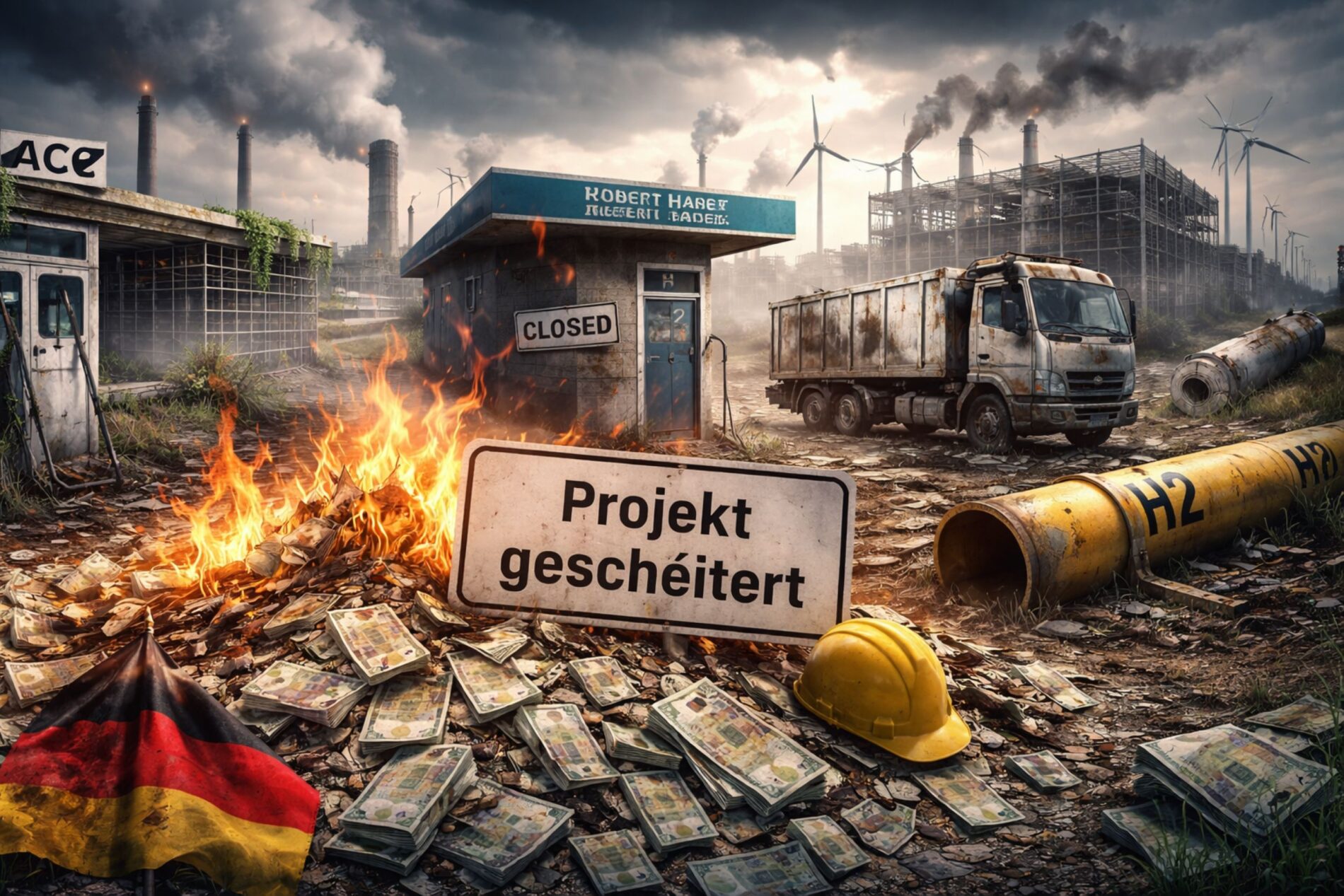
Robert Habeck sold the green transformation as an engine for economic growth and portrayed new industries as a surefire job creator. His followers celebrated him as a green messiah, even though much of it only seemed viable thanks to subsidies and special regulations. Today, little substance remains of that initial vision of progress, as one project after another ends in retreat or stagnation. In many cases, the government subsidies are lost forever.
Battery Policy as a Total Loss – Big Promises, Zero Results
Northvolt is the most egregious example, as the damage has already impacted the federal budget. The federal government reimbursed KfW for the value of the convertible bond, including ancillary costs, amounting to €620.6 million, as recently as December 2024. Schleswig-Holstein is expected to cover €300 million of this, as the federal and state governments had each guaranteed half of the loan. Thus, a key element of the battery industry narrative is effectively a loss, even though the Gigafactory story served for years as proof of an “industrial revolution.”
ACC in Kaiserslautern completes the picture, as its flagship project also came to an end. Germany and France had pledged €1.3 billion in subsidies, with €437 million earmarked for the German plant alone. Nevertheless, ACC ultimately abandoned the project, even though the region anticipated around 2,000 jobs. So, once again, only an empty site remains, while the logic of subsidies fails to create a market.
Hydrogen-powered garbage trucks as a symbol – purchased, subsidized, parked
In Spree-Neiße, two hydrogen-powered garbage trucks sit unused in the depot because refueling infrastructure is lacking. According to reports, the vehicles cost around €1 million and have yet to be driven a single kilometer in regular operation. Furthermore, this case demonstrates how quickly an idea can fail when faced with the realities of daily operations. In the end, it’s not the brochure that matters, but the fuel pump.
Bielefeld represents the next level of escalation, as it procured seven hydrogen-powered garbage trucks with federal funding. Initially, vehicles had to travel 80 km round trip to refuel, which already consumed both range and time. Since the beginning of 2026, the nearest hydrogen refueling station has been closed, while the alternative is a 180 km trip per refueling. At the same time, there is a subsidized hydrogen refueling station in Bielefeld, but due to funding conditions, only buses are allowed to refuel there, and garbage trucks are excluded.
Electrolyzers and pipelines – expensive infrastructure without customers
A 30 MW electrolyzer was planned for the WESTKÜSTE100 real-world laboratory in Heide, but the project was abandoned. Subsidies of around €36 million were available, but the project was deemed unviable in terms of economic viability and framework conditions. Thus, not only is the plant missing, but also the benefits, which had already been factored into political calculations. At the same time, it’s clear: without cheap electricity, “green” hydrogen remains an illusion.
In Saarland, three large electrolyzer projects have been halted. In Völklingen-Fenne, a grant of €100 million from the federal and state governments was in place, but according to the report, not a single cent has been disbursed so far. In Saarlouis, an electrolyzer with a capacity of 200 to 400 MW was planned, but the demand collapsed. In Perl, Lhyfe announced a 70 MW electrolyzer, but this project is also considered to have been halted. Nevertheless, money is flowing into the cross-border mosaHYc pipeline, as the network operators are reportedly investing €110 million in the grid.
Schwäbisch Gmünd – Built, But Without Customers and Without a Viable Concept
Schwäbisch Gmünd represents a different kind of risk because, although construction has taken place, the question of who will buy the hydrogen remains unanswered. According to reports, the electrolyzer on the Gügling mountain cost around €20 million, and the subsidy amounted to €6.3 million. Nevertheless, it remains unclear who will purchase the hydrogen in significant quantities, and a planned hydrogen refueling station is also considered a construction site on paper. Thus, a showcase project threatens to become a wasted investment.
At the same time, confidence in other hydrogen projects in the region is waning because studies and recalculations are dismantling their benefits. In the Ostalb district, the hydrogen bus is being criticized as an expensive idea, and the planning, according to reports, appears to be a project that can only be stabilized with expert opinions. This creates a pattern: first comes the vision, then the calculations, and in the end, stagnation. This is precisely how Habeck’s expensive legacy is being created, both on a small and large scale.
Simultaneously, confidence in other hydrogen projects in the region is waning because studies and recalculations are dismantling their potential benefits.
Chip Factories – Record Subsidies Without Production
The same pattern is evident in the chip manufacturing sector, only on an even larger scale. Intel’s planned plant in Magdeburg was slated to receive €9.9 billion in state subsidies, yet the project was shelved, losing its status as a secure anchor for jobs and the region’s economic future. The debate also highlighted how dependent such projects are on low energy prices, stable supply chains, and reliable demand. If these factors falter, even record subsidies are of no help, as corporations will simply shift their investments to other regions.
A Mess Instead of Economic Growth
In the end, what remains is not a “growth miracle,” but a mess of subsidy proposals. Billions were promised politically, and millions have already been lost. Regions are waiting for jobs, but they are left with unfinished plans and stagnation. Municipalities are buying vehicles, but they can’t find hydrogen. Operators are building infrastructure, but they can’t find customers. And while some continue to celebrate Habeck, reality boils down to a sobering verdict: This transformation has burned through money instead of delivering added value. (KOB)