
Renewable energy sources, which only provide electricity depending on the weather, require storage solutions. The focus here is on chemical battery storage, which is currently experiencing a boom worldwide and also in Germany. However, this rapid growth is causing various problems. According to experts, the two biggest are phantom projects and grid overloads. (fr, 25.11.2025)
Currently Largest Storage Project in Gundremmingen
In Gundremmingen, Bavaria, a nuclear power plant once stood, its cooling towers spectacularly demolished in the fall of 2025. Following this final stage of decommissioning, a symbolic groundbreaking ceremony took place in October 2025: Germany’s largest battery storage facility is now being built on the site of the former nuclear power plant, marking a turning point in German energy policy. RWE will invest approximately €230 million in the facility, which, with a capacity of 700 MWh and a continuous output of 400 MW, will capture surplus solar and wind power and feed it back into the grid at night, in winter, and during periods of low wind.
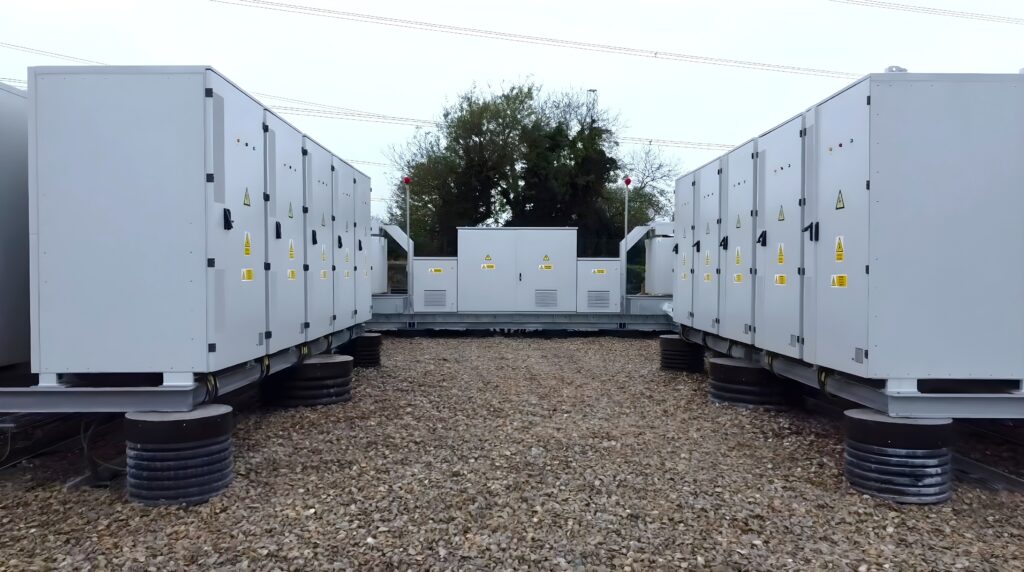
At the groundbreaking ceremony, RWE CEO Markus Krebber illustrated the project’s capabilities with a single figure: the storage facility will supply enough electricity to power an average electric car for 3.9 million kilometers. Bavarian Minister-President Markus Söder, in his speech, elevated the occasion to an event of national significance. He stated that it was simply a matter of preventing problems in the electricity grid, which Germany, a highly industrialized nation, could not afford. In Germany, the economy and energy had top priority. With the central component of the planned storage facility, renewable energies would be made viable for the future. However, the CSU politician’s fine words are contrasted by a sobering reality: the storage boom presents considerable challenges.
Growth in Storage Capacity in Germany
For about five years now, chemical battery storage systems in Germany have been expanding at a rate that exceeds the capacity of the grid and load balancing system. The Open Energy Tracker from the DIW (German Institute for Economic Research) determined the following figures:
Between 2020 and 2025, Germany’s storage capacity increased several times over, reaching approximately 23 gigawatt-hours (GWh) as of November 2025.
The largest increase in capacity comes from residential and commercial storage systems. These are installed by homeowners and small and medium-sized enterprises (SMEs) in addition to rooftop photovoltaic systems.
Large-scale systems with a capacity of more than one megawatt-hour now supply about 3.3 GWh in Germany. These are currently being expanded significantly, as demonstrated by the project in Gundremmingen.
However, chemical battery storage is not the only option. There has always been a significant difference between daytime and nighttime electricity demand. This was addressed as early as the 19th century with pumped-storage hydroelectric plants, which use surplus nighttime electricity to pump water from a lower to a higher reservoir. During the day, when electricity demand is higher, the water flows back down, driving generators. To this day, pumped-storage hydroelectric plants dominate energy storage in Germany and many other countries. Their capacity in Germany is around 55 gigawatt-hours. This figure has barely changed since the early 2000s because energy companies, grid operators, and consumers are increasingly relying on the more affordable chemical battery storage systems.
Problems for Grid Operators
Industrial and commercial providers, in particular, don’t want to miss out on the storage boom. They are therefore diligently planning new expansion projects, which is now putting grid operators under pressure. The industry portal Regelleistung Online (Regulatory Power Online) has calculated a total of over 500 gigawatts of connection requests for large battery storage systems for the year 2025. Operators like RWE and E.ON are criticizing the flood of applications. They criticize the current “first-come, first-served” principle: grid operators must process incoming applications strictly in order of receipt. This is also why there are so many “paper projects” whose financing and implementation remain uncertain.
The applicants are often small startups looking to secure a piece of the pie. E.ON CEO Leonhard Birnbaum recently warned of this. On LinkedIn, he urged an adjustment to the approval regulations. Otherwise, he warned, “the grid will be shut down for years.” RWE board member Markus Krebber agrees. He estimates (probably realistically) that up to 70 percent of all submitted projects will never be implemented. In line with other serious investors, he is calling for substantial reservation fees for all grid connection requests.
Do the numerous battery storage systems protect against periods of low wind and solar power generation?
Experts say: probably not. They provide the German energy sector with short-term flexibility, but cannot compensate for the loss of renewable energy during a prolonged period of low wind and solar power generation. Therefore, according to the German Institute for Economic Research (DIW), gas-fired power plants, as demanded by Economics Minister Katharina Reiche (CDU), are unavoidable. Hydrogen chains could also be a great help once this technology becomes cost-effective. Reiche is therefore probably on the right track with her proposal to build hydrogen-capable gas power plants, despite all the criticism.