
In the Havelland district of Brandenburg, District Administrator Roger Lewandowski (CDU) has ended the “H2VL Hydrogen Region Havelland” project. He cites the lack of federal and state funding as the reason for abandoning the project. The project was intended to advance the energy transition in the district while simultaneously decarbonizing transportation and heating. The district council had commissioned a feasibility study, funded by the Federal Ministry for Digital and Economic Affairs, which cost a total of €400,000. The funding model proved to be a decisive risk factor, as, according to the District Administrator, subsidies remained limited to heavy industry, while municipal applications received no funding at all. (maz-online: 23.02.26)
H2VL Future Project – Hydrogen Project Ends Due to Lack of Funding
Lewandowski linked H2VL to a concrete operating concept, but implementation was blocked without funding. “I had envisioned operating the buses in Westhavelland with hydrogen and those in Easthavelland with electricity.” The district was thus targeting public transport and also aiming for a visible starting point for the technology. A hydrogen bus is expensive, and infrastructure increases operating costs. According to the district, it could not proceed without subsidies, and therefore halted the project.
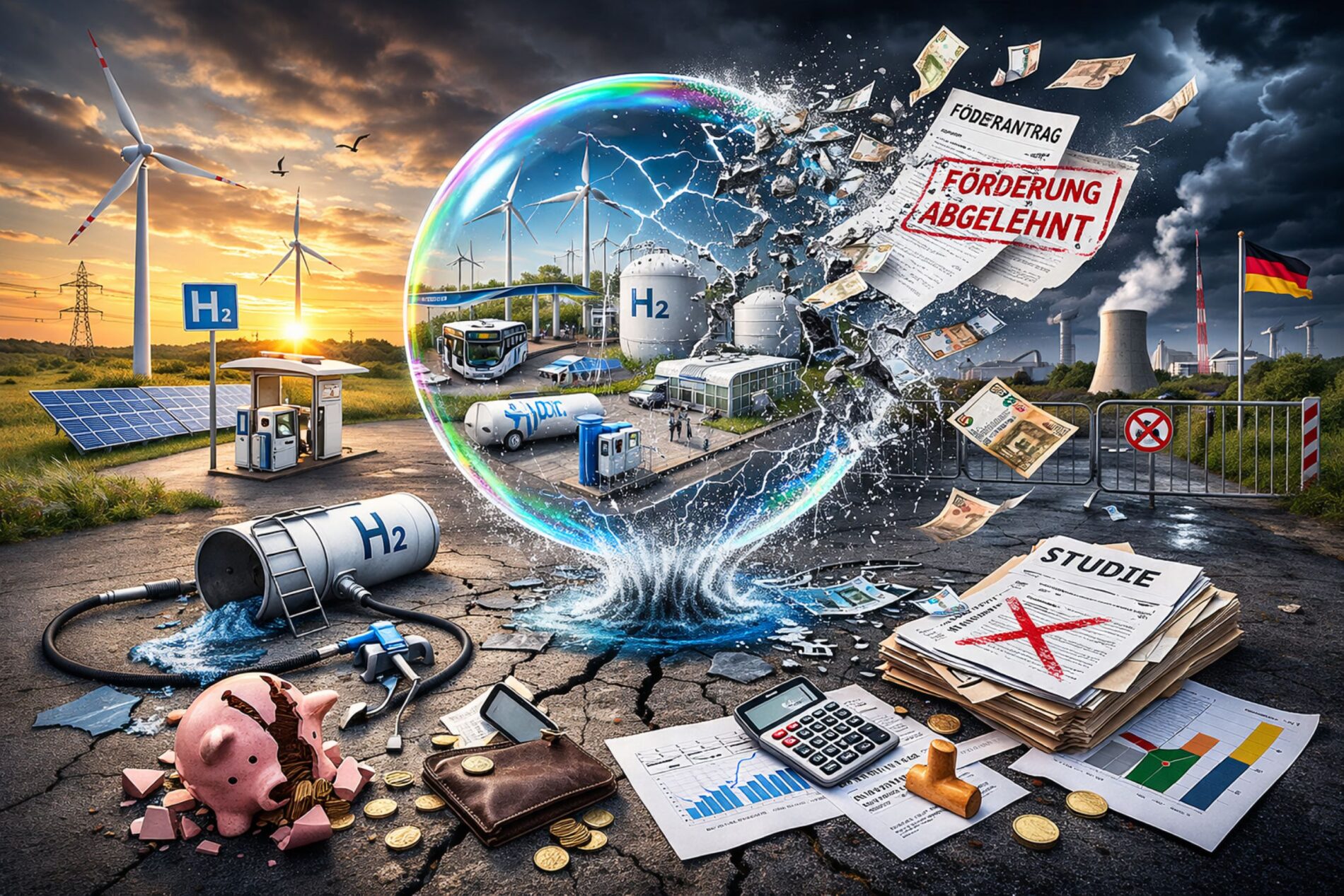
The district administrator says he was clearly informed that subsidies were only intended for heavy industry. A regional hydrogen cycle had no political weight, while municipal fleets were left out. Lewandowski also criticizes the external communication, while simultaneously pointing to the local effort involved. “It’s also frustrating because the feasibility study presented interesting forecasts.” This leaves a contradiction: The district had a plan, but the financing was lacking.
Study, filling station, and electrolysis: East Havelland should get started
Hydrogen is produced through electrolysis, i.e., by splitting water with electricity, while renewable energy determines the climate balance. The study outlined potential applications for the district. In East Havelland, stakeholders were already searching for a location for a hydrogen filling station. The plan was to sell hydrogen produced by an electrolyzer there and also to support market growth.
The study also mentions an electrolyzer in Ketzin/Havel and another facility in Premnitz. For Premnitz, the draft plan envisioned hydrogen produced from waste. Therefore, the documents referred to it as orange hydrogen, not green. Whether Ketzin and Premnitz will continue after the hydrogen region project ends remains unexplained, while the outstanding issues now carry particular weight.
Wind Power and District Heating – Westhavelland as a Second Pillar
In western Havelland, wind power was intended to decarbonize district heating, while an electrolyzer was to store surplus energy. Excess wind power can be preserved as hydrogen, which is why the combination was considered a viable system solution. At the same time, an electrolyzer generates waste heat. This heat can be fed into a district heating network and also improves the plant’s efficiency.
The search for suitable locations for the wind turbines was underway, but it lacked any investment prospects. The future project thus hinged on several permits and funding commitments. When these commitments failed to materialize, the foundation for the next step was missing. As a result, the technical sketch remained a mere memorandum.
Forecasts to 2030 and Broad Participation in Nauen
The study sees great potential for green hydrogen produced from renewable energy sources in the Havelland region. According to the document, between 300 and 1,500 tons could be produced annually by 2030, although this range reflects the uncertainty of the assumptions. The district administration envisions that this could “cover the anticipated demand, especially in road-based heavy goods transport.” In addition to public transport buses, waste collection vehicles were also considered as potential applications, and other uses were also envisioned.
Many stakeholders collaborated and contributed their expertise. In 2023, participants met in Nauen for a final meeting to discuss the details of the study. This process tied up time and expectations, but it also created a network. Following the project’s cancellation, the operational framework is now lacking, while the results remain unused.
Climate Targets Remain, but Budgetary Imposition Forces Priorities
The Havelland district still intends to significantly reduce greenhouse gas emissions, which is why the district council adopted a climate protection concept. Transportation and heating are particularly important, and this is precisely where H2VL was intended to focus its efforts. “We had the idea of exploring our own potential applications for hydrogen.” With the end of this ambitious project, the district must now give greater weight to alternatives, and the question of realistic interim plans is becoming paramount.
District Administrator Lewandowski points to the financial situation of many municipalities. Therefore, the district must set priorities. The district cannot achieve its ambitious goals alone, while the state and federal governments are pursuing other priorities. The result is clear: The Havelland hydrogen region remains, for the time being, a thing of the past.