
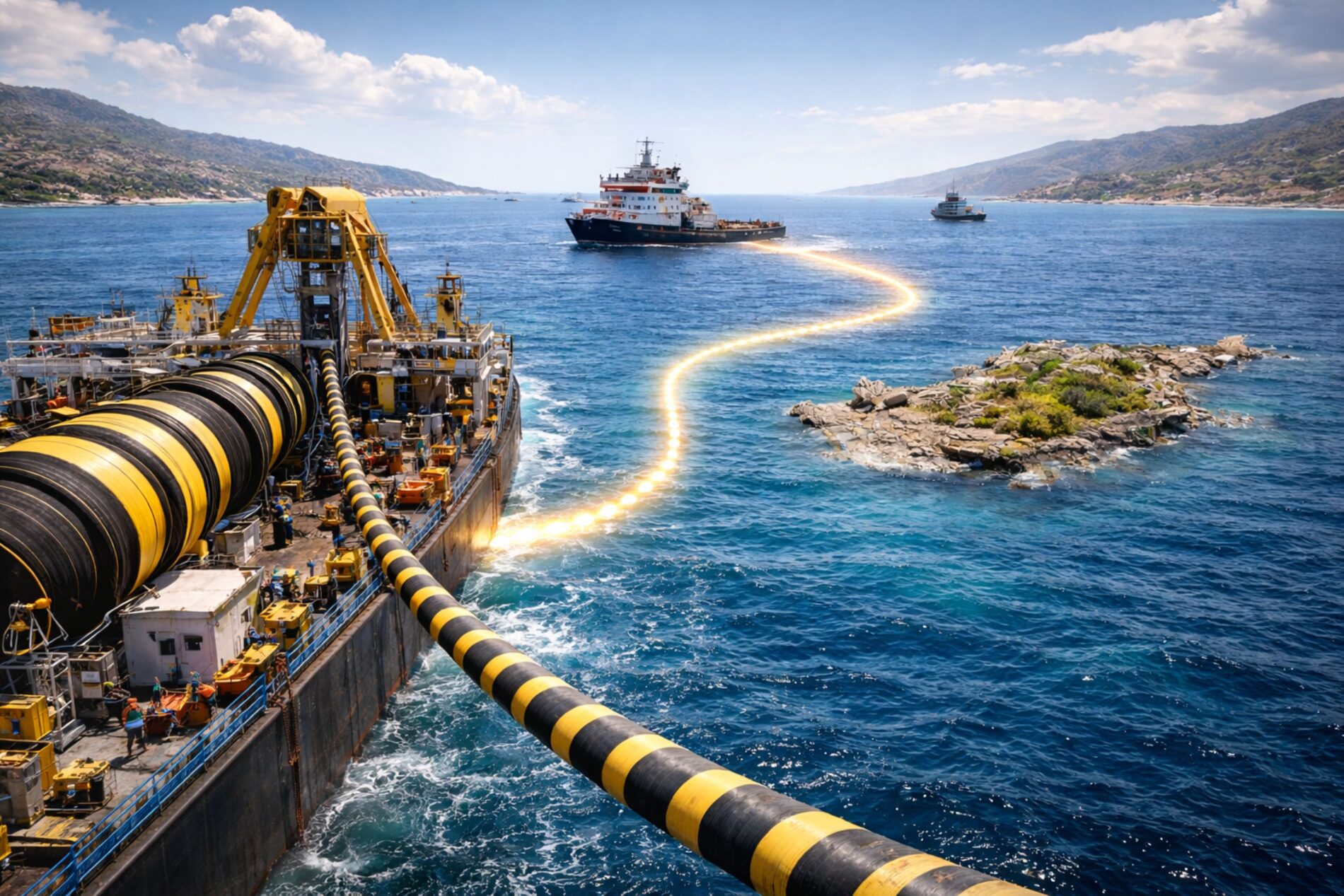
The planned Great Sea Interconnector power cable across the Mediterranean, connecting Crete, Cyprus, and eventually Israel, is on the verge of collapse despite EU funding. The project aims to end Cyprus’s energy isolation. It received €657.9 million in EU funding and was considered a strategic project in the eastern Mediterranean. Originally slated for completion by the end of 2023, construction has yet to begin. According to former Energy Minister Giorgos Papanastasiou, local interests in Cyprus are hindering the project. This has resulted in persistently high electricity costs, risks to grid stability and security of supply, and significant losses in renewable energy production. (handelsblatt: 05.03.26)
Why the Mediterranean Project is Crucial for Cyprus
Cyprus is the only EU member state without a connection to a national electricity grid. Therefore, the island remains entirely dependent on its own electricity production. Around 74 percent of its electricity comes from power plants that burn heavy fuel oil or diesel. This makes electricity expensive and also puts a strain on the environment.
Renewable energies currently cover only about 25 percent of electricity production. However, a key problem lies with the grid. In 2024, Cyprus had to curtail around 29 percent of the green electricity it generated because the grid couldn’t handle the volume. Connecting to the European interconnected grid would alleviate these bottlenecks. Furthermore, the island could utilize its solar and wind power potential much more effectively.
Local interests block cheaper electricity
Parts of the domestic energy sector see this as a threat. Cheaper imported electricity would undermine existing business models. Papanastasiou stated: “Anything that enters the small Cypriot market from another source and is not under the control of local players is perceived as a threat.” With this statement, he clearly describes the core of the conflict.
Operators of solar and wind farms currently benefit from high feed-in tariffs. These are based on the high costs of conventional electricity production. The oil industry also opposes rapid change. If electricity were to come via the cable from Greece, the state-owned electricity company EAC could gradually phase out its oil-fired power plants. Papanastasiou sums up this position succinctly: “They want everything to stay the same.”
Political Uncertainty Burdens the Eastern Mediterranean
The project also lacks clear political support in Cyprus. President Nikos Christodoulides publicly affirms his commitment to the cable, but for months he has been sending contradictory signals. Papanastasiou, one of the most prominent proponents, lost his office last December, significantly strengthening the project’s opponents.
Greece and Cyprus have now suspended the project for the time being. The economic and technical foundations are to be reassessed, and a new feasibility study is to be commissioned. However, many observers see this as the de facto end of the Mediterranean project. This threatens to leave Cyprus further isolated in terms of energy, while Israel also remains without a connection to the European power grid.
The consequences extend beyond energy policy. The dispute is straining the traditionally close relations between Greece and Cyprus. At the same time, the stalemate benefits Turkey, which rejects the cable as a violation of international law. Ankara claims a maritime area through which the cable is planned as its own exclusive economic zone. The EU, however, remains committed to the project. Energy Commissioner Dan Jørgensen called it “of strategic importance” and demanded “full cooperation and coordination among the member states involved.” Without this political backing, however, the world’s longest undersea power cable is unlikely to be built.