
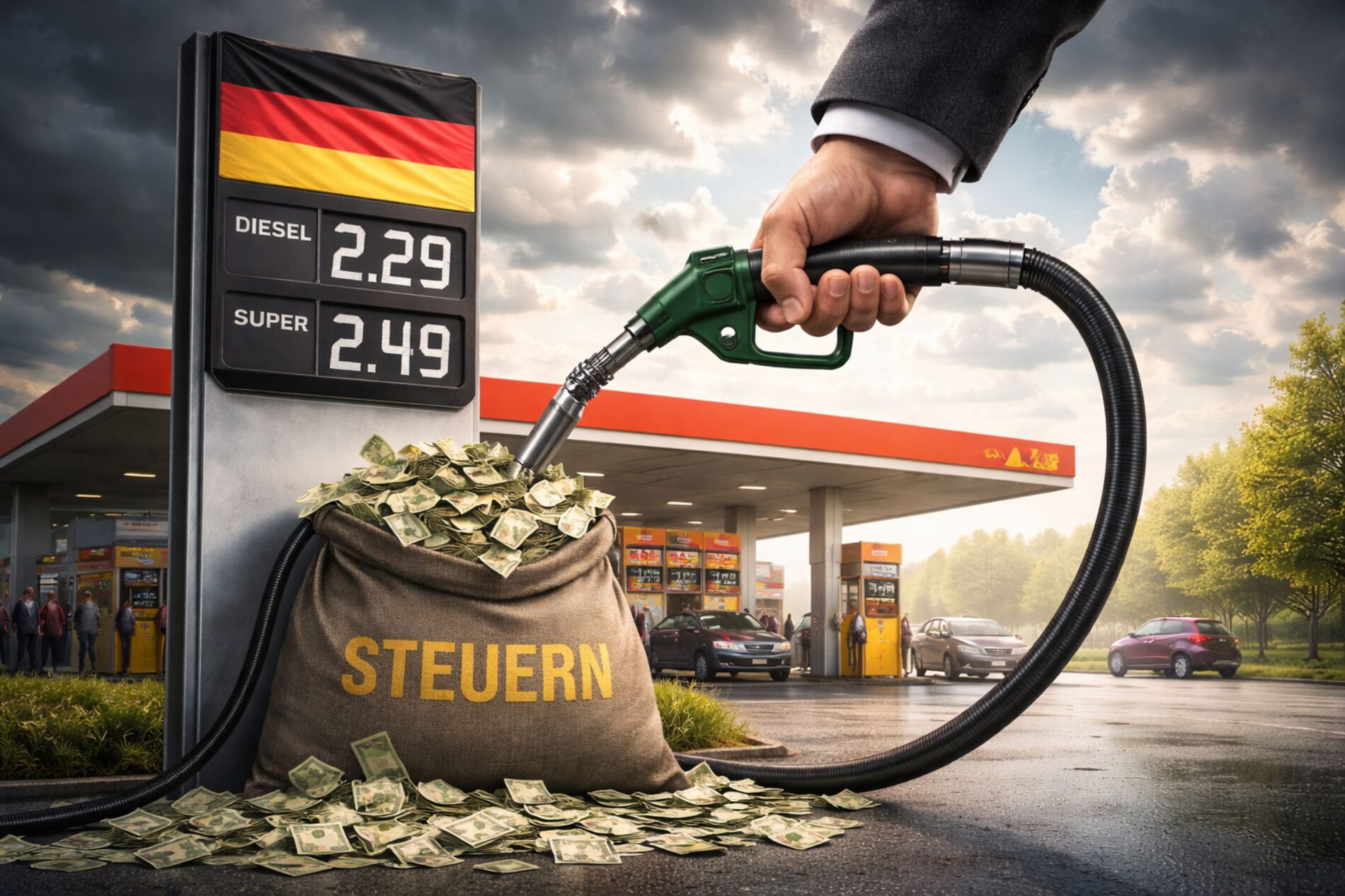
In Germany, fuel prices have risen sharply since the start of the Iran-Iraq War on February 28, 2026, while the federal government is simultaneously recording substantial additional revenue through value-added tax (VAT). According to calculations by NIUS, this extra revenue had already totaled more than €390 million by April 8. Since mid-March, it has sometimes exceeded €10 million per day, and over the Easter weekend, it even surpassed €15 million daily. Several European countries are already taking direct action, lowering the prices of gasoline and diesel. In Berlin, however, the debate is primarily focused on future tax relief measures, including a higher commuter allowance. This would not take effect until next year. The problem is therefore twofold: commuters, tradespeople, and freight companies are paying more immediately, while higher transport costs are further driving up inflation. Other governments in Europe are lowering the price per liter. In Germany, however, there is growing suspicion that the government is exploiting the crisis for fiscal gain for as long as possible. Every price increase brings in additional millions for the budget. (nius: 08.04.26)
Europe’s Neighbors Take Action, Berlin Talks About Later
The Czech Republic demonstrates particularly clearly how differently governments can react. Prague published maximum permissible prices, effective April 8: 43.15 crowns for gasoline and 49.59 crowns for diesel. At the same time, the government is limiting the profit margins of oil companies and reducing the excise tax on diesel. It openly states its goal: to curb the general rise in fuel prices and eliminate local price extremes. (welt: 07.04.26)
The Czech Republic is not alone in this, however. Poland is reducing the VAT on fuel from 23 to 8 percent and also plans to cap pump prices. Romania and Hungary have already introduced price limits to mitigate the impact of the war on fuel costs. Several European countries, such as Austria, Italy, and Spain, are also deliberately foregoing revenue, thus providing immediate relief to citizens and businesses. Germany, therefore, deviates from this pattern. Here, the government continues to discuss measures that will not help at the pump, either now or in the future, and thus will not curb future inflation.
Commuter Allowance Offers Little Return and Distributes Aid Unequally
This is precisely why the German debate seems so skewed. A potential increase in the commuter allowance from the current 38 cents to up to 45 cents per kilometer would only reach citizens next year via their tax returns. This means the government immediately collects the additional millions, while the relief comes at the earliest later. Moreover, even then, only a limited portion of those affected would be covered, although the additional VAT revenue is generated from every fuel purchase. Thus, only a fraction of today’s additional revenue would actually be returned, and even that with a significant delay.
Added to this is the social imbalance. A higher commuter allowance primarily benefits high-earning, employed drivers. Higher income groups benefit significantly more than those with lower incomes because their tax relief is greater due to the progressive tax rate. Those who earn little, pay little income tax, or don’t benefit to any significant extent at all, still bear the brunt of the higher fuel prices immediately. This is precisely where a serious suspicion arises. With every more expensive liter of fuel, state revenues also increase. As long as Berlin delays direct tax relief, these additional millions will continue to flow into the budget day after day. High fuel prices thus remain not only a problem for motorists, but also a state revenue model with the side effect of rising inflation.