
In Germany and Europe, energy policy decisions continue to have repercussions today because governments have shut down nuclear power plants or rejected new construction projects, even though electricity demand is rising due to industry, electric vehicles, and heating applications. These decisions were often based on flawed reasoning regarding supposedly unaffordable costs, persistently unresolved issues of nuclear waste storage, and safety risks, which opponents of nuclear power have presented without clearly distinguishing between past accidents and current technology. The decisive risk factor, therefore, lies in decisions that remove guaranteed power from the grid while wind and solar power cannot reliably feed in at all times. The consequences are higher system costs, a growing need for reserve capacity, and increasing import dependency. In Germany, nuclear energy was completely phased out in 2023, while the need for stable electricity generation persists.
The cost argument of nuclear power opponents often doesn’t stand up to practical comparison
A central argument against nuclear power plants is that nuclear power is inherently too expensive. This judgment is frequently based on individual projects, but it ignores the overall systemic context. Those who only consider construction costs overlook grid expansion, storage requirements, and safeguards during periods of low power generation.
A prominent example is the Hinkley Point C nuclear power plant in Great Britain. The project is expensive, but a large part of the long construction time and increased costs did not simply stem from the technology itself. Decisive factors were primarily British special regulations and regulatory adjustments that necessitated extensive modifications to the EPR design. Added to this were lost construction expertise, the need to rebuild supply chains, and a lack of industrial routine after decades of inactivity. Hinkley Point, therefore, represents less the supposedly unaffordable nature of nuclear power than the costs of politically and regulatoryally altered frameworks.
Those who draw general conclusions from such projects overlook crucial counterexamples. This is precisely where the weakness of many cost arguments becomes apparent, as they reduce complex systemic issues to individual problematic projects. Many opponents of nuclear power thus treat Hinkley Point as proof of the entire technology, even though the case primarily reflects exceptional political and regulatory approaches.
Barakah presents a different cost reality
Barakah in the United Arab Emirates provides a counterexample. The nuclear power plant was built with official total financing of US$24.4 billion, or approximately €21.1 billion, for four reactors with a total capacity of 5.6 gigawatts. All units are now operational and supply a significant portion of the country’s electricity.
For comparison, Germany’s EEG (Renewable Energy Sources Act) funding requirement for 2025 is around €17 billion per year. This means that a single large nuclear power project can reach a scale within just a few years that is regularly incurred as an annual sum in the German subsidy system. This comparison does not demonstrate a direct correlation between the costs, but it does illustrate the scale.
Barakah stands for standardized construction methods, stable political frameworks, and established industrial processes. These are precisely the factors often lacking in Western projects. Therefore, Barakah demonstrates that high costs are not an inherent law of nuclear energy, but rather depend heavily on political and structural conditions.
Safety debate often remains fixated on historical events
The safety discussion frequently focuses on events like Chernobyl or Fukushima, but these cases do not reflect the current state of technology. Equating modern reactors with plants from previous decades is essentially comparing a car from the 1950s with a modern vehicle in terms of safety. Old reactors and new plants differ fundamentally in their design, control systems, and safety systems. Modern reactors have passive safety systems and significantly stricter regulatory requirements. This also changes the risk assessment, because today’s technology can no longer be judged by the standards of past generations.
Nevertheless, older disasters continue to shape public perception. This creates a distorted picture that does not adequately consider current technologies. An objective assessment must therefore distinguish between historical events and current technical standards.
The issue of nuclear waste disposal is politically exaggerated
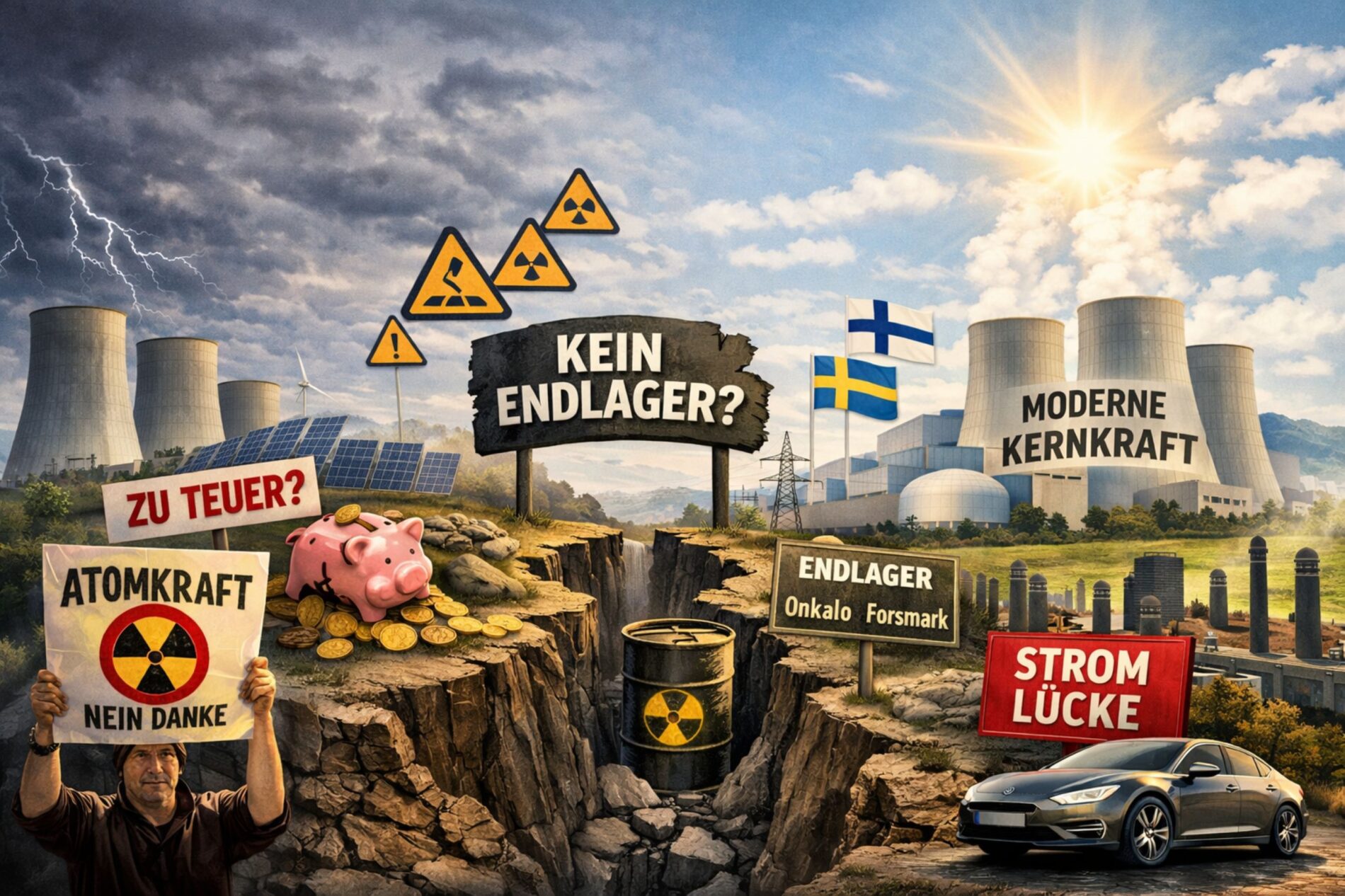
A particularly effective argument against nuclear power is the disposal of radioactive waste. The impression is often given that there is no solution. This portrayal amplifies uncertainty and fuels fears, but it does not reflect actual developments.
Countries like Finland and Sweden have implemented or approved concrete nuclear waste repository projects. In Finland, the Onkalo deep geological repository is under construction, while in Sweden, an approved concept is beginning construction. The technical solution is therefore available. Implementation depends primarily on political decisions.
Consequences for the electricity system and the economy
Miscalculations regarding costs, safety, and disposal directly impact the energy system. If secured power plant capacities are reduced, the need for grid expansion, reserves, and imports increases. These factors raise the overall cost of electricity supply.
For companies, this means less planning certainty and rising energy costs. Households bear the burden through higher electricity prices. In the long term, the quality of the political framework will determine whether security of supply and economic stability can be guaranteed. Precisely because opponents of nuclear power have strongly influenced public perception for years, a sober reassessment of the actual consequences remains necessary. (KOB)