
A shift in policy is emerging in Brussels because emissions trading, with its certificate costs, is increasingly squeezing industry dry. However, this change of thinking is coming far too late. The EU has been tightening the screws for years, while many countries outside Europe do not bear comparable burdens. This has put the competitiveness of European companies on the global market under pressure. Now Brussels is trying to rectify the situation, even though the damage to investments and business locations is already clearly visible.
Certificates increase production and energy costs
The principle is simple, but the effect is brutal. Anyone who causes emissions needs a permit, a “certificate.” This price is passed through the entire value chain, from electricity to intermediate products to the final product. This creates permanent additional costs that can hardly be passed on in full in global competition. At the same time, competitors benefit if they can offer products without a CO₂ surcharge.
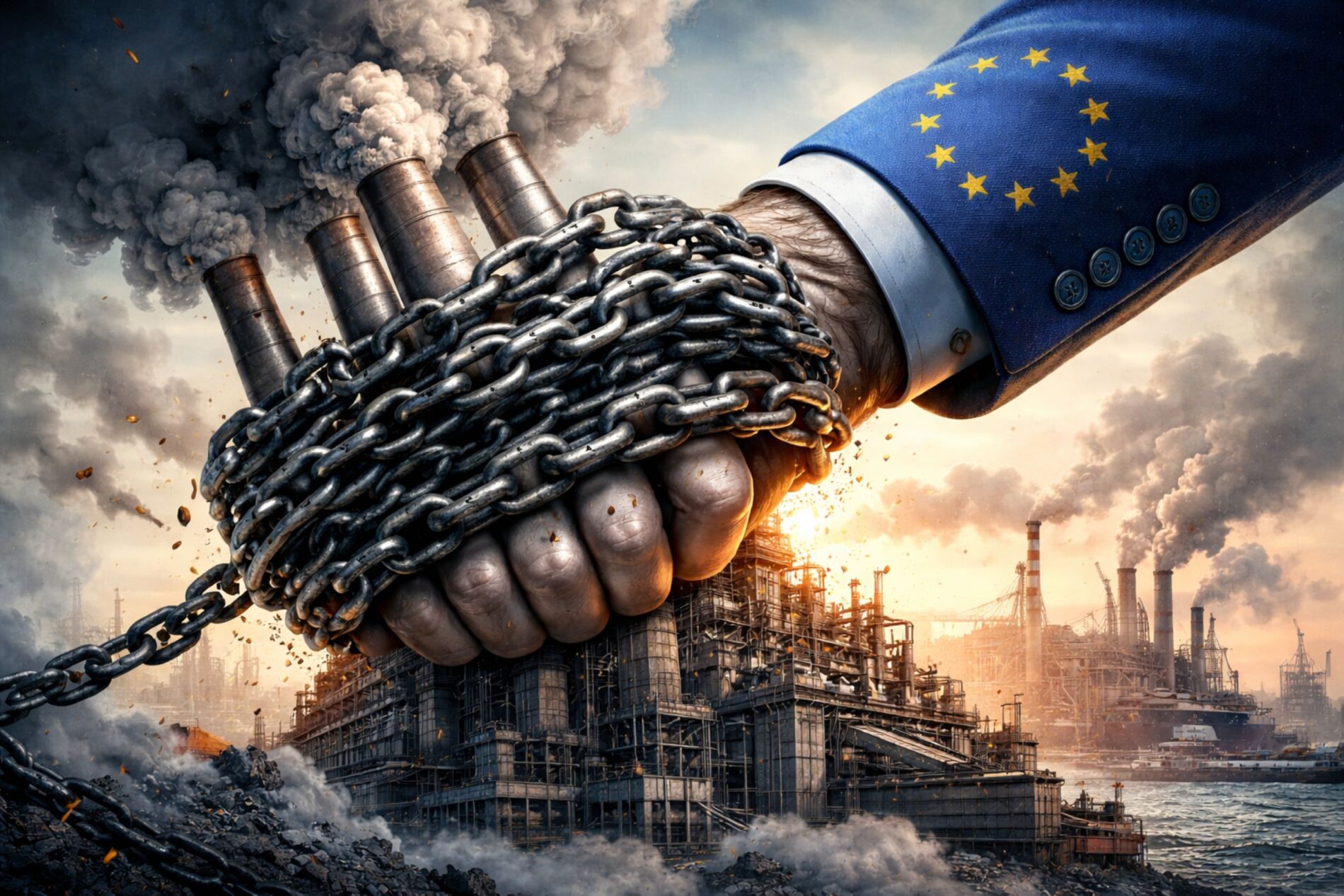
Added to this is the political control. The EU sets quantities, rules, and interventions, so instead of a free market, an administered price system is created. This increases uncertainty for companies because decisions depend not only on demand but also on policy shifts in Brussels. This is precisely why any adjustment to the system immediately becomes a location-related issue. And this is why the ETS behaves less like a market economy and more like regulation with a price tag.
“Green table” instead of market logic
The EU tried to build a market that behaves like a real market. This is precisely where the design flaw lies. Emissions trading is based on politically created scarcity, not natural scarcity. Therefore, perverse incentives arise as soon as special interests interfere with the process. Furthermore, EU compromises often follow the lowest common denominator, while the global market takes no such considerations.
History provides the proof. Lobbyists tinkered with the system until it was “as full of holes as a tea strainer.” The price remained weak for many years, and the effect on investment remained limited. Later, regulations were tightened, and the CO₂ price rose sharply. Today, a carbon allowance is about ten times more expensive than it was ten years ago, and this has exacerbated the cost surge in industry.
Global Imbalance and Investment Backlog
The problem remains the international context. If Europe regulates more strictly while other countries remain more lenient, a structural disadvantage arises. Production then migrates to where energy and regulations are cheaper. While this lowers EU emissions in the statistics, global emissions can actually increase. Moreover, Europe loses added value and know-how, while competitors gain market share.
Energy-intensive industries are particularly hard hit. Steel, chemicals, cement, and basic materials can only pass on price increases to a limited extent. Therefore, margins shrink, and investments are postponed or planned abroad altogether. Many companies have long since factored the certificates into their calculations as fixed costs, making every expansion a calculation against Europe’s competitiveness. At the same time, the impression is growing that Brussels only reacts when the political pressure becomes unsustainable.
Late Correction as a Sign of Weakness
If the EU now wants to loosen its rules, it will appear as an admission of weakness. Politicians established a certificate market on the drawing board without properly assessing the consequences for competitiveness and relocation. The rules were then tightened, even though global synchronization failed to materialize. Now, a late adjustment is supposed to limit the damage, even though many decisions have already been made. This increases uncertainty because companies cannot rely on stability.
Ultimately, what matters is what investors learn. If rules become negotiable in the face of adversity, adjustments are less worthwhile than political pressure. And if the framework is constantly shaky, Europe becomes more expensive for capital. Therefore, not only the price of the certificates is crucial, but also the message behind them: Europe sets rules that it later relaxes.