
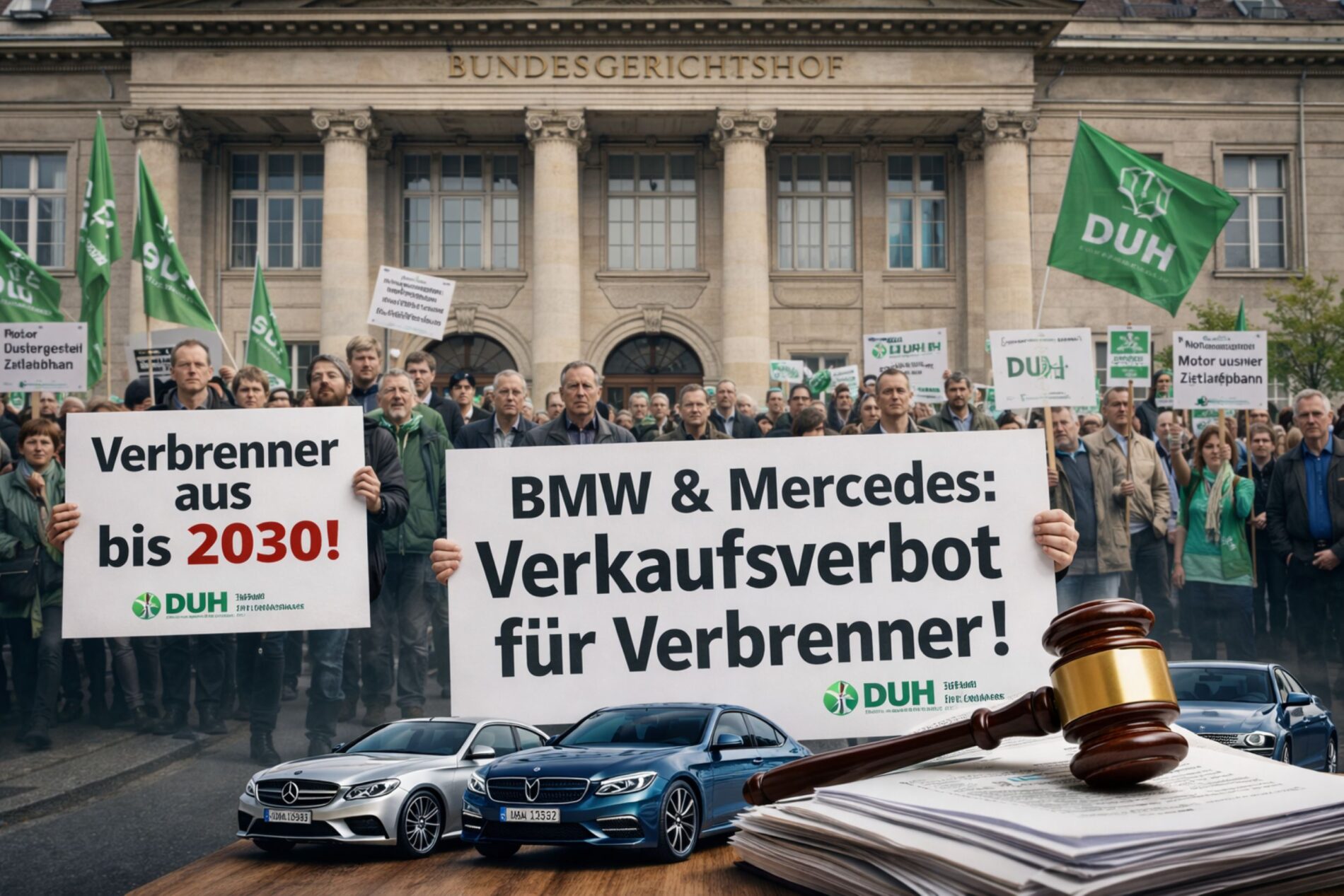
The Federal Court of Justice in Karlsruhe heard appeals in climate lawsuits brought by the German Environmental Aid Association (DUH) against BMW and Mercedes. Three managing directors of the DUH are suing as private individuals, claiming that their personal rights are violated by emissions. However, their application seeks a court-ordered ban. They demand that both companies only be allowed to sell cars with combustion engines until October 31, 2030, while a ban should take effect earlier if a certain CO₂ emission level is reached. At its core, the case revolves around the question of whether courts can compel private companies to refrain from climate-related actions, even though such interventions are normally regulated by the legislature. Furthermore, a landmark ruling is at stake. (nzz: 02.03.26)
Court Ruling as Leverage Against Internal Combustion Engines
Barbara Metz, Sascha Müller-Kraenner, and Jürgen Resch filed their lawsuits in 2021 with courts in Bavaria and Baden-Württemberg, which is why the cases initially went to different instances. They base their claims on the 2021 climate ruling of the Federal Constitutional Court, because at that time Karlsruhe emphasized a state obligation to set more concrete climate protection goals. The plaintiffs derive pressure for action from this ruling, while simultaneously linking it to the accusation that current emissions will restrict civil liberties in the future.
The lower courts ruled in favor of the automakers, but their focus was less on technology and more on constitutional logic. BMW and Mercedes are private companies, while fundamental rights are primarily defensive rights against the state. Their application to private entities is only considered in exceptional cases, and courts impose strict limits. The Federal Court of Justice (BGH) must now explore precisely these limits.
Stuttgart Higher Regional Court takes a hard line against politics
The Stuttgart Higher Regional Court dismissed an appeal as “manifestly unfounded” because it interprets the scope of fundamental rights vis-à-vis private entities narrowly. The court also argued that the legislature had adopted more ambitious climate targets after the climate agreement, therefore the primary responsibility lies with politicians. Private companies should not be subject to obligations that exceed legal requirements, as this would undermine the separation of powers. With this ruling, the Higher Regional Court clearly positioned the proceedings as a question of jurisdiction.
BMW and Mercedes are taking the same position before the Federal Court of Justice, while defining a ban on certain drive systems as a parliamentary responsibility. BMW’s lawyer, Reiner Hall, told the German Press Agency (dpa): “The plaintiffs think they’re smarter than the legislature.” A BMW spokesperson also emphasized that the debate about climate targets belongs in the plenary hall, not the courtroom, and that a single court ruling cannot replace political deliberation.
Why the Federal Court of Justice (BGH) is nevertheless reviewing the case
The fact that the case went all the way to Karlsruhe is due to the structure of the lawsuit, because a class action lawsuit by the environmental organization Deutsche Umwelthilfe (DUH) was not available under civil law in this case. The right to bring class action lawsuits only applies in certain areas, such as consumer protection or competition law, which is why the three managing directors appeared personally. The BGH nevertheless deemed the case worthy of review, thereby signaling that fundamental legal questions remain open. A decision has not yet been reached, but the significance grows with each instance.
DUH is known in Germany as a litigation organization, and its lawsuits against diesel driving bans have led to traffic restrictions in several cities. Critics see this as an attempt to force policy through court rulings, while the organization emphasizes enforcement and effectiveness. With the lawsuits against BMW and Mercedes, she is breaking new legal ground, because a ruling could, for the first time, establish climate policy injunctions against private companies that go beyond statutory standards. Precisely for this reason, a third court decision in this direction would send a signal far beyond the automotive industry.
Precedents until 2026 remain in flux
Liability approaches against large emitters already exist, but their development has not been straightforward. While the Higher Regional Court of Hamm dismissed a Peruvian farmer’s lawsuit against RWE, it acknowledged in principle that large greenhouse gas emitters could be held liable for climate damage. This establishes a framework, while courts simultaneously impose high standards of causality and reasonableness. This also influences the question of the scope of civil injunctions.
Furthermore, three constitutional complaints against the amended Climate Protection Act are pending before the Federal Constitutional Court, meaning the framework remains politically and legally contested. This increases the pressure for clear jurisdiction, while companies demand planning certainty. Whether the Federal Court of Justice grants the plaintiffs leeway or draws a sharp line between civil and political jurisdiction will determine how often climate policy will be handled through civil courts rather than parliaments in the future. For industry, therefore, not only a date but an entire mechanism is under scrutiny.