
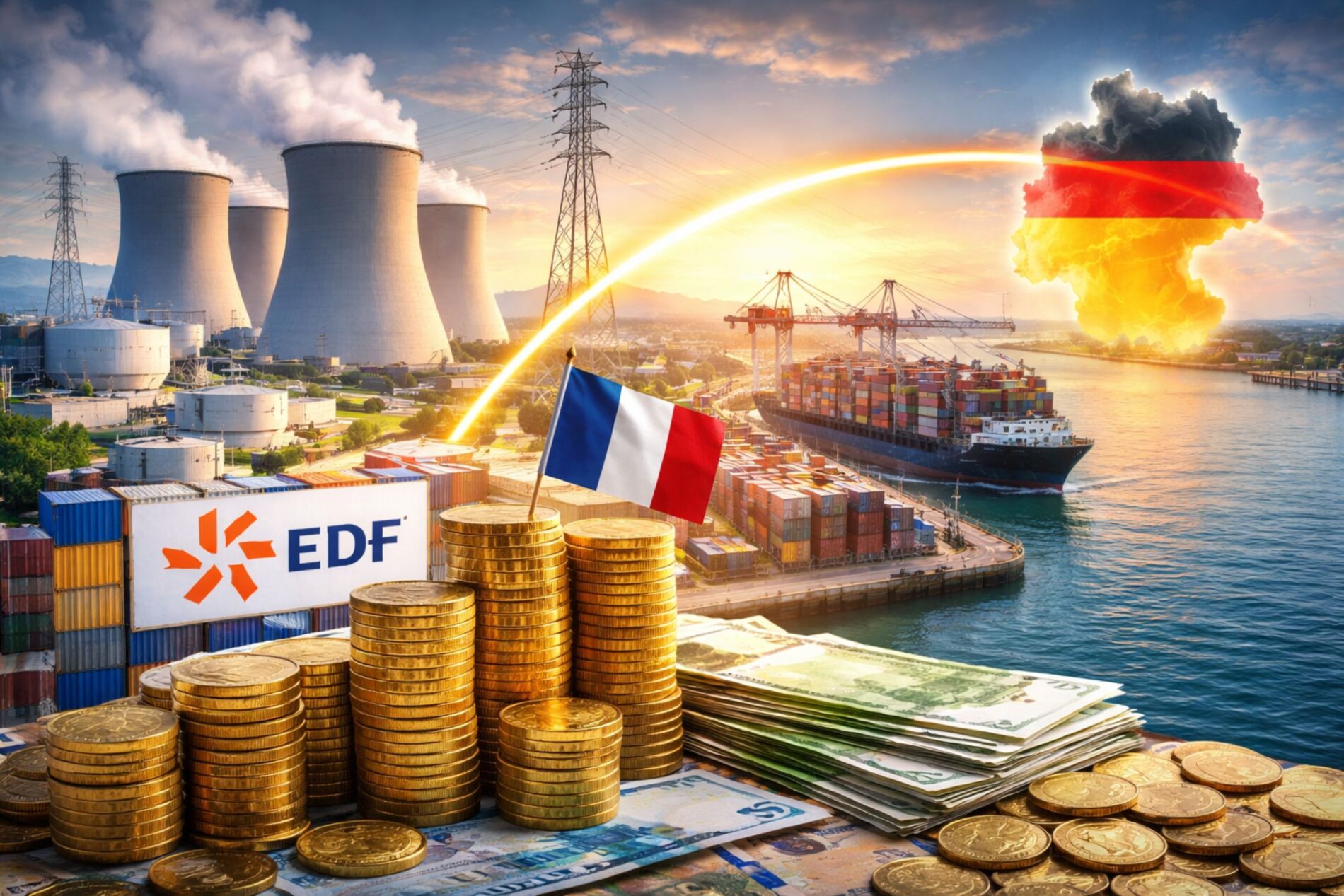
Despite falling wholesale prices and a multi-billion euro write-down, the French energy company EDF once again posted a strong profit in 2025. The positive result is primarily due to increased electricity production from French nuclear power plants, whose exports reached record levels. At the same time, cost risks such as the British construction project Hinkley Point C and other planned reactors are weighing on the outlook. The context of European energy supply is particularly relevant: France exports large quantities of nuclear power, significantly more to Germany than vice versa. The decisive factor remains the cost-effective production of nuclear power, which creates competitive advantages during periods of weak wind and solar output and simultaneously attracts investment in energy-intensive projects such as data centers. (faz: 20.02.26)
Energy company profits from rising nuclear power production
EDF reported an operating profit of €13.1 billion for 2025, while after deducting all costs, a profit of €8.6 billion remained. At the same time, however, a write-down of €2.5 billion weighed on the balance sheet. This charge is related to the construction of the Hinkley Point C nuclear power plant in the UK, which continues to experience delays and rising costs. Furthermore, the planned six new reactors in France, with estimated construction costs of €72.8 billion, raise long-term financial questions.
Despite these risks, the energy company remains highly profitable because its reactors are generating more electricity again. Production rose by around three percent in 2025 to 373 terawatt-hours. Output had previously declined significantly during the COVID-19 pandemic and due to corrosion problems. Now, the previous production level of 380 terawatt-hours from 2019 is once again within reach.
Record Exports Change the Relationship with Germany
A significant portion of the electricity flowed abroad, which is why France achieved a new export record of 92 terawatt-hours net in 2025. Around 70 percent of this amount is likely to have been nuclear power, as the 57 reactors accounted for the largest share of total electricity generation. The economic value of the exports is in the mid-single-digit billions, further solidifying France’s role as a major electricity supplier to Europe.
The change is particularly evident in the relationship with Germany. Since Germany’s nuclear phase-out in April 2023, Germany has been importing significantly more electricity from France. According to data from the Fraunhofer Institute for Solar Energy Systems ISE, 13.7 terawatt-hours of electricity were recently imported from France, while only 2.5 terawatt-hours were exported. Import volumes were already higher the previous year, permanently reversing the previous export ratio.
Nuclear Power Secures Competitive Advantages
Demand for French electricity rises, especially during periods of low wind and solar output, as wind and solar plants then produce only small amounts. French nuclear power plants operate with low fuel costs, and the low-carbon production process also eliminates additional CO2 costs in the European emissions trading system. The energy regulator CRE estimates medium-term production costs at around six cents per kilowatt-hour, which remains very competitive compared to other European countries.
The government is actively promoting this advantage, while at the same time the special ARENH mechanism expired at the end of 2025. This system previously obligated EDF to supply 100 terawatt-hours at fixed special rates. Large customers are now negotiating individual long-term contracts at higher prices, providing the energy company with additional revenue opportunities. At the same time, the energy policy remains clearly focused on nuclear power.
Investors are counting on a stable power supply
Representatives of the French economic development agency see this as a strong signal for international investors. Pascal Cagni explained: “France currently possesses a competitive advantage that few other major economies in the world can claim: abundant and largely CO2-free electricity.” Besides nuclear power, around 25 percent of electricity generation comes from renewable sources, resulting in a total of approximately 95 percent low-carbon production.
The artificial intelligence boom is increasing the demand for a stable energy supply, which is why large data centers are coming into focus. France is positioning itself as a preferred location in Europe, while international investors are preparing multi-billion-euro projects. Among others, the United Arab Emirates is planning investments of up to 50 billion euros in an AI campus with a data center. This demonstrates that affordable and reliably available electricity is increasingly becoming a decisive factor in industrial development.