
In the Schleswig-Holstein Wadden Sea, the Schleswig-Holstein Administrative Court has issued an injunction against oil production on the Mittelplate oil drilling platform, brought by the German Environmental Aid Association (DUH). The production halt is effective immediately. According to the court, the reason is the lack of an enforceable production permit, as a mandatory biennial inventory review did not include an assessment of the impact on the Natura 2000 habitat. An FFH impact assessment, under EU nature conservation law, examines whether a project such as oil production in a Natura 2000 area significantly impairs protected habitats and animal and plant species. Mittelplate has been extracting oil in the Wadden Sea, a particularly protected area, since 1987. The DUH considers the facility outdated and warns of accident risks. The ruling halts current production and forces the operator to suspend operations. This creates planning and legal risks for the company and authorities. An appeal by the operator to the court was unsuccessful in obtaining a stay of execution. (ntv: 26.02.26)
A Legal Mechanism to Stop Funding: But with Harsh Side Effects
The court prohibited funding “until further notice,” while an appeal by the operator, according to information from the proceedings, has no suspensive effect. This shifts the impact of an open legal question into operational reality, even though no acute incident has been reported. This is precisely the point of criticism: A funding halt by preliminary injunction creates a de facto finality for a limited time, even though the substantive issue is still pending. This is permissible under the rule of law, but it has a particularly severe impact on an existing infrastructure.
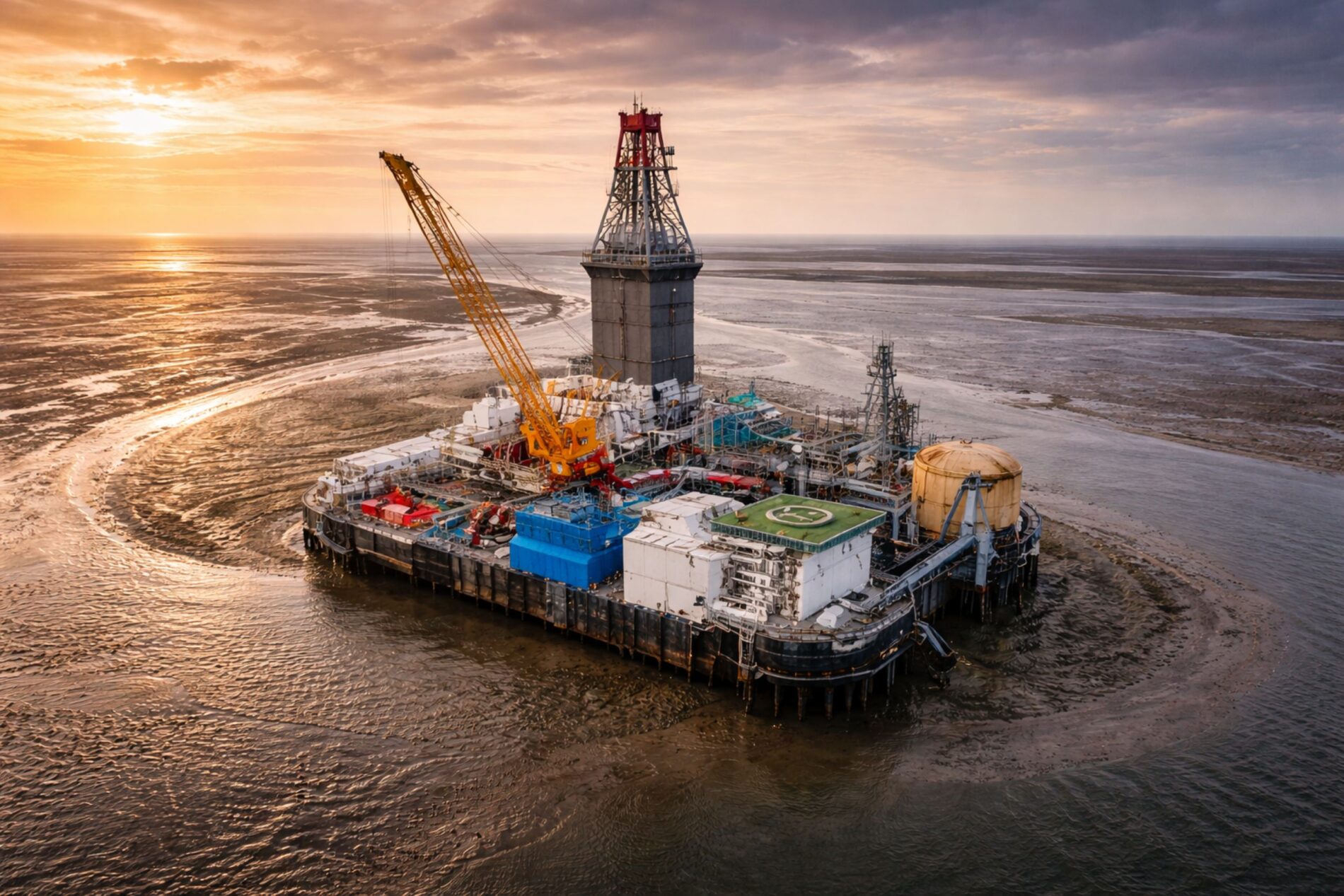
The German Environmental Aid (DUH) celebrated the decision as a historic victory for nature conservation, while simultaneously emphasizing the need for a more confrontational stance. DUH Federal Managing Director Sascha Müller-Kraenner declared: “Germany’s largest World Heritage Site must not be exploited without a thorough examination of the environmental impacts of oil production.” He added: “The Wadden Sea is one of Europe’s most sensitive and valuable ecosystems and must not be further endangered by oil production.” The DUH describes the platform as outdated and warns: “The risk of an accident increases with each passing day.” These statements increase the pressure, but they do not replace a transparent, publicly documented assessment of safety data, regulatory practices, and testing procedures.
The operator disagrees and points to regulatory oversight as the conflict escalates
The operator, Wintershall Dea Germany, announced that it will carefully review the decision, while the company maintains a different assessment of the permitting situation. A spokesperson said: “In our opinion, the main operating plan for the Mittelplate drilling and production platform was approved in compliance with all applicable legal requirements.” He further stated that the operation of the facility had always been under close state supervision and in accordance with existing regulations. The operator describes the facility as state-of-the-art and points out that more than 40 million tons of oil have been extracted since October 1987, while the German Environmental Aid (DUH) fundamentally questions this continuity.
The legal proceedings began in 2024 with an objection filed by the DUH with the responsible State Authority for Mining, Energy and Geology (LBEG), which was rejected as not having been submitted within the prescribed time limit. As a result, the dispute continued in court. The DUH justified its actions by arguing that an assessment of the impact on the Natura 2000 habitat (FFH) had never been carried out based on the operating plans, and that this also applied, in their view, to the operating plan for 2024 to 2026. This led to a lawsuit against the rejection, while the preliminary injunction proceedings have now definitively enforced the production halt.
Supply, planning, and operational duration until 2041 – why timing is so crucial
Oil has been extracted from Mittelplate since 1987. The operator reports more than 40 million tons produced to date. Another 10 to 15 million tons are considered recoverable. Therefore, any interruption significantly impacts operations. It costs money and disrupts planning.
Since May 2024, Schleswig-Holstein has refrained from approving any new oil fields. Wintershall withdrew its corresponding applications. Existing production is still slated to end by 2041. This is precisely why the intervention seems so drastic. The phase-out is already politically planned. Nevertheless, an abrupt stop-and-go increases the risks. It burdens operations and investments. Furthermore, regulatory oversight becomes more difficult. At the same time, the likelihood of further legal proceedings with similar consequences increases.