
In Germany, Fermi Deutsche Industriekraft GmbH, together with the Finnish developer Steady Energy, has been driving forward a project since March 2026 that is reigniting the debate about nuclear power. The impetus is a peculiarity in the Atomic Energy Act, which explicitly prohibits only the commercial generation of electricity from nuclear fission, while purely heat-generating plants are not explicitly mentioned. The consortium therefore aims to bring small reactors for district heating and industrial plants to Germany. The greatest risks are considered to be not just the technology or economic viability alone, but above all, permitting, political resistance, and lengthy procedures. At the same time, the initiators are touting significantly lower heating costs and envision initial deployment within this decade. (epochtimes: 25.03.36)
The Atomic Energy Act opens up legal leeway
The plan is based on Section 7 of the Atomic Energy Act. It states: “[…] No permits will be granted for the construction and operation of facilities for the fission of nuclear fuels for the commercial generation of electricity and for facilities for the reprocessing of irradiated nuclear fuels. […]” The crucial point is therefore the addition regarding electricity generation. According to this interpretation, reactors that exclusively supply heat do not automatically fall under the explicit prohibition.
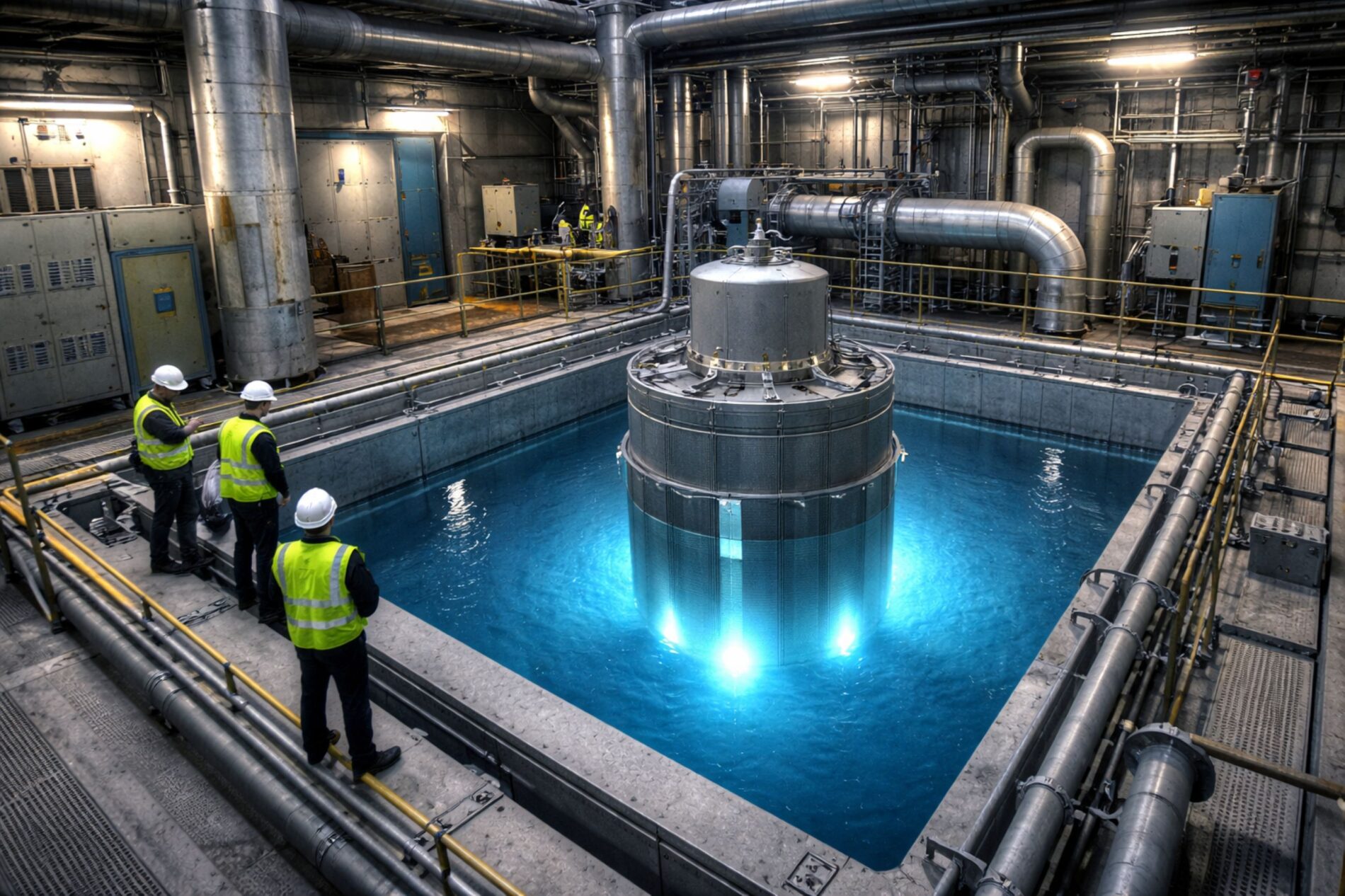
However, this does not automatically pave the way for new nuclear power plants. Even a thermal reactor would have to undergo a full nuclear regulatory process. Furthermore, questions regarding location, protection against sabotage, operational safety, and public acceptance remain unresolved. This last point, in particular, makes the project politically sensitive, while the operators are banking on a market niche in the heating sector.
The reactor is intended to make district heating cheaper
The technical basis is the LDR-50 from Steady Energy. This is a small, modular reactor designed solely for heat generation and therefore does not require turbines or generators for electricity production. The system is designed for 50 megawatts of thermal output, while the reactors are intended to operate at comparatively low temperatures of around 140 degrees Celsius. According to the project partners, this increases the usable efficiency and also reduces technical complexity.
The plant is to be built underground, with each reactor situated in its own water basin. This basin serves both as shielding and a heat storage unit. A passive cooling system, designed to function without pumps or external power supply, will also be incorporated. The operators see this as a significant safety advantage, but German approval for this concept has not yet been granted. A demonstrator has been under construction in Helsinki since February 2026, but for the time being, heat will be generated electrically rather than nuclear power.
Economically attractive, politically sensitive
The economic appeal of the model lies in the promised costs. Fermi Deutsche Industriekraft anticipates being able to generate heat initially for around €40 per megawatt-hour. After 30 years, the costs are expected to drop to approximately €15. This would be significantly less than many current district heating prices in major German cities, which often range between €140 and €180 and are sometimes even higher. This promise is therefore particularly attractive for municipal utilities and energy-intensive businesses.
However, whether this will become a real project will not be decided on the drawing board. Support is coming from Estonia and Finland, while former EnBW Chief Technology Officer Ulrich Gräber is overseeing the project in Germany. He also anticipates resistance from nuclear power opponents and points to the role of the individual states in the permitting process. Thus, the situation remains open: Legally, the Atomic Energy Act provides a point of leverage; economically, it offers a strong selling point; and technically, it presents a concrete concept. Nevertheless, there is still a long way to go between this idea and a German thermal reactor. The Atomic Energy Act alone will not change that.