
In Munster, Lower Saxony, another operational test of the German Armed Forces’ new digital radio system was aborted in November due to serious malfunctions. An internal report from early January classifies the D-LBO basic system as so deficient that, according to the test assessment, it posed a “danger to life and limb” during training and exercises with retrofitted main battle tanks. Vehicles such as the Leopard 2 A7V were particularly affected, while at the same time, radio communication, situational awareness, and central command functions failed. This exacerbates the crisis of a project worth more than eleven billion euros, whose operational readiness is not foreseeable until September 2026, according to the report. Moreover, the Ministry of Defense has withheld this critical finding from Parliament since January, despite the significant consequences for the security, training, and operational capability of the armed forces. (welt: 20.03.26)
Digital radio fails even at basic functions
The report describes not peripheral problems, but failures in core operations. Particularly critical is the voice communication between battle tanks, which did not function reliably after the installation of the new technology. In some cases, soldiers could not even tell if a radio message had been transmitted at all.
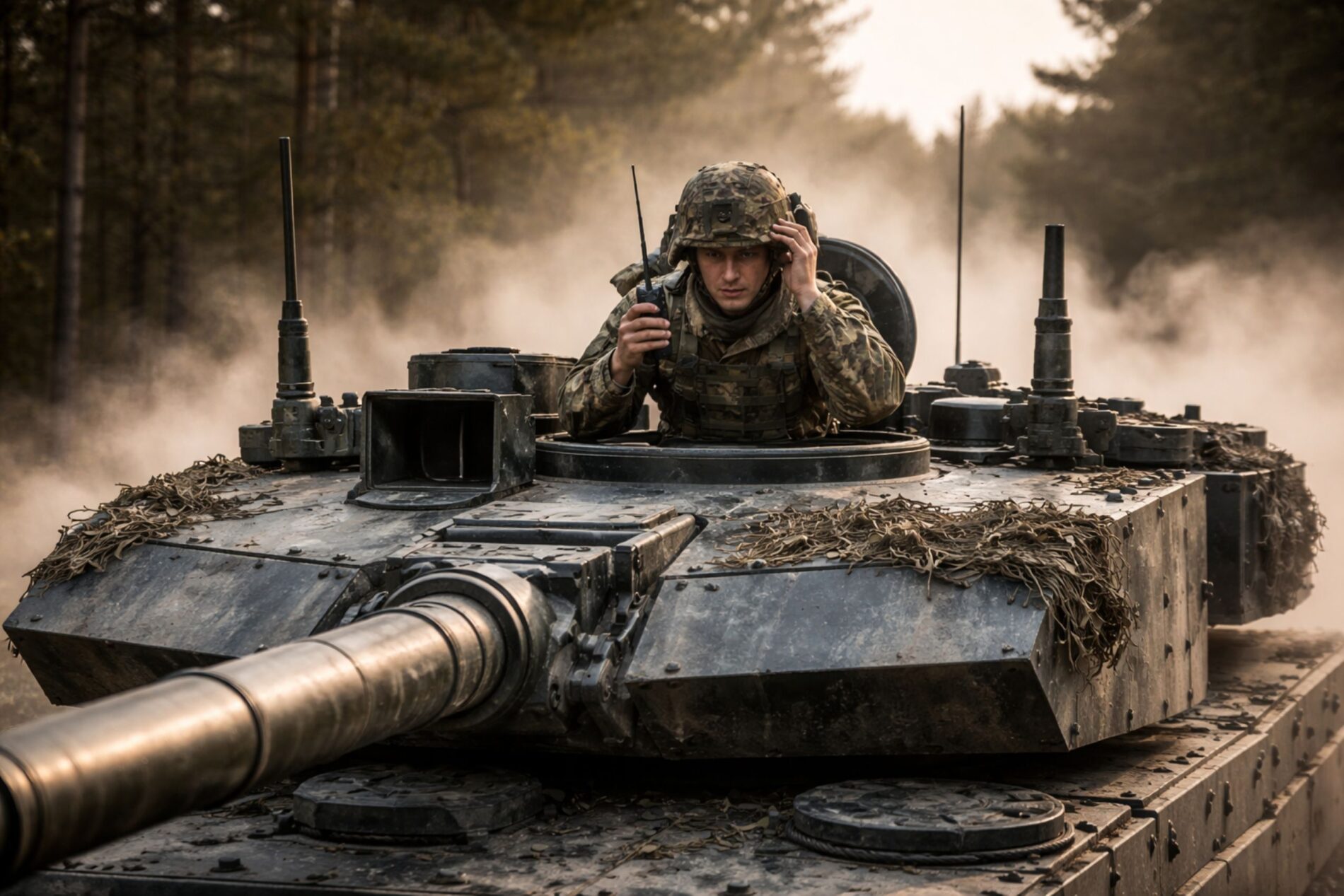
This poses a significant risk, especially in combat. An immediate ceasefire, referred to in the report as a “stop,” could not be reliably transmitted. Therefore, the assessment states unequivocally: “In its current state, the D-LBO basic system is neither ready for operational testing nor suitable for training and exercises. Whether operational readiness can be achieved by September 2026 is currently unforeseeable.”
Report contradicts public statements
The findings from Munster are also politically sensitive. Representatives of the Ministry had expressed confidence during the tests, but the report paints a different picture. In particular, the responsible General, Michael Vetter, had publicly declared that the radio had “passed with flying colors” at a military technical service facility.
The statements regarding practical use also sounded considerably more positive than the subsequent test results. Vetter said of the firing range that the soldiers were enthusiastic “about the range and power of the radio.” Regarding radio communication, he also explained: “Voice communication is working quite well; we actually had very good results in the test.”
Range and Simultaneous Operation Remain Critical
The report delivers a harsh verdict. Even voice communication alone is “to be rated as deficient overall,” and radio transmissions were sometimes too quiet. The report even refers to “aquarium noises,” meaning gurgling and static during transmission.
In addition to voice quality, the technical performance also failed in key areas. Simultaneous data and voice communication was barely stable, while the radio ranges “fell far short of requirements at all transmission power levels.” The system didn’t even achieve a range of ten kilometers, which is why the digital radio system also failed within combat units.
Further Deficiencies Plague the Overall Project
Other components of the large-scale project also caused problems. The data radio connection of the Puma infantry fighting vehicle showed deficiencies, and the configuration of the central middleware “Tactical Core” also presented difficulties. Current Bundeswehr documents also note that only one fixed frequency can be maintained in the retrofitted Leopard tank, while the security and tactical channels cannot be used simultaneously.
This further increases the pressure on the D-LBO project. The goal is the seamless networking of soldiers, vehicles, and command posts; in addition, tens of thousands of vehicles need to be digitized. This latest failure is particularly significant because an initial test in May 2025 had already failed. Despite this, Defense Minister Boris Pistorius still referred to the project as being “on schedule” in September, even though this claim proved untenable. The ministry again responded evasively to further inquiries, merely referring to a later briefing of parliament in a “confidential” setting. Therefore, it remains unclear when the Bundeswehr’s digital radio system will actually be operational.