
The state-owned company Deutsche Bahn plans to purchase Chinese electric buses, directly contradicting political demands for greater economic patriotism. Especially during a period of weak economic growth, leading politicians are calling for industrial responsibility, while the state-owned company is placing orders in China of all places. This decision simultaneously strains the debate surrounding electric buses, the influence of Chinese imports, the role of Deutsche Bahn, and the claim to economic patriotism. (spiegel: 09.12.25)
State-owned company under political pressure
The conflict stems from the public responsibility of a state-owned company, as the federal government remains the owner of Deutsche Bahn. Expectations are correspondingly high because political demands and business practices are diverging. At a congress of the IG BCE (Mining, Chemical and Energy Industrial Union) in late October 2024, SPD co-chairman and Vice Chancellor Lars Klingbeil explicitly called for greater commitment to domestic production from company management. He argued that government support should be linked to a clear commitment to domestic production to preserve value creation and jobs.
Shortly thereafter, in early November 2024, the SPD executive committee reaffirmed this position in a resolution. According to the party leadership, companies with state participation, in particular, should assume special responsibility. In this context, Deutsche Bahn’s actions take on additional significance, as the state-owned corporation does not operate as an ordinary market participant, but rather as a public contracting authority with symbolic implications.
The term “large public enterprise” aptly describes this role, as economic decisions have political repercussions. This is precisely why the criticism is directed less at electric buses themselves, but rather at the origin and strategic evaluation of the suppliers.
Contract Award to Chinese Manufacturers
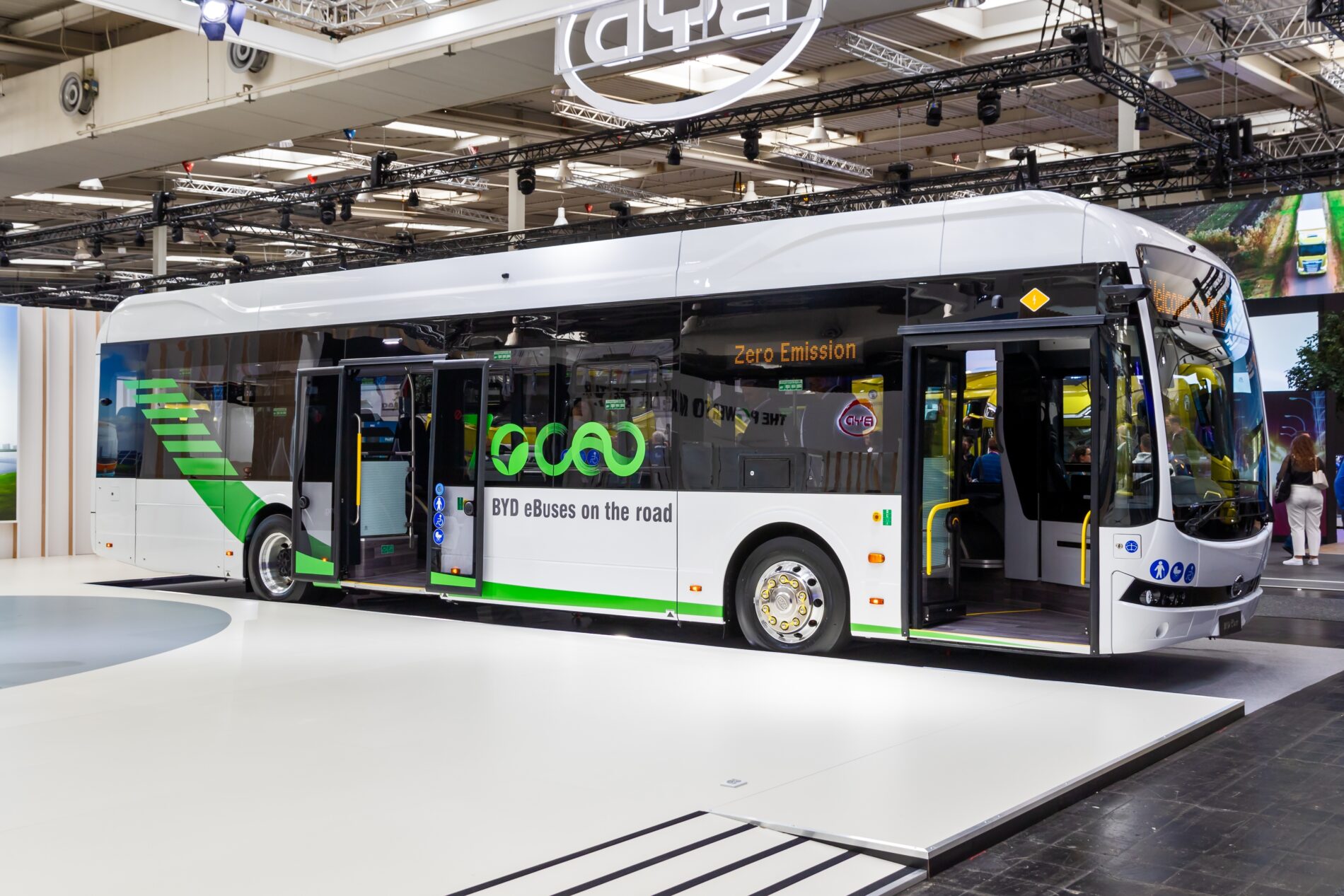
In early April 2024, Deutsche Bahn issued a tender for a large-scale contract for the delivery of buses. The tender comprised several lots and extended over multi-year framework agreements. According to consistent reports, a key portion of the contract was awarded to the Chinese manufacturer BYD. Further lots were awarded to Zhongtong Bus and MAN, with BYD apparently receiving the lion’s share.
The company did not confirm specific figures, but the number of vehicles is estimated to be several thousand. The railway company merely referred to ongoing proceedings and pointed to the suppliers’ European subsidiaries. While this remains formally correct, the arrangement is politically reassuring. After all, a state-owned company is indirectly ordering electric buses from Chinese manufacturers, while politicians are simultaneously warning of growing dependence on Chinese imports.
Unions See Job Losses
The Railway and Transport Union (EVG) was particularly vocal. Its chairman, Martin Burkert, announced that he would raise the issue with the supervisory board. As the owner’s representative, the federal government bears responsibility, which is why mere appeals are insufficient. The state-owned company must demonstrate that its commitment to its home region is more than just a political slogan.
Burkert also pointed to the aggressive pricing strategies of Chinese manufacturers. This practice increases the pressure on European suppliers and intensifies competition in an already strained market. Although BYD now also produces in Hungary, the strategic dependency remains. From the EVG’s perspective, this threatens a gradual erosion of industrial substance.
Symbolic Significance Beyond the Transport Sector
This case has implications far beyond Deutsche Bahn. Electric buses are considered a key technology for the transport revolution, which is why government procurement receives special attention. If a state-owned company prioritizes Chinese imports while politically demanding commitment to its home region, a difficult-to-resolve contradiction arises.
Even as a federally owned company, Deutsche Bahn doesn’t operate in a vacuum. Every major decision influences debates about industrial policy, competition, and employment. This is precisely why the public utility is now facing intense criticism. The situation illustrates how closely intertwined economic efficiency and political responsibility remain.
Ultimately, the issue isn’t so much about individual buses, but about credibility. A state-owned corporation that acts differently than politically mandated provides ammunition for attack. In economically challenging times, neutrality is no longer sufficient, because state-owned companies serve as role models. This is exactly the standard by which Deutsche Bahn is now being judged.