
In Germany, factories are closing while corporations are building new capacities in Eastern Europe. This no longer just affects suppliers or individual locations. Even large DAX-listed companies are relocating production and investments. As a result, jobs, supply chains, and industrial know-how are gradually migrating away. Hungary is attracting the most companies. (berliner-zeitung: 29.01.26)
DAX-listed companies invest billions in Eastern Europe
BMW exemplifies this change of course, as the company will open a new plant in Debrecen, Hungary, in 2025. More than two billion euros have been invested in the factory, which will produce models of the “New Class.” Over 2,000 jobs are planned there in the long term, meaning this growth will originate outside of Germany.
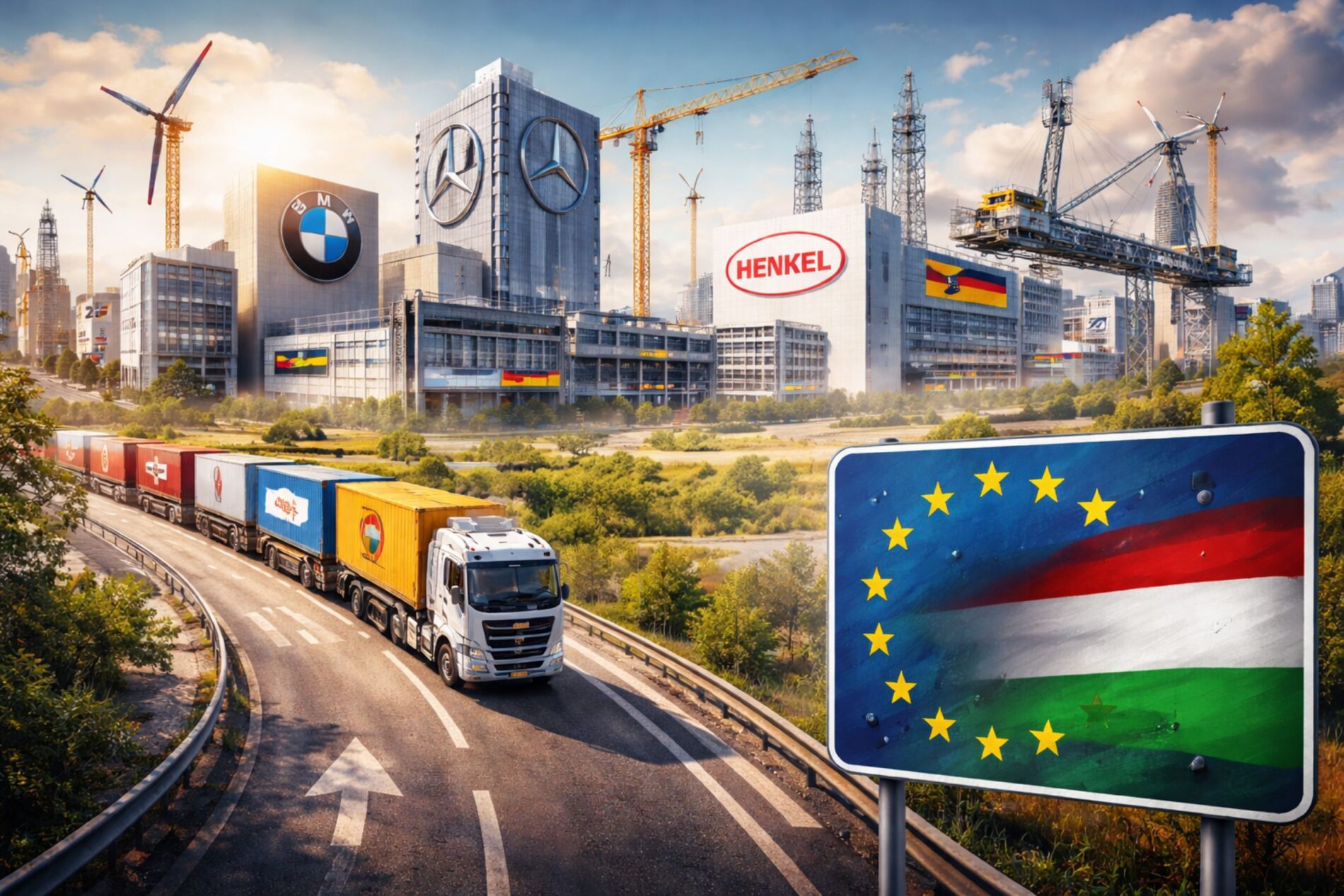
Mercedes-Benz is pursuing the same approach in Hungary, where the company is expanding its plant in Kecskemét with an investment of around one billion euros. Capacity is set to increase to 200,000 vehicles per year, while production in Germany will decline. Chief Financial Officer Harald Wilhelm outlined a clear cost strategy for this expansion. The share of manufacturing in low-cost countries is to grow from 15 percent in 2023 to 30 percent by 2030.
Suppliers follow OEMs as new supply chains emerge
When automakers build new plants, suppliers follow suit because shorter transport routes reduce costs. ZF Friedrichshafen is constructing new factories in Hungary for shock absorbers and axle modules, which will supply future electric models. The investment amounts to approximately 62 million euros, supplemented by government subsidies.
Bosch opened a logistics and warehouse center in Miskolc, also in Hungary, in early 2025. The investment for this facility totals 147.6 million euros. This creates a denser industrial network that stretches from new vehicle plants to logistics and component manufacturing.
Plant closures in Germany reveal the price of relocation
At the same time, sites are disappearing, even though some plants were previously profitable. GKN Driveline closed its Zwickau-Mosel plant, resulting in the loss of more than 800 jobs. The company cited upheaval in the automotive industry, falling prices, and rising costs as the reasons for the move. Simultaneously, a new plant was built in Hungary, benefiting from government subsidies.
Henkel withdrew from eastern Germany because its adhesives plant in Heidenau closed at the end of 2024. Around 40 jobs were lost. Production moved to Környe in Hungary. A previous commitment by Henkel CEO Carsten Knobel adds a layer of significance to this situation. At the end of August 2024, he publicly stated that no plant in Germany would be closed.
Why corporations are relocating: wages, taxes, and pace
The cost squeeze remains the central driver, as it alters every location calculation. An industrial worker in Hungary earns an average of around €1,500 gross per month, while in Germany the figure is over €4,600. Hungary also attracts investors with a corporate tax rate of nine percent, whereas the effective tax burden in Germany is often around 30 percent.
Administrative practices also play a role, as permits can be costly in terms of both time and money. Hungary offers fast-track procedures, tax breaks, and affordable building land for large projects. Marko Graf from the Osnabrück Chamber of Industry and Commerce (IHK Osnabrück) illustrates the difference with a clear analogy: investors in Germany too rarely receive the “red carpet” treatment.
Serbia as an Export Platform with Free Trade
Serbia is also attracting German projects, even though it is not an EU member. Continental opened an electronics factory for displays and infotainment systems near Novi Sad in 2023. ZF has been operating a plant in Pančevo, Serbia, since 2019 and later expanded it. Boysen also has a large overseas factory in Subotica.
The decisive advantage lies in foreign trade, as Serbia has free trade agreements with the EU, the Eurasian Economic Union, Turkey, the UK, and, since October 2023, also with China. This allows goods from Serbia to reach very large markets duty-free. Special economic zones offer additional benefits, increasing its attractiveness compared to more expensive locations.
Ultimately, a pattern emerges: DAX-listed companies are relocating future production capacities to Eastern Europe, and their suppliers are following suit. At the same time, higher energy prices, complex procedures, and high taxes remain in Germany. For many board members, this leads to a sobering conclusion, and it is increasingly in favor of Eastern Europe.