
Finland’s wind power didn’t just collapse during the cold snap; in many places, it failed completely. The main reason is icing. Ice builds up on rotor blades, sensors, and anemometers, and even a thin layer renders the turbines inefficient. Operators then automatically shut down the turbines because of the risk of imbalance and ice throw. Additionally, in the core wind power regions, low-lying fog clouds linger at blade level, constantly forming new ice. This turns winter weather into a systemic problem.
Fingrid Registers Collapse in Power Generation
Finnish grid operator Fingrid reported that wind farms are temporarily delivering only a tiny fraction of their installed capacity. Western Finland is particularly hard hit, as a large portion of the country’s wind power capacity is located there. Temperatures plummeted to around -20°C, causing the rotors to ice up rapidly. The result is a near-total shutdown, as many turbines are simultaneously disconnected from the grid.
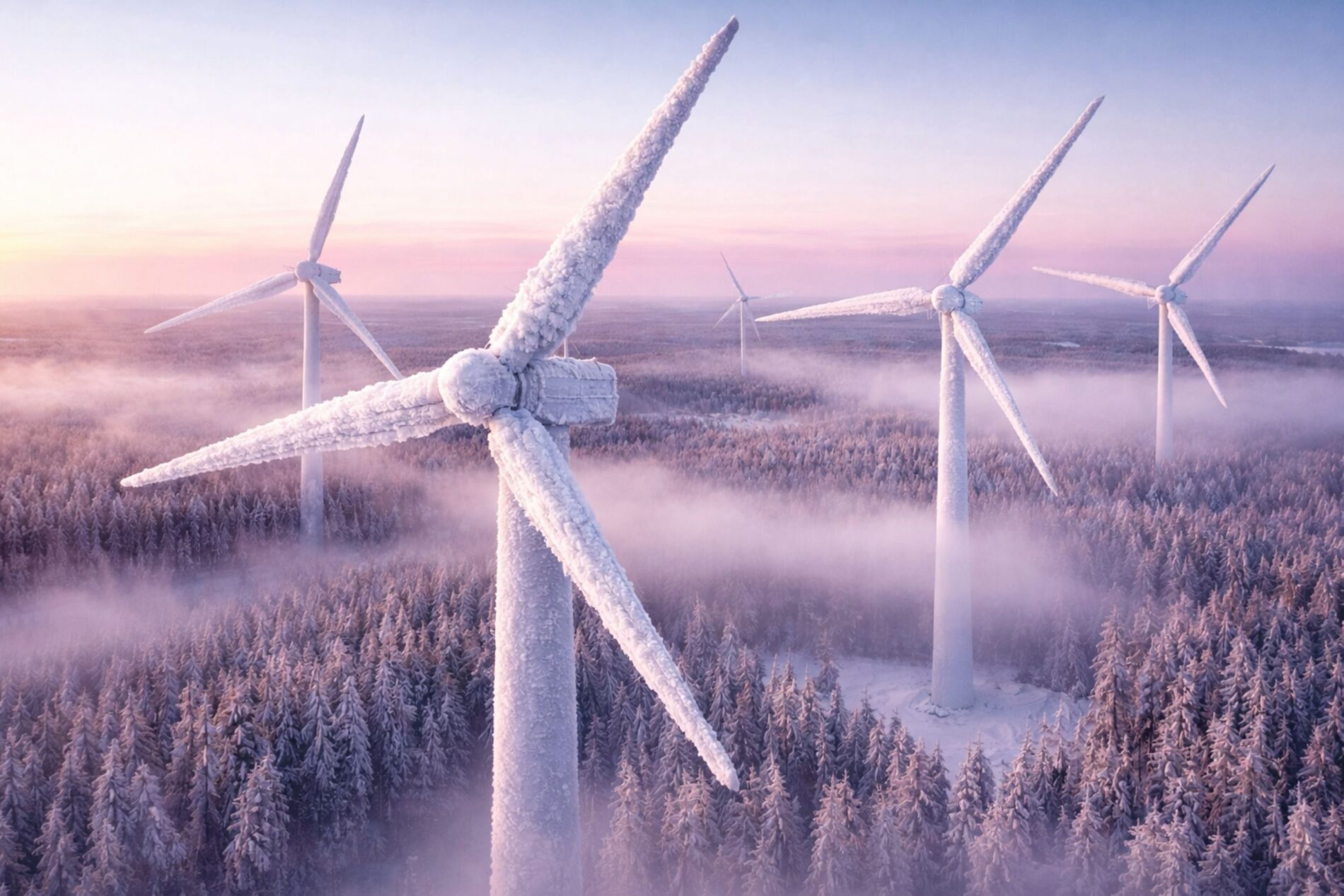
The problem of icing is not theoretical, but physically significant, because ice alters the profile of the rotor blades, thus disrupting the aerodynamics. At the same time, the resulting imbalance increases the loads on bearings and gearboxes, which is why operators shut down the turbines for safety reasons. And if the ice keeps rebuilding due to fog, even a brief restart offers little help.
“Fog clouds at rotor height” exacerbate icing
A consultant for the industry company Kjeller Vindteknikk describes the situation in Finland’s most important wind power region as follows: “In Finland’s most important wind power region, low-lying fog clouds lie at approximately the height of the rotor blades, and they constantly form new ice.” This is crucial because icing then occurs not only during snowfall. It also grows during calm, cold temperature inversions. This puts wind farms in a downward spiral, because even if individual turbines restart, they quickly freeze again.
Weather data also shows that the cold is not just a brief anomaly. The European Centre for Medium-Range Weather Forecasts (ECMWF) expects temperatures to remain significantly below the long-term average until at least mid-February. On average, temperatures could be around seven degrees below the 30-year norm, meaning the risk of icing will remain consistently high.
Lack of blade heating exacerbates shutdowns
Finland has rapidly expanded its wind power capacity, but many turbines lack technical protection against icing. Blade heating systems or anti-icing systems are not mandatory to prevent icing, and operators are often not required to report centrally whether their turbines are equipped with them. This makes a portion of the fleet particularly vulnerable during the cold snap. Furthermore, the pressure is mounting because the turbines without heating are precisely the ones that shut down first.
Added to this is a second obstacle: Winds have been unusually weak across large parts of the Nordic region recently. An index from Kjeller Vindteknikk shows that January in the north was significantly less windy than any January in the last 20 years. This puts Finland in a double bind, because iced-up rotors are at a standstill and the few operating turbines deliver hardly any power during the lull.
Electricity prices remain high because backup power is expensive
When wind power shuts down on a large scale, other power plants and imports have to step in. This drives up wholesale prices because reserve capacity is more expensive and demand increases during the cold weather. This week, electricity prices temporarily reached a two-year high, even though there was some relief afterward. Nevertheless, the situation remains tense because the cold weather persists and the wind gap is not closing quickly.
Forecasts indicate that Finland’s wind production could remain extremely low for another two weeks. Meteorologists also expect Nordic wind power generation to be up to 20 percent below normal for weeks. This cold snap thus demonstrates in full force what icing means in real-world operation: not less wind power, but idle turbines and a power system that has to switch to expensive backup sources during peak demand.