
Germany’s nuclear phase-out was, as is well known, decided more or less hastily after the Fukushima nuclear disaster in Japan. In retrospect, it is almost single-handedly decreed by then-Chancellor Angela Merkel (CDU). Today, it is considered arguably the most consequential energy policy decision in Germany in recent decades. (t-online 23.11.2025)
Shutdown of Germany’s Nuclear Power Plants and Environmental Consequences
In 2023, the last German nuclear power plants were shut down. Although Angela Merkel had announced the phase-out in 2011, she was, with political acumen, essentially bowing to the majority pressure of the German public. The Fukushima nuclear disaster had demonstrated that, under certain circumstances, the technology is not entirely controllable.
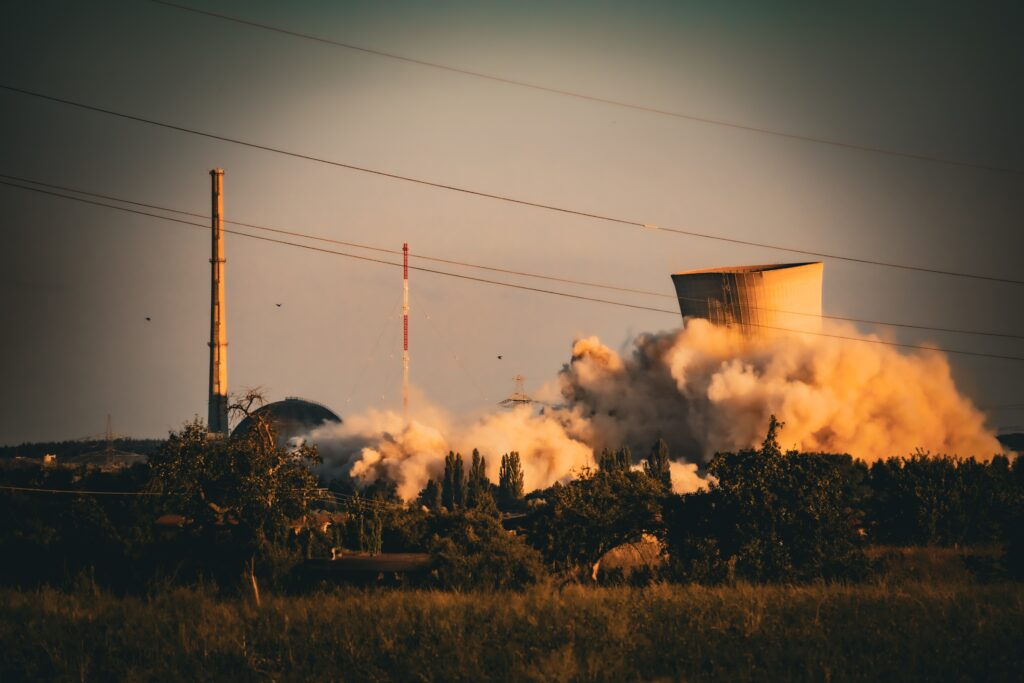
In 2025, WePlanet, an independent climate protection organization, quantified the environmental consequences of this decision. The environmentalists, who are by no means proponents of nuclear power per se, found the result simply appalling. The nuclear power had to be replaced by gas and coal. This resulted in the loss of approximately 800 TWh (terawatt hours) of low-CO₂ nuclear power in the country. (WePlanet, Deutschlands Atomausstieg)
This amount is currently sufficient to supply Germany with electricity for two years. While renewable energies have been significantly expanded and now cover almost 60% of our electricity needs, the 25% of nuclear power that was available until 2011 is still missing from the German electricity mix to achieve climate policy goals. Although nuclear power is not CO₂-neutral, as some CO₂ is inevitably released along its value chain, including uranium mining, fuel transport, and final storage, and final storage is considered challenging, the nuclear power plants themselves emit virtually no greenhouse gases. However, their decommissioning has resulted in the missing capacity being replaced in Germany by 98% coal-fired power and 2% gas-fired power. According to studies, this has led to 733.5 megatons of additional CO₂ equivalents that would not have occurred without the nuclear power plant shutdowns.
Germany’s Climate Record
The German Federal Environment Agency (UBA) confirms that greenhouse gas emissions in Germany have declined continuously since 1990. In 2024, the reduction was an impressive 54.3%. However, no steady reduction has been observed since the 2010s. This is likely due to the shutdown of nuclear power plants, which has not yet been fully compensated for by renewable energies. The consequences are excessively high electricity prices in Germany and health problems caused by CO₂, methane, and heavy metals, which are considered particularly harmful. The overall environmental impact has probably claimed the lives of around 20,000 people in Germany, while the WHO estimates the number of deaths after the Chernobyl disaster at approximately 4,000. The nuclear phase-out also has precarious economic consequences.
The increase in coal-fired power generation has led to higher CO₂ levies for German companies under the ETS (European Emissions Trading System). The direct result is the extremely high electricity prices in Germany. This correlation is confirmed by further studies, such as those by BCG (Boston Consulting Group). In particular, the depreciation of former German nuclear power plants has recently made their electricity comparatively inexpensive. However, the construction of new nuclear power plants is not recommended, as both BCG and WePlanet emphasize. This is extremely expensive and takes up to 15 years, which does little to advance climate goals. Furthermore, nuclear power from new power plants is the most expensive energy option.
While mini nuclear power plants (so-called SMRs) now exist, which are less expensive to build and could make nuclear power attractive again in terms of price, the study authors did not examine this option in detail because SMRs (Small Modular Reactors) currently only exist as pilot projects. According to general consensus, they are unlikely to become widespread before the mid-2030s at the earliest, assuming there is still a demand for nuclear power at that time. After all, solar and wind energy are on the rise worldwide, and storage technologies—crucial for periods of low wind and solar output—are becoming increasingly smarter and more affordable. This leads to the conclusion that Germany need not consider new nuclear power technologies, but has made a fatal mistake in terms of climate, health, and energy policy by prematurely shutting down its existing nuclear power plants.
Conclusion
WePlanet, in agreement with other experts, draws a sobering conclusion regarding Germany’s nuclear phase-out. It was intended to reduce risks, which it only achieved with regard to a possible, but actually very unlikely, nuclear accident. The situation in Fukushima was, after all, triggered by a tectonic event, the probability of which in Germany is practically zero. On the other hand, our nuclear phase-out has increased the risks to the climate, the economy, and our health. WePlanet therefore warns: CO₂-free energy sources should never be abandoned lightly if they are considered sufficiently safe according to prevailing technical opinion. This was the case with German nuclear power plants. Even Angela Merkel, who holds a doctorate in physics, knew this.