
The Chinese central government is steering the heat pump industry with a strategy paper entitled “Action Plan to Promote High-Quality Development in the Heat Pump Industry.” In it, China is focusing on scaling up production, higher standards, and increased research by 2030. The goal remains a competitive advantage in the international market. The German Heat Pump Association (BWP) has published a German version of the document. The association warns of an offensive by Chinese manufacturers into European markets. The main risk is seen as the combination of price pressure and state funding. In Germany, this could have consequences for market share, investment, and planning certainty. (t-online: 19.02.26)
BWP warns of offensive and growing import pressure
The BWP therefore sees the development as critical. Asian manufacturers are developing devices specifically for Europe. “The fact that Chinese manufacturers are able to tap into European markets is also evident in the fact that almost all of them now offer propane heat pumps. These were developed specifically for the European market within just a few years,” says Björn Schreinermacher, Head of Policy at the BWP. Europe prefers natural refrigerants. Furthermore, an EU regulation for their installation will come into effect in 2028. Propane is one of the most common natural refrigerants.
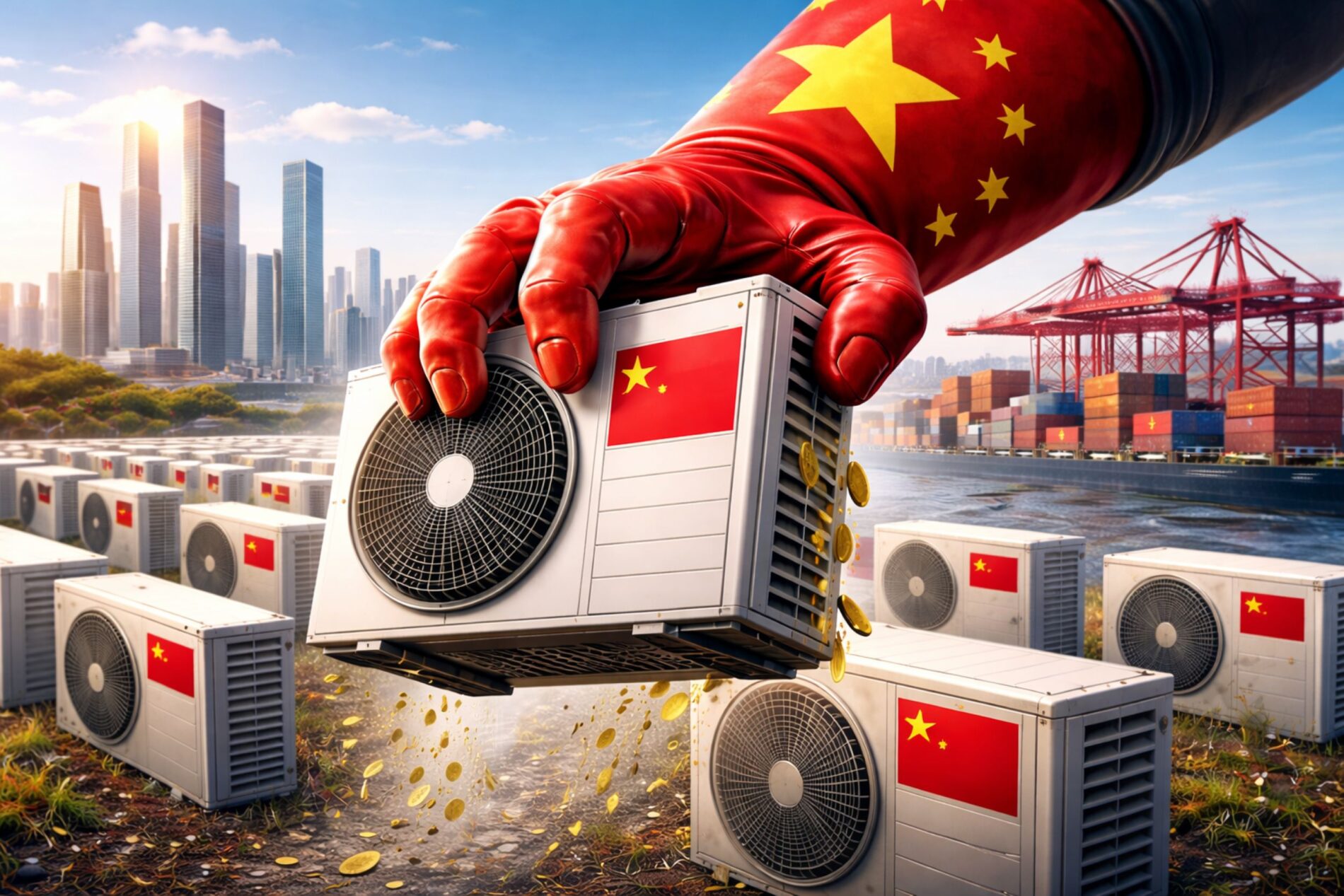
Schreinermacher also casts his attention on Berlin. “We therefore take this connection very seriously and expect the same from the German government,” he clarifies. Viessmann, Bosch, Stiebel Eltron, and Vaillant continue to produce in Germany. At the same time, pressure from Asian competitors is increasing. Many in the industry fear a domino effect: first solar, then cars, now heating.
Beijing’s Action Plan – Mass Production, Miniaturization, and a Leap in Efficiency
The action plan outlines concrete goals for 2030. China aims to significantly upgrade its domestic heat pump industry. Beijing wants to raise standards and accelerate technological development. A key focus is miniaturization. Devices are to become more compact and quicker to install. Simultaneously, they are to operate more efficiently and with a lower carbon footprint. Therefore, the government is planning increased research and development. According to the plan, devices should operate at least 20 percent more efficiently by 2030.
Nevertheless, the focus is clearly on production volume. China plans to scale up for both the domestic market and exports. This shifts the competitive landscape. Prices can then fall more quickly. European manufacturers will thus lose considerable leeway.
Heat Pumps as Standard in Buildings, Transportation, and Agriculture
With its action plan, China aims to widely roll out heat pumps. They are to gradually replace coal-fired boilers and coal combustion. This applies to residential buildings, but also to schools. The document also mentions hospitals, hotels, and offices. Industry is also to receive suitable solutions. China is also considering transportation. Cars and buses are to be heated with heat pumps. Agriculture is also included in the plan. The message is clear: heat pumps are to become the standard.
Beijing links this to “green” production. Manufacturers are to keep their carbon footprint small. They are to operate with low carbon emissions throughout the entire supply chain. Furthermore, China is to expand international cooperation. Beijing wants to “leverage its advantages” to gain a foothold globally. This appears climate-related, but geopolitics lies behind it. China continues to import large quantities of oil, coal, and gas. Beijing wants to reduce this dependence. Wind and solar power are growing rapidly, and at the same time, China is digitizing its networks. Large-scale storage facilities are being added. Electric cars are becoming more widespread, and the heat pump offensive fits into this picture.
Money, subsidies, legislation: The pressure is on Europe
An industry expert speaks of massive financing. He told t-online that manufacturers could receive “virtually unlimited access to financial resources.” Funding from regional governments and platforms is mentioned. Banks are also expected to provide interest-free loans. This is intended to accelerate the ramp-up of production. The world is familiar with this pattern from the photovoltaic sector. The automotive industry has also experienced it. Therefore, the German Association of Photovoltaic Manufacturers (BWP) considers the initiative politically driven. It sees it as more than just normal competition.
In Germany, the reform of the “Heating Act” is exacerbating the uncertainty. As long as the federal government doesn’t present any concrete proposals, planning certainty is lacking. Moreover, much depends on subsidies. “Should there be a reform or even a reduction in heating subsidies at the same time, this could trigger a race for the cheapest offers. Current subsidies lead to high quality expectations and demand for European manufacturers. This could change if price pressure increases further,” warns Schreinermacher.
The Building Modernization Act (GMG) is expected to provide its key points next week. The legislative process will then begin. In parallel, the EU is discussing a “Made in Europe” requirement. This could apply to public contracts and subsidies. However, details remain open. Strict origin rules are being considered in Brussels. Examples mentioned include electric cars and steel. A similar idea is circulating in Germany: subsidies could be tied to European heat pumps. These decisions will determine the effectiveness of the initiative.