
China achieved its economic rise through enormous energy consumption and is now rapidly expanding its energy system. Following the collapse of the real estate market, significant capital flowed into solar factories and the automotive industry, resulting in massive overcapacity in these sectors. At the same time, the central risk factor remains: a large portion of the production marketed as green still relies on coal. The consequences of the solar boom range from losses along the solar supply chain to bankruptcies and job cuts, as well as increasing price pressure on electric vehicles. China’s energy balance therefore reveals a stark contradiction: outwardly, it projects the image of a green industrial powerhouse, while in the background, fossil fuels and the expansion of nuclear power underpin the system. (financialpost: 17.03.26)
Industry’s Energy Balance – The Green Boom Has a Fossil Core
In the West, solar panels, batteries, and electric cars are the primary focus of China’s energy policy. This view is appealing, but it only scratches the surface. A significant portion of this industry continues to rely on electricity generated from coal, a fact that is often overlooked in many debates.
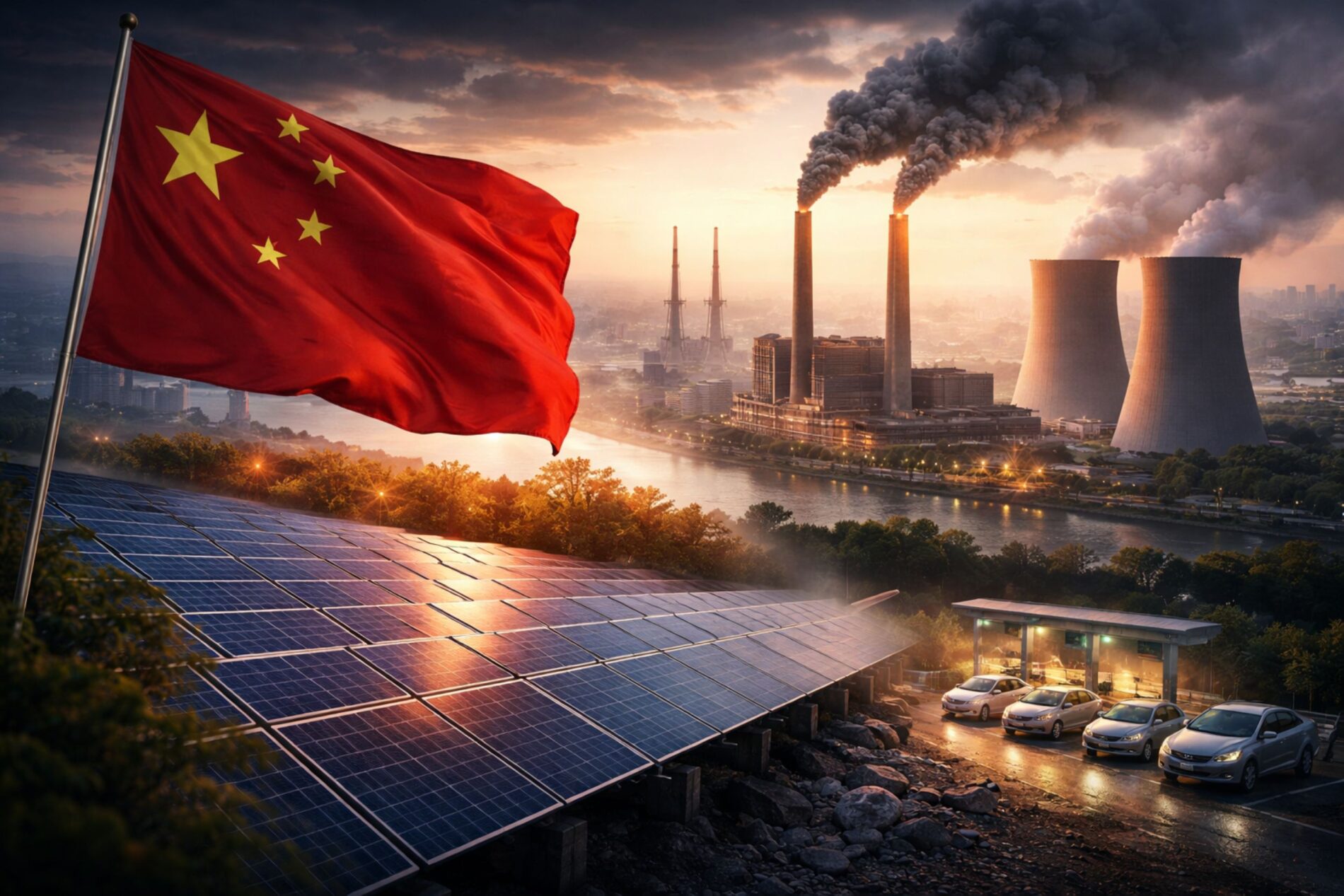
This is particularly evident in the solar industry. After the end of the real estate boom, investors sought new investment opportunities, leading to a significant influx of capital into module production. Capacities were built up in a short time, now far exceeding what the global market can absorb. While this appears to be a sign of strength, it primarily reveals overextension, which is putting a strain on the industry’s economy.
Solar Industry and Electric Cars Under Pressure
The economic consequences of the solar boom are already substantial. According to the International Energy Agency, all segments of the Chinese solar supply chain recorded losses in 2024. Margins were often minus 20 percent or even lower. Furthermore, more than 40 companies went bankrupt, while the industry cut around a third of its jobs. The export success thus masks a deep crisis stemming from overcapacity and cutthroat competition.
Added to this is the inherent contradiction in the manufacturing process itself. According to available data, every Chinese silicon smelter requires its own coal-fired power plant. This is precisely why the production of solar technology relies on fossil fuels. A similar pattern can be observed in the electric car sector. There, too, a great deal of capital flowed in after the real estate crisis, because local governments needed new economic pillars. The automotive industry and its services now account for around one-tenth of China’s gross domestic product.
Nuclear Power Secures the System Behind the Green Window
But pressure is also mounting in the electric car sector. According to one forecast, of the current 129 Chinese brands, only 15 could still be economically viable by 2030. While Chinese buyers account for almost two-thirds of all electric cars sold worldwide, this sales are also based on government subsidies and very low prices. Moreover, the vehicles’ energy balance is less impressive than their image suggests. Battery packs are produced using coal-fired power, and the vehicles are charged in a grid that remains heavily reliant on coal. According to a recent estimate, a Chinese electric car will still produce 85 to 90 percent of the CO₂ emissions of a gasoline-powered car over its lifetime.
This is precisely why the common narrative of the green superpower falls short. China did not become wealthy through austerity, but through its ability to provide large quantities of energy at any time. This is the strategic core of its development. Beijing is rapidly expanding its nuclear power capacity because, unlike weather-dependent sources, it provides a reliable electricity supply. It stabilizes both the grid and industry, while solar power and electric vehicles primarily serve as the visible showcase. China’s long-term energy balance will therefore not be determined solely by export figures or sales records, but by the question of which energy sources truly secure prosperity, production, and supply.