
In Guangdong, in southern China, a pilot plant for a novel hybrid reactor, the “China Initiative Accelerator Driven System,” is currently under construction. This reactor will use a particle accelerator to convert highly radioactive nuclear waste into new fuel. Researchers from the Chinese Academy of Sciences aim to commission the megawatt-scale prototype by 2027. The project addresses a key problem of nuclear power: the need to store highly radioactive waste for extremely long periods. At the same time, the crucial risk factor is considered technically mitigated because the reactor core remains subcritical and the process stops immediately once the accelerator is switched off. If the project succeeds, the required storage period could be significantly reduced, while the utilization of the fuel could be considerably increased. (scmp: 06.03.26)
This is how the new system in Guangdong works
The concept is based on an Accelerator Driven System, or ADS for short. The facility uses a particle accelerator approximately 350 meters long. It bombards a subcritical reactor core with neutrons. Therefore, the reactor cannot sustain the chain reaction on its own, making the system more controllable.
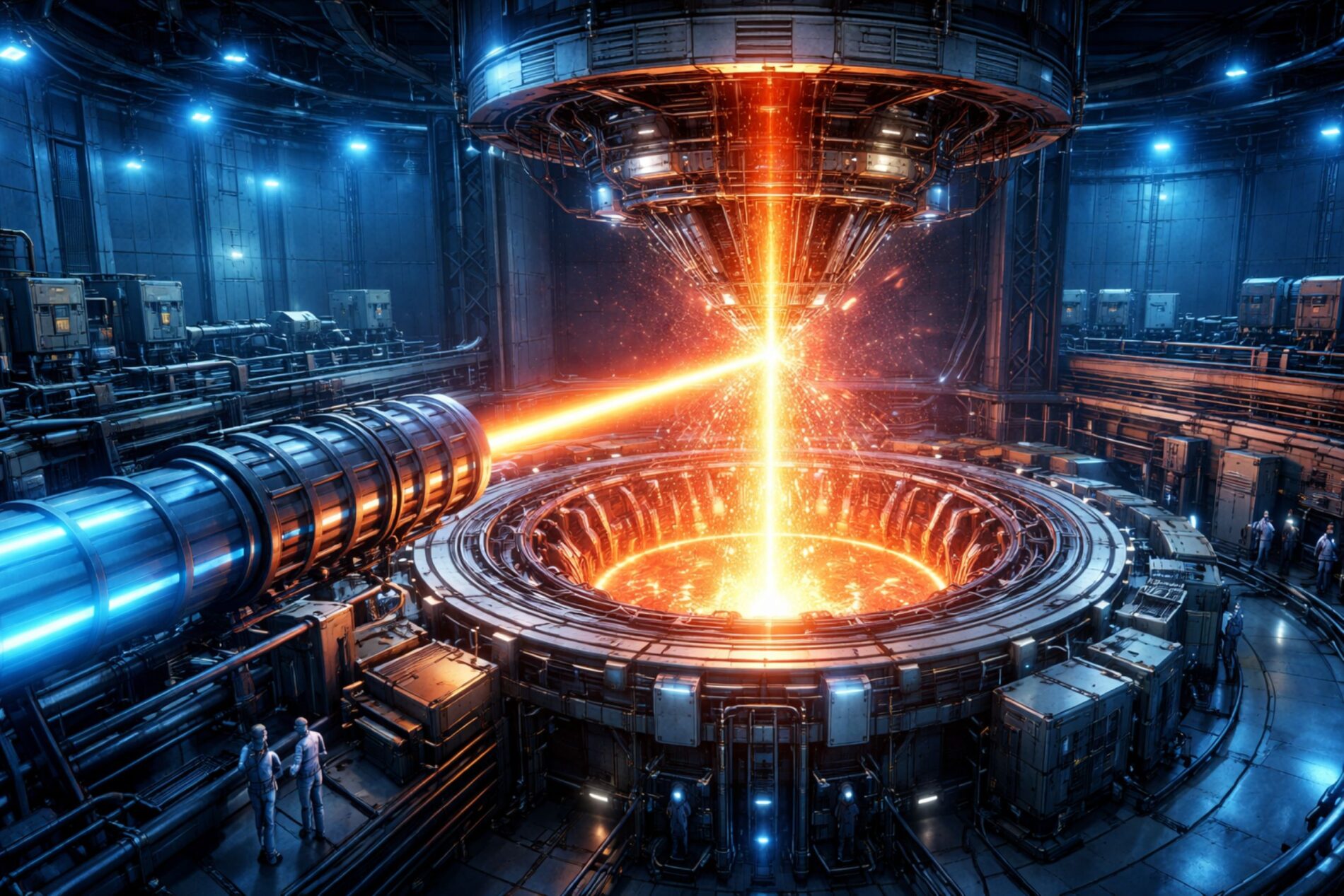
Technically, CiADS relies on a high-current proton beam. A superconducting linear accelerator accelerates it to about 80 percent of the speed of light. The beam then strikes a liquid alloy of lead and bismuth. This releases large quantities of neutrons, which are intended to convert uranium-238 into plutonium-239. A leading researcher describes the goal as follows: “to then convert uranium-238 into the new nuclear fuel plutonium-239 and thus turn ‘waste’ into a treasure.”
Why China is relying on nuclear waste as fuel
The prototype is primarily intended to test transmutation. This refers to the conversion of long-lived radioactive materials into other isotopes that decay more quickly or can be used further. This could theoretically reduce the necessary storage time from tens of thousands of years to just a few centuries. Fuel efficiency would also increase because the system is designed to extract significantly more energy from the available material.
However, the technology is not only intended for disposal. China is explicitly planning a dual-use system that can simultaneously generate electricity. Conventional reactors only utilize a portion of uranium’s energy potential, while the ADS concept aims to convert waste materials into fissile material and thus into usable fuel. Project leaders have very high expectations for this and even speak of a prospect that could secure humanity’s energy needs for the next 1,000 years.
Belgium and the USA are also conducting research, but at a slower pace
Despite its potential, practical applicability has not yet been proven. Worldwide, there are currently no commercially viable ADS facilities, only experimental projects. This is precisely the crucial caveat, as there is a significant technological gap between laboratory success and stable, continuous operation. China is therefore pushing for an early pilot phase, while other countries are proceeding much more cautiously.
In Belgium, a similar but smaller project, MYRRHA, is underway. It is being led by the nuclear research center SCK•CEN, and the accelerator is scheduled to be tested this year. Full reactor operation is not planned until 2036. An ADS project is also being developed in the USA, aiming to reduce the radioactivity of nuclear waste by significantly reducing problematic isotopes. However, the American timeline is far less ambitious, with operational readiness not expected for at least 30 years.