
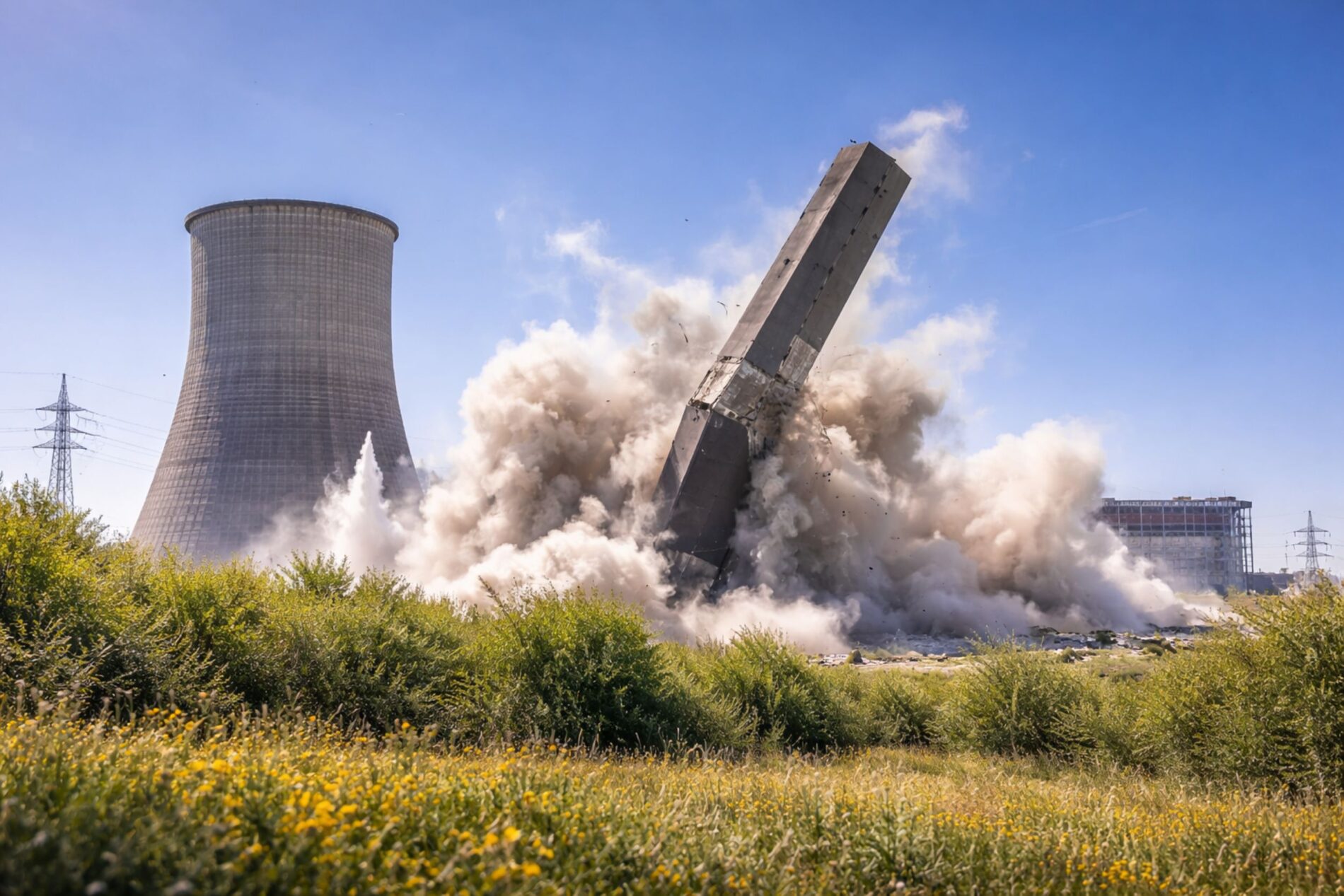
On Sunday, February 22, 2026, the chimney of the coal-fired power plant in Ibbenbüren was demolished, despite gas shortages and the fact that LNG terminals sometimes require icebreakers to clear ice. The demolition affected a plant that had been feeding 840 megawatts of controllable power into the German electricity grid. This controllable capacity is now permanently lost. The key risk factor lies in the loss of guaranteed power while electricity demand continues. The consequences range from additional replacement demand and high investment costs to further price pressure on businesses and private consumers. At the same time, the debate over energy policy is intensifying. (ntv: 22.02.26)
Demolition with 600 Kilograms – and the Grid Gap Remains
Approximately 600 kilograms of explosives were used in the demolition. This not only destroyed a structure but also a piece of secured power generation. The grid must still compensate for the missing power, which is why replacement capacity immediately becomes the focus. As a rule of thumb: 392 wind turbines in the 6-megawatt class would be needed for a theoretical replacement, assuming an availability of 18 percent. This figure is crucial because fluctuating feed-in simultaneously requires reserves, grid connection, and backup power.
The investment costs for this number of wind turbines amount to approximately four billion euros. In addition, around 300 million euros are incurred annually for operation, feed-in tariffs, grid connection, and backup power. Over 20 years, the investment, operating costs, and subsidies thus total approximately nine billion euros, while the coal-fired power plant can no longer emit carbon dioxide. Small and medium-sized enterprises, electricity customers, and taxpayers are expected to foot the bill, which is why the burden is widely distributed. For industry, the electricity price is around 18 cents per kilowatt-hour, which further cements competitive disadvantages in international comparison.
Media hype and background music as reliable power disappears
While some are portraying the demolition as a success, hard facts are simultaneously emerging in the power grid. The Bild newspaper wrote: “With the demolition, a defining chapter in energy history comes to an end and makes way for renewable energy.” The Tagesschau news program rejoiced on the occasion of the cooling tower’s demolition: “Another coal-fired power plant gone!” A video from the demolition company features upbeat music, followed by spontaneous applause.
The bottom line is this: A controllable unit disappears in seconds, but a replacement doesn’t appear at the same speed. Wind and solar power provide energy, but they don’t deliver power at all times, which is why reserve power plants and grid expansion are becoming increasingly important. This is precisely where the systemic conflict lies, because security of supply requires predictable capacity. The demolition in Ibbenbüren thus becomes a symbol, while the costs will drag on for years.
Foreign countries expand coal-fired power generation, thereby reducing costs
China continues to rely heavily on coal-fired power plants because it ensures grid stability. In 2025, around 85 gigawatts of new coal-fired power plant capacity were brought online or put under construction there, equivalent to roughly 100 to 110 power plants of the Ibbenbüren class in just one year. This scale increases the controllable reserve, while Germany is reducing its capacity, thus widening the gap while maintaining guaranteed capacity. Chinese industry pays around 9 cents per kilowatt-hour, which keeps energy-intensive production cheaper there.
India is also pushing ahead with its coal plans because demand is rising due to strong economic growth. In the first ten months of the 2025/26 fiscal year, up to January 2026, around 8.8 gigawatts of thermal capacity were brought online there, almost exclusively coal-fired, which corresponds to about ten power plants like Ibbenbüren. The industrial electricity price in India is around 10 cents per kilowatt-hour, so the cost base remains lower there. In the US, the government halted or postponed the closure of over 17 gigawatts of coal-fired power plant capacity in 2025/2026, keeping roughly 20 units the size of the Ibbenbüren power plant online longer.
Small CO₂ effect – significant impact on Germany’s economic standing
The rationale focuses on climate protection, but the global effect remains limited. Even with a complete shutdown of German coal-fired power plants, global CO₂ emissions will decrease by a maximum of around 0.5 percent. If planned backup gas-fired power plants running on LNG are included, the savings will be only about 0.2 to 0.4 percent, further diminishing the overall effect. CO₂ does not stop at national borders, while production relocations can simultaneously shift emissions abroad.
Germany’s industrial electricity prices are two to three times higher than those of the US and significantly higher than those of China, leading to a greater exodus of energy-intensive industries. When companies leave, added value moves with them, resulting in a loss of economic strength for Germany as a business location. The demolition in Ibbenbüren thus represents not only dismantling, but also a debate about costs and safety, which politically charges every further step.