
Aircraft need energy-dense fuels, which is why batteries will play a minor role for the foreseeable future. Research is searching for alternatives to petroleum-based kerosene. Now, teams at the Joint BioEnergy Institute (JBEI) have reported a breakthrough: They are cultivating microbes that produce precursors for aviation fuel in the laboratory up to 36 times more efficiently than previous strains. This brings synthetic kerosene from biomass closer to industrial-scale production. (newscenter: 29.01.26)
Microbes Turn Isoprenol into a Building Block for DMCO
At the heart of the process is isoprenol, a clear and volatile molecule, because it can be chemically processed into a synthetic aviation fuel. This fuel is called dimethylcyclooctane (DMCO). DMCO has a higher energy density than conventional kerosene and is therefore suitable for long-haul flights. This is precisely where the problem lay for a long time: metabolic pathways are complex, and even minor interventions often have side effects. This combination of reduced speed and increased costs made biofuel precursors unattractive.
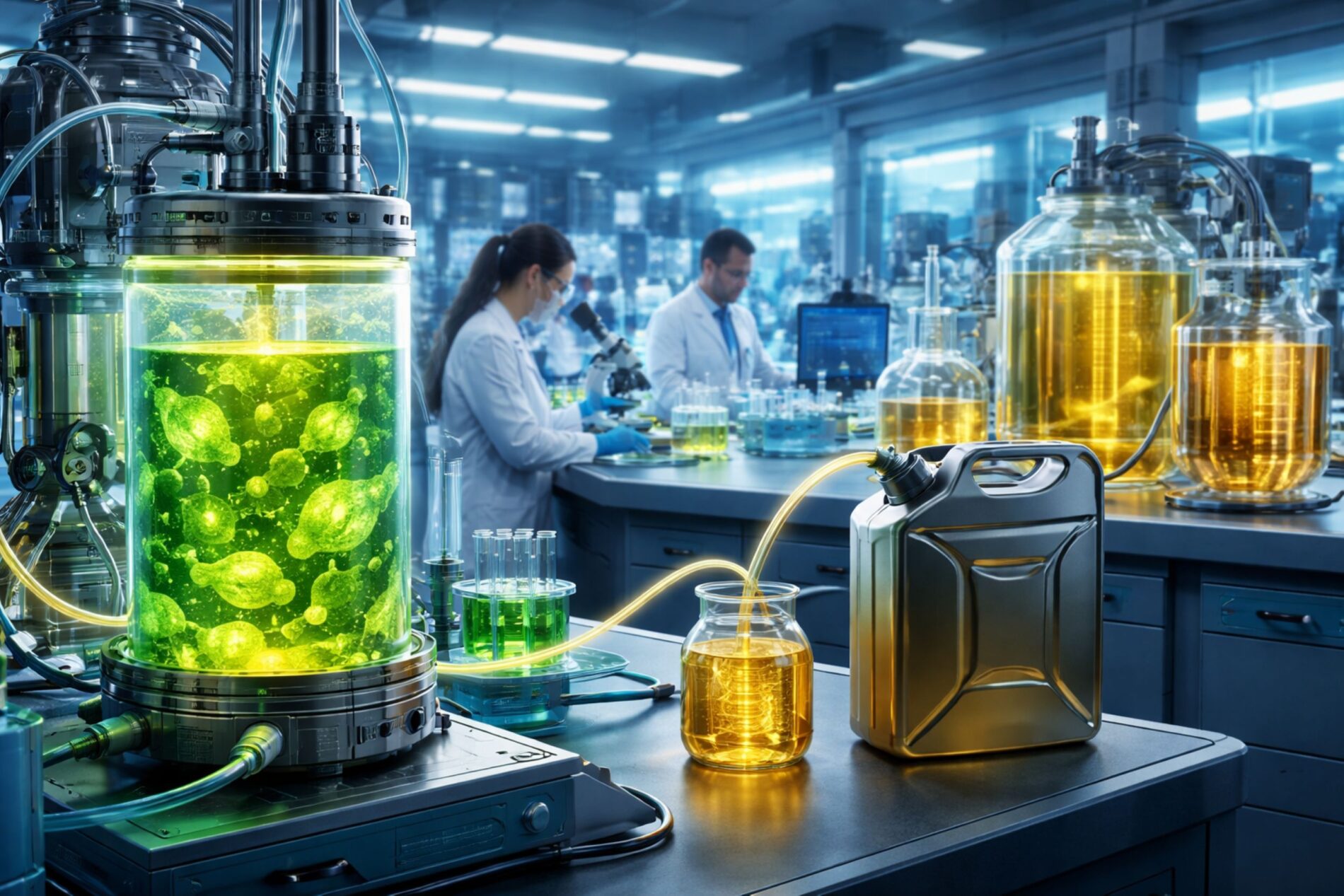
Two recent studies now show how laboratories are drastically accelerating the process while simultaneously increasing the success rate. The JBEI, led by Lawrence Berkeley National Laboratory, combines artificial intelligence, automation, and biological sensing. One team focuses on data-driven optimization, the other on biological discovery. Thomas Eng describes the interplay as follows: “These are two powerful, complementary strategies. One is data-driven optimization, the other is discovery. Together, they offer us a way to progress much faster than with traditional trial-and-error methods,” Eng explains.
AI Pipeline Replaces Trial-and-Error in Metabolism
The AI team led by Taek Soon Lee and Héctor García Martín is building a pipeline that enables robots to generate and test hundreds of genetic variants in parallel. An algorithm reads the measurement data and suggests new gene combinations, instead of relying on intuition from humans. García Martín says, “Standard metabolic engineering is slow because it relies on human intuition and biological knowledge.” He adds, “Our goal was to make strain improvement systematic and rapid.”
The team uses CRISPR interference as a tool, because it allows researchers to selectively throttle genes instead of completely switching them off. This makes subtle metabolic effects visible and prevents total damage to the cell’s metabolism. After six development cycles of just a few weeks each, isoprenol production increases to about five times that of the initial strain. Here, microbes provide the raw material for a new development cycle in the lab.
Biosensors Turn a Problem into a Selection Tool
The second team encountered an obstacle, but it became a lever. The bacteria Pseudomonas putida produced isoprenol and then quickly broke it down again. At first, this seemed like self-sabotage. Then Eng reversed the logic: If the cell “detects” isoprenol, there must be a protein that recognizes it. “That was a real aha moment,” said Eng. “Wait a minute, if they can perceive it, there must be a protein that recognizes it. Maybe we can turn the problem into a tool.”
The researchers identified a sensor system consisting of two proteins and built a biosensor from it, so that each cell emits its own isoprenol production as a signal. The stronger the signal, the better the yield. The team then coupled the signal to genes essential for survival. The result is simple: Only top producers continue to grow. This allows millions of variants to be quickly screened, and microbes are transformed from a production risk into a measuring instrument.
What the results mean for industrial fermenters
The end result is “champion” strains that produce up to 36 times more isoprenol than the original microorganism, with both methods demonstrating distinct strengths. The AI pipeline optimizes known parameters in a targeted manner. The biosensor uncovers unexpected parameters. The studies were published in Nature Communications and Science Advances.
The next test is scaling up to larger fermenters, because only then do stable yields and costs per liter truly matter. Laboratory data are only convincing if they hold up under industrial parameters. García Martín outlines the potential consequences: “If these approaches become widespread, they could reshape the industry. Instead of needing a decade and hundreds of people to develop a new bioproduct, small teams could achieve this in a year or less,” he explains.