
Carbon dioxide is produced in many industrial processes and remains available as a raw material. At the same time, aviation, shipping, and parts of the chemical industry still require liquid energy carriers. Electricity alone often cannot cover these applications because energy density, storage, and existing infrastructure play a major role. A new study from China now describes a laboratory method for converting CO2 into an important precursor for synthetic fuels using sunlight and water, and the results are significantly better than those of many previous approaches. (smartup-news: 09.02.26)
Why CO2 as a raw material for fuels is once again coming into focus
The basic idea is old, but the technology remained too weak for a long time. Plants use sunlight to build energy-rich compounds from carbon dioxide. Researchers have been trying to artificially replicate this very principle for years. However, many systems failed due to unstable reaction processes and low yields. Now, a new component has been added that makes the process more controllable because a charge storage system keeps electrons available in a targeted manner.
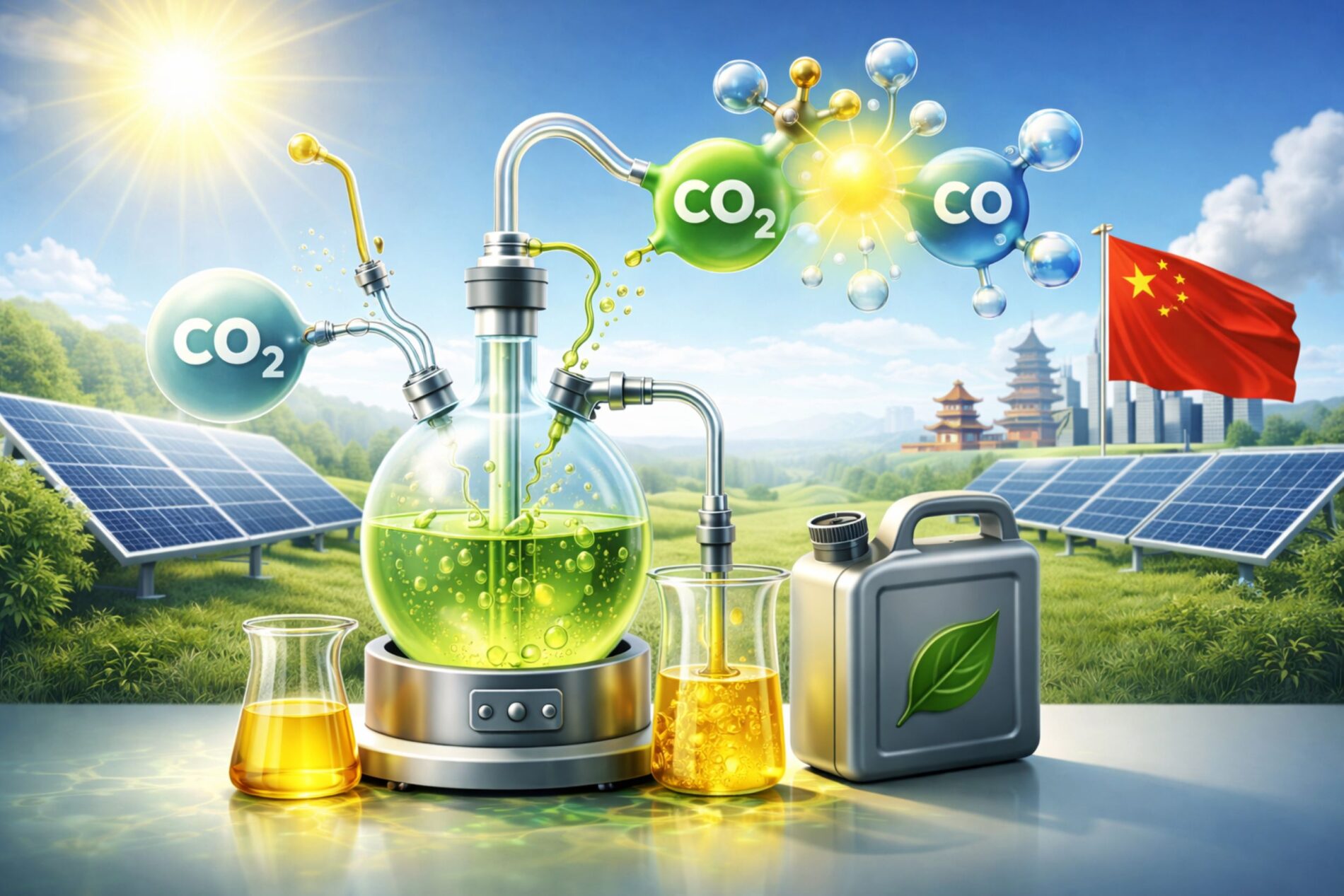
In the lab, two steps must align perfectly, and this is considered a challenge. On the one hand, CO2 must be reduced. On the other hand, water must serve as an electron donor. Many processes require additional chemicals or an external energy input for this, but the new approach relies on sunlight as the sole energy source. This makes the concept interesting because it aims to generate molecules directly from light and simple starting materials.
The technical core – silver-modified tungsten trioxide as an electron buffer
The process was developed by a team from the Chinese Academy of Sciences and the Hong Kong University of Science and Technology. At its heart is a material made of silver-modified tungsten trioxide. It performs a storage function, similar to that of an electron transport molecule in plants. Under the influence of light, the material absorbs electrons, stores them temporarily, and releases them in a controlled manner. This ensures that sufficient charge remains at the reaction sites to prevent the CO2 conversion from stopping.
The direct product is carbon monoxide. In industry, this gas is an important feedstock for synthesis gases. In further process steps, liquid fuels, including precursors to gasoline or kerosene, can be produced from synthesis gases. This approach therefore focuses not on exotic laboratory products, but on an established intermediate component that fits into existing process chains.
Laboratory measurements – significantly higher yield than comparable systems
The study provides measurable data and goes beyond the concept paper stage. Approximately 1.5 millimoles of carbon monoxide are produced per gram of the material used per hour, and this value serves as a performance measure for the system. Even more important is the comparison, as the yield is expected to be around one hundred times higher than in similar processes without the electron storage device. The reaction runs exclusively on sunlight, so no external power source is required.
The system also remains lean in terms of the materials used. Only water and carbon dioxide are needed, eliminating the need for additional chemicals that would have to be consumed and later disposed of. Among other things, the researchers used cobalt phthalocyanine in combination with tungsten oxide as a catalyst. However, the most important factor is the effect of the memory, because it stabilizes the process and increases the chances of a successful response.
What the charge storage system achieves chemically and where its limitations lie
Chemically speaking, the tungsten oxide switches between two oxidation states during the reaction. This reversible switch acts as a buffer because electrons are not immediately lost but are “parked” within the structure. It is precisely such losses that have hampered many artificial photosynthesis systems to date. Furthermore, the study shows that the performance gain is not limited to a single catalyst but also increases significantly with other active components.
The authors describe it as a “bio-inspired strategy for the efficient photochemical reduction of carbon dioxide” and a “universal approach for the production of solar fuels.” At the same time, the classification remains clear, as this is laboratory research. Statements regarding costs, production volumes, or industrial implementation are not yet available. Nevertheless, the process demonstrates a potential way to convert CO2 into an industrially relevant building block for synthetic fuels using sunlight.