
In 2014, the Chancellor’s Office needed up-to-date images from space. Russia had annexed Crimea. Therefore, the German government wanted to know whether Russian forces were operating covertly in eastern Ukraine. They were looking for evidence of troop movements. Equipment and supply routes were also important. For this, the Federal Intelligence Service (BND) needed external providers, but these failed to deliver for days. A dedicated satellite was intended to close this gap. The goal is independence, but reality remains elusive, as Project Georg has been dragging on for years and its launch has been repeatedly postponed. (heise: 13.01.26)
Satellite as a National Project – Deadlines Slip, Statements Remain Vague
The name “Georg” has stood for a national reconnaissance project for years, but the timelines are crumbling. Internally, the initial launch was planned for 2022, later followed by 2024 and 2025. Now, the target is simply “sometime in 2026,” while concrete dates are lacking.
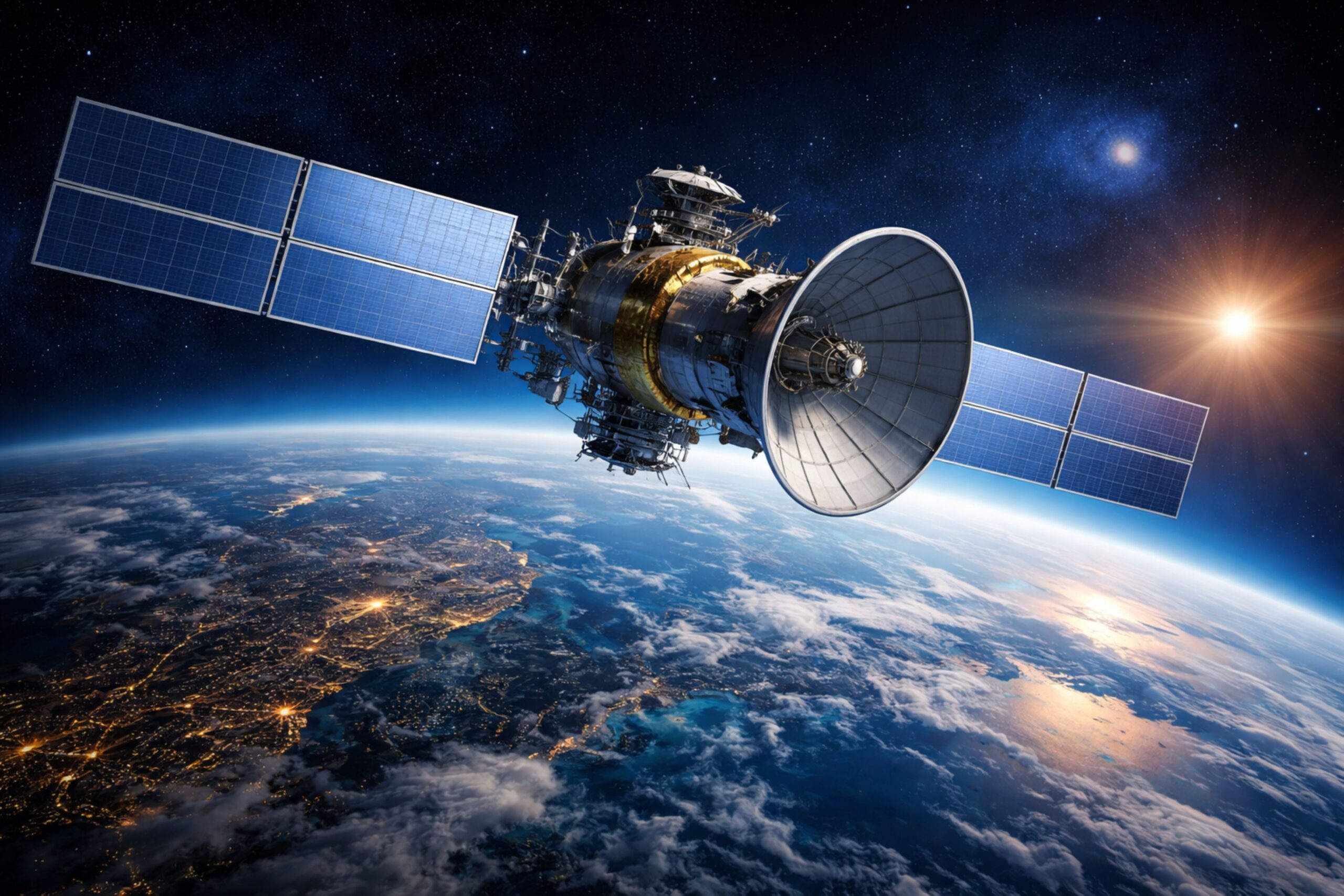
Publicly, the government cites secrecy, citing the jurisdiction of parliament and security bodies. Behind the scenes, the tone is more subdued than before, although expectations remain high. A former head of the BND (Federal Intelligence Service) also spoke of production delays, further narrowing the scope for action.
German Armed Forces’ experience with OHB – technical flaws reduce lifespan in orbit
The biggest warning comes from another program, as the German Armed Forces ordered their own space-based reconnaissance systems from the same manufacturer. Radar systems were launched into orbit in 2023, but two units initially remained inoperative. The antennas failed to deploy, and the mission hung in the balance.
The manufacturer only salvaged the situation after risky maneuvers, but these interventions consumed a significant amount of fuel. This reduces the expected operational time, and this is precisely the scenario the Chancellor’s Office wants to avoid with the Georg project. Another satellite must not end in a costly failure; otherwise, the political signal would be disastrous.
BND Remains Dependent – Data Purchases Instead of In-House Optics
Financially, the project is already substantial, yet the foreign intelligence service continues to rely on interim solutions. The BND uses data from the German Armed Forces, equipment from partner agencies, and purchases from commercial providers. While this practice delivers results in the short term, it doesn’t replace its own chain of sensors, analysis, and prioritization.
Especially in espionage, speed is crucial, and situational awareness is often needed within hours. Those who depend on partners then lose control over resolution, timing, and availability. Therefore, the pressure remains high to launch its own optical reconnaissance satellite into space, even if the technology undergoes longer testing on the ground.
Space Security and Launch Issues: SpaceX Fills a European Gap
Strategically, space is becoming increasingly important, as Germany aims to better protect critical infrastructure and military capabilities in orbit. The new approach to space security focuses on developing its own networks, more resilient systems, and reducing dependence. The goal sounds clear, but its implementation clashes with the lack of European heavy-lift launches.
Therefore, a launch with SpaceX is considered a realistic scenario, even though it appears politically inconvenient. Europe cannot currently reliably launch every payload into space itself, and this hinders its sovereignty. Anyone who is serious about space security must not only build sensors but also strengthen launch systems; otherwise, its options will remain limited.
Costs, Control, Consequences – Why the Chancellor’s Office Prefers to Wait
A risk assessment prevails in the Chancellor’s Office, because a failed launch would destroy both trust and money. It’s better to delay Georg than to have a complex orbiter fail after just a few months. This caution is understandable, but it prolongs dependence on SpaceX for daily intelligence gathering.
At the same time, there’s a growing expectation that the BND (Federal Intelligence Service) will be able to provide its own intelligence more quickly in crisis situations and that Germany won’t have to constantly rely on SpaceX. As long as Georg remains unlaunched, the balance sheet remains ambivalent: high costs, limited autonomy, and a project that is politically considered a benchmark for modern space security.