
At the beginning of February, the water level of the Baltic Sea dropped unusually sharply, by 67 cm below normal. At the same time, approximately one-third of the Baltic Sea is frozen over with a remarkably thick layer of ice. Researchers describe this as a rare weather anomaly because wind and air pressure have a particularly direct impact in this region. As a result, ports, shipping, and sensitive habitats on the seabed are all under stress. (tvpworld: 13.02.26)
Why the Baltic Sea suddenly seems so empty
Researchers at the Institute of Oceanology of the Polish Academy of Sciences report an average water level of around 67 centimeters below normal during the first weeks of February. This is the lowest level recorded since 1886. And the magnitude is enormous, as the deficit corresponds to approximately 275 cubic kilometers of water.
This amount can be made more tangible through comparison, as it roughly corresponds to the annual rainfall of the United Kingdom. However, for coastal areas, it’s not just the quantity that matters, but its practical impact. Shallower approaches make maneuvering more difficult, causing local disruptions to port and cargo operations.
Wind, High Pressure, and the Wind Set-Down Effect
The primary driver is not the rainfall itself, but the air currents over the basin. Strong winds push water through the Danish Sound towards the North Sea, while a high-pressure system simultaneously promotes stable conditions without strong fronts. This creates a typical constellation that meteorologists describe as a “wind set-down.”
In this process, water doesn’t disappear from the system; instead, it shifts within the Baltic Sea. Water accumulates at distant ends, while levels in other zones drop rapidly, even though the total volume remains the same. This dynamic is precisely what makes the event so critical, as local bottlenecks can quickly become problematic.
The researchers also emphasize that other explanations are not applicable here. The statement reads: “It is not a lack of precipitation or a ‘drying up of the sea’ due to reduced river inflows” that triggered the phenomenon. They add: “The Baltic Sea has very little natural water inflow or outflow from the land; therefore, wind and pressure have a much greater influence.”
Consequences for Ships and Oxygen on the Seabed
The low water levels primarily affect shipping, as shallow approaches and channels offer less leeway. This is especially true in areas where every decimeter counts, while larger sea areas often appear harmless. Nevertheless, individual ports may have to make last-minute changes because safe drafts cannot be guaranteed everywhere.
At the same time, another problem is intensifying: falling water levels can reduce oxygen on the seabed. Mussels, worms, and other benthic organisms live there, and they require stable conditions. When oxygen levels drop, the risk of localized disruptions increases, potentially altering entire microhabitats.
More ice than usual – and an official ice path in Estonia
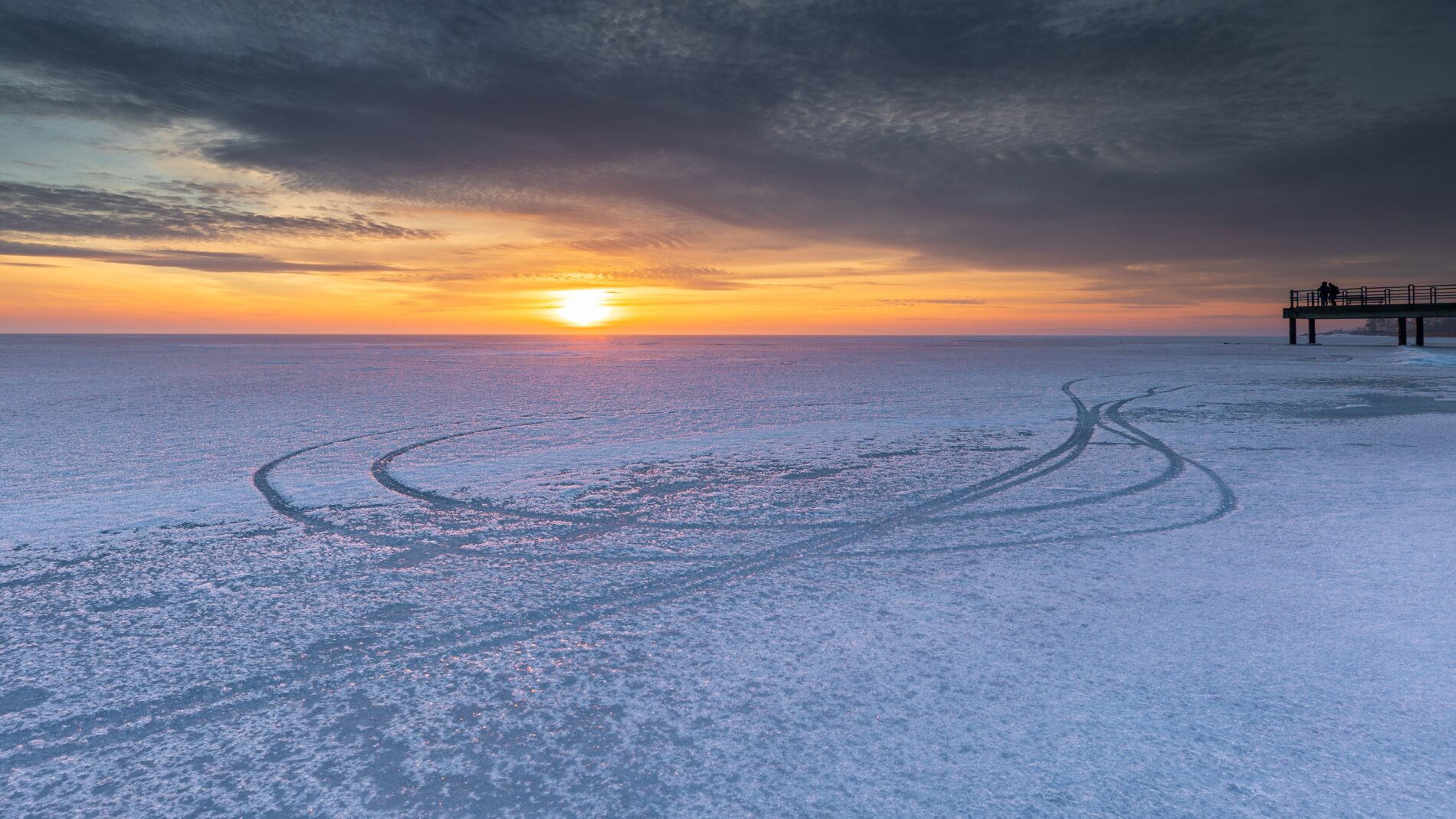
A record low water level coincides with a prolonged cold spell since the beginning of January, causing the Baltic Sea to freeze over significantly more than usual this winter. According to the Finnish Meteorological Institute, ice covers approximately one-third of the entire Baltic Sea. The ice is particularly thick in the Gulf of Finland, where depths of 10 to 40 centimeters have been reported – the most in 15 years.
Estonia responded pragmatically by opening an official ice path last week. It is 17 kilometers long and connects two islands, suddenly making it possible to travel across the frozen sea. However, authorities are explicitly warning against walking on the ice, as weaker areas exist and cracks can form under pressure.