
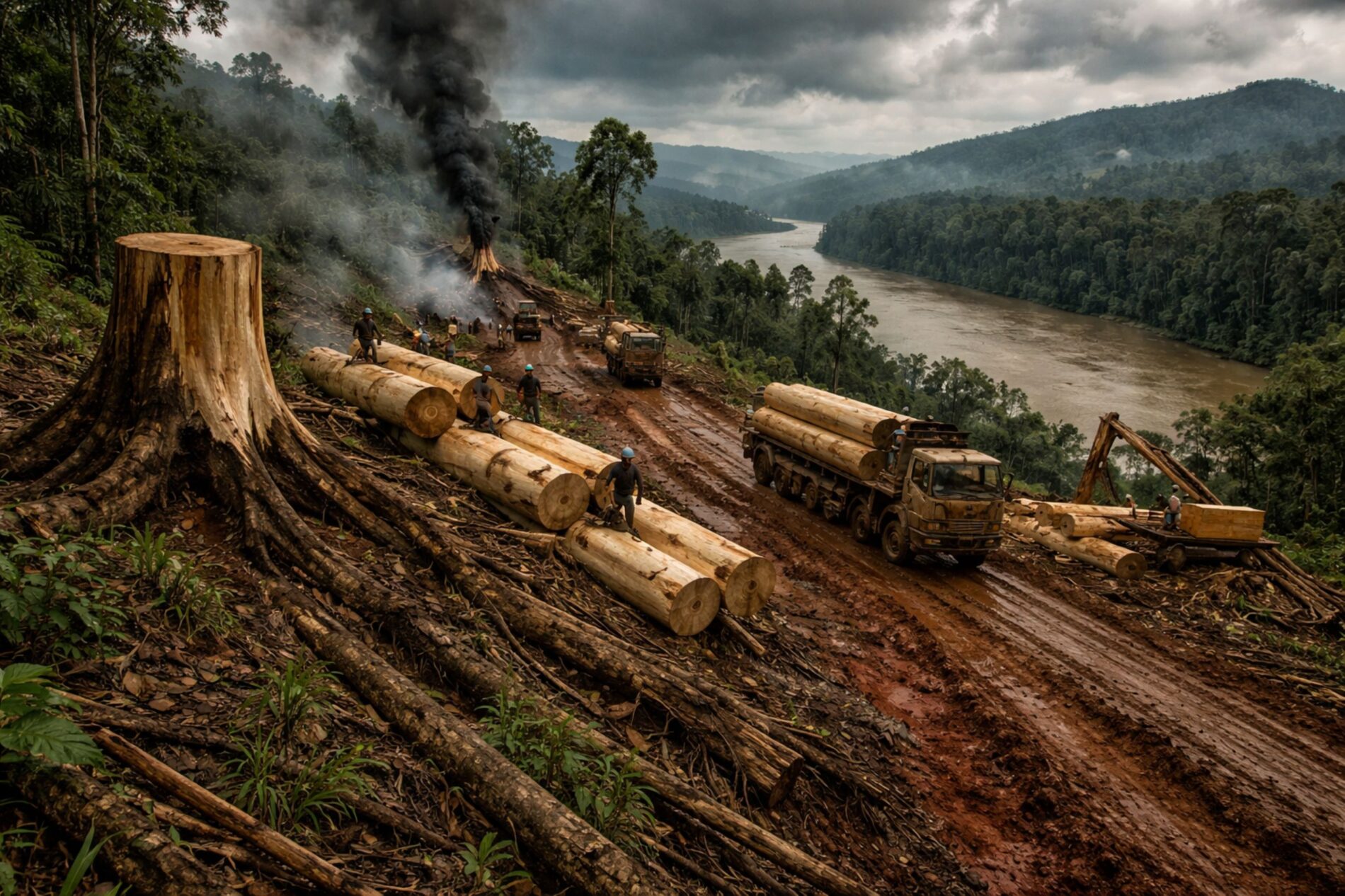
In the Amazon region, particularly in Ecuador, an estimated 500,000 balsa trees have been illegally harvested from natural forests every year since the beginning of this decade. The global wind power industry requires large quantities of balsa wood for rotor blades. The trigger is the sharply increased demand for rotor blades. Sustainable plantations have long been unable to meet this demand. As a result, logging is shifting into intact rainforest areas and indigenous territories, which constitutes the decisive risk factor. The consequences range from severe disruption to fragile ecosystems to increasing pressure on protected areas. Furthermore, local communities and large forest areas in regions considered the last remaining intact landscapes in the country are coming under strain. (dailysceptic:17.03.26)
Balsa wood is driving deforestation in the rainforest
The material remains indispensable for many rotor blades, even though it only makes up one part of the overall structure. According to calculations, up to 40 trees are needed for a set of three rotor blades. At the same time, around 55 percent of commercial balsa production is used in the construction of wind turbines. Therefore, the demand for this raw material has risen sharply with the global expansion of the industry.
Ecuador exports the majority of the world’s traded timber. In recent years, production has typically hovered around 500,000 cubic meters, or approximately 80,000 tons, per year. Around 2020, the volume jumped significantly, while previous sustainable volumes were considerably lower. Estimates for 2021 project exports of 80,000 to 100,000 tons, 60,000 to 80,000 tons for 2022, and 50,000 to 80,000 tons each for 2023 and 2024.
Plantations no longer sufficient
The real crisis began when existing plantations could no longer meet demand. Investigators from the Environment Investigation Agency concluded that exports from illegal logging in pristine rainforests increased by up to 50 percent. Exporters are accused of exploiting natural forests as a “convenient and readily available substitute” after older plantation stocks were rapidly depleted.
The geographical extent of the problem is particularly alarming. According to the investigation, traders reported that the logging is taking place “from north to south in most of the country’s Amazonian provinces.” Furthermore, at least 50 percent of production is now believed to originate from illegal sources. This percentage varies between 10 and 70 percent, depending on the exporter. In 2020 alone, 20,000 trees were illegally felled in the Achuar territory along the Copataza River between March and September, and estimates in some regions indicate losses of up to 75 percent of the forest stock.
The ecological damage continues to grow
If one calculates the turbine demand with known production data, the result is an annual consumption of more than one million trees. Even if only half of this is attributed to illegal logging, approximately 523,810 mature trees still disappear from natural forests each year. Even if this figure remains controversial, it nevertheless illustrates the scale of the problem and significantly exceeds other individual deforestation projects that have garnered considerable international attention.
Although manufacturers are now attempting to partially replace balsa wood with synthetic foams, the raw material remains in use in critical areas of many rotor blades due to its favorable strength-to-weight ratio. Hybrid designs are increasing, while the wood continues to offer advantages in areas of high shear stress. Therefore, the consumption of balsa wood remains high. As a result, with each new turbine series, the strain on rainforests, biodiversity, and indigenous habitats increases.