
Ahead of the state elections on March 8, 2026, Baden-Württemberg is heading towards a pattern that has eroded the Ruhr region for decades: too much prosperity from a single leading industry, too little buffer against the collapse of the entire value chain. Back then, coal and steel were driven out of the market; today, the automotive industry, along with its network of suppliers, is experiencing an erosion that is costing first orders, then investments, and ultimately, production sites. The triggers are plummeting revenues from combustion engines and an electric vehicle ramp-up that is taking hold more slowly than planned, while at the same time sales and profits are collapsing in the Chinese and US markets. In China, competition is carving out the market, and the US is protecting its market with tariffs. The setting is a highly industrialized country with global brands, yet municipal finances and employment are heavily dependent on this sector. Baden-Württemberg’s economic output fell by 0.4 percent in 2024, insolvencies rose by 30 percent to 2,445 cases, and the unemployment rate climbed to 4.8 percent by January 2026. If this line holds, then the southwest will not lose “image”, but industrial substance – like the Ruhr area, only quieter and even faster.
The Ruhr region as a benchmark: Monoculture erodes resilience
The parallel lies in the monoculture, because one leading industry overshadows everything else and thus concentrates risks. In Baden-Württemberg, industry contributes 38.1 percent to gross value added, while the federal government only achieves 28.5 percent. This makes the region efficient, but also vulnerable. Robert Lehmann from the Ifo Institute, referring to US tariffs, speaks of a classic example of a German state where external trade shocks immediately impact production and employment. When export markets fluctuate, it’s not just sales that fluctuate here, but stability.
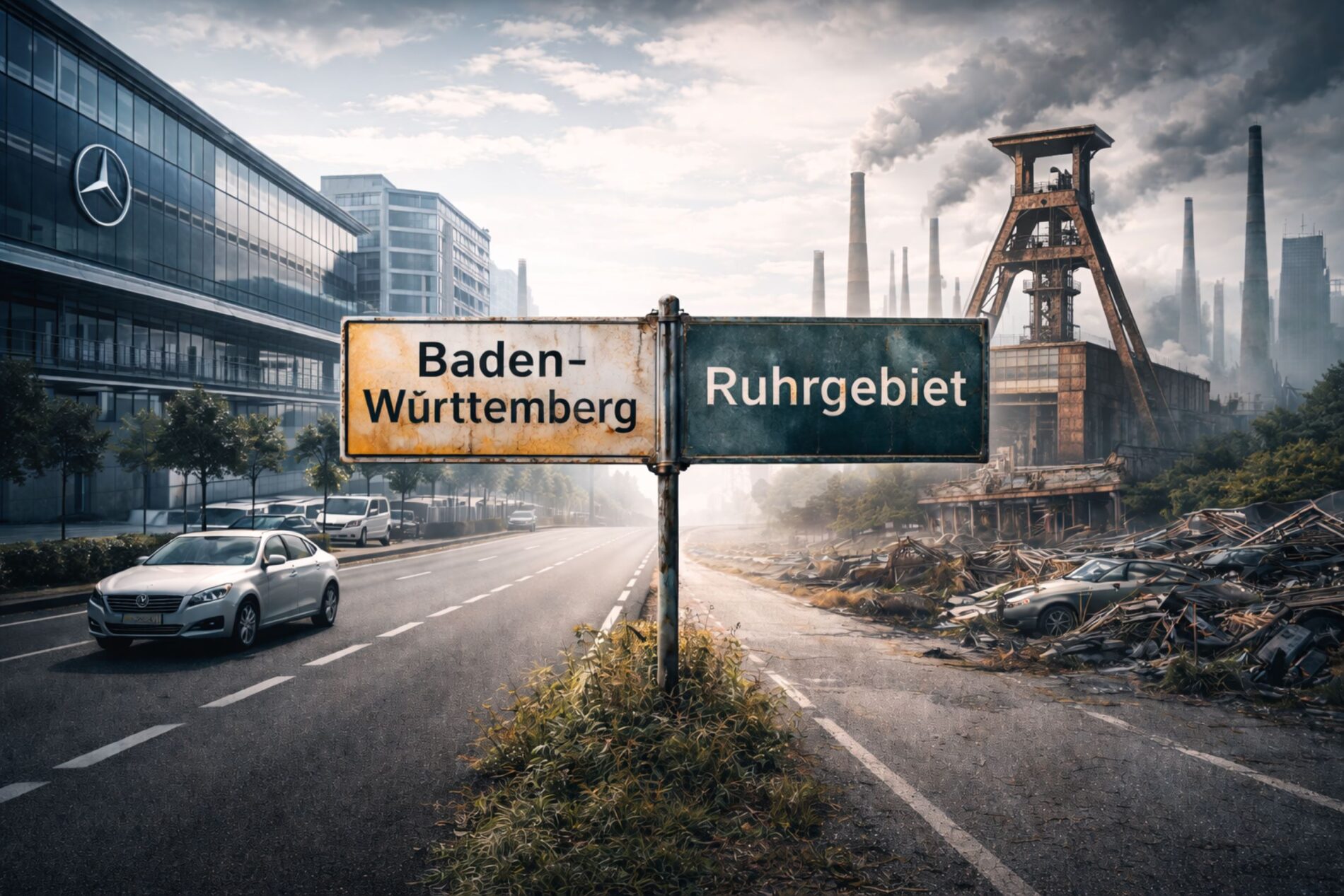
As in the Ruhr region, not only direct employment but the entire surrounding sector depends on the leading industry. Tools, logistics, engineering firms, and skilled trades depend on orders and projects. If these orders dry up, planning collapses first, followed by the very foundation. This is precisely what made the decline in the Ruhr region so protracted and so costly.
When the big players cut costs, the network behind them collapses
The major manufacturers set the course because they define production volumes, platforms, and development contracts. Mercedes-Benz and Porsche have to adjust costs and model programs while simultaneously reorganizing their powertrain and software strategies. The major suppliers Bosch, ZF, and Mahle are dependent on these decisions because they have to restructure product lines and reallocate capacities. When development budgets shrink, so does the pipeline for suppliers, and this hits the region faster than many expect.
This structural shift doesn’t feel like a mere economic downturn, but rather like a shift in value creation. Parts are eliminated, platforms are standardized, and vertical integration decreases. This fits the Ruhr region pattern, because not only are jobs disappearing, but entire areas of expertise are losing importance.
China as a sales black hole – without a profit anchor, restructuring will be brutal
The critical point is the loss of sales in China. If German manufacturers sell less there, they lack the profit contributions that previously financed restructuring efforts. Therefore, cost-cutting programs are more stringent, while investments are more selective. This increases the pressure on locations in southwest Germany, because fixed costs remain high and profit targets still apply.
As a result, the risk shifts from individual plants to entire regions. If China is no longer a market for volume and margins, then every structural flaw in the domestic network becomes visible. That is the moment when a leading industry becomes a liability.
Insolvencies and Succession – The Silent Side of the Ruhr Area Effect
Insolvencies rose by 30 percent in 2024 to 2,445 cases, the highest figure since 2010. Such numbers are more than just statistics because they represent the loss of value creation across the region. Cornelius Pleser, who liquidates company assets, says: “Ten years ago, there was significantly more capital in the market, and investors or successors were often found within the framework of insolvency proceedings.” Today, the process more frequently ends in closure, resulting in the loss of expertise.
This erosion is also evident in the labor market. The unemployment rate rose from 3.9 percent (January 2023) to 4.8 percent (January 2026), while job vacancies fell by 30 percent compared to 2022. By 2030, 14,000 jobs are expected to be lost in the automotive industry alone, which is why the downturn has a structural impact. IG Metall state chairwoman Barbara Resch says: “The situation is very tense,” and she warns: “Demand isn’t coming in now, and at some point, they’ll simply run out of money.”
Election on March 8 – Accelerate restructuring or manage erosion?
Economists warn against artificially maintaining old structures, which is why politicians are under pressure. IWH President Reint Gropp says: “We have to allow a process of predatory competition in which new ideas displace the old ones.” At the same time, business leaders are demanding investments in networks, rail, and roads because no new industry can scale without infrastructure. The federal government is planning a fund of over 500 billion euros, with 13 billion euros earmarked for Baden-Württemberg. However, Hanno Kempermann, managing director of the business-oriented consulting firm IW Consult, calls this “a drop in the ocean.”
The comparison to the Ruhr region therefore remains more than just dramatic rhetoric. If Baden-Württemberg clings to its automotive monoculture for too long and delays the restructuring, then structural change will become a permanent loss. That would be the same path as before, just with a different industry.
Whoever loses now loses permanently
The Ruhr region shows how difficult it is to return to broad industrial strength once chains break. Baden-Württemberg has innovation and research, but ultimately, what counts is scaling up into jobs and added value. When bankruptcies, job cuts, and a backlog of investments coincide, a region doesn’t collapse overnight. It gradually weakens. (KOB)