
The terrorist attack on a cable bridge in southwest Berlin led to a widespread power outage. Repairing the damaged connection took several days. During this time, numerous residents in Steglitz-Zehlendorf had to manage without electricity, and in many places, the heating also failed. Because the attack struck a central connection in Berlin’s power grid, the consequences were particularly severe – making it all the more concerning that the federal government, by its own admission, has no overview of comparable critical nodes in the entire German power grid. (tagesspiegel: 26.01.26)
Terrorist attack exposes weaknesses in network transparency
Following the incident, Green Party MP Alaa Alhamwi submitted a parliamentary inquiry regarding network security. He wanted to know whether the German government was aware of any vulnerabilities in the German electricity grid resulting from a lack of (n-1) security. This concerns areas where the failure of a single network element can trigger major supply disruptions. According to the Tagesspiegel newspaper, the Federal Ministry for Economic Affairs and Energy responded unequivocally: “The Federal Government, and in particular the responsible Federal Network Agency, has no figures on how many end customers are not connected with (n-1) security.”
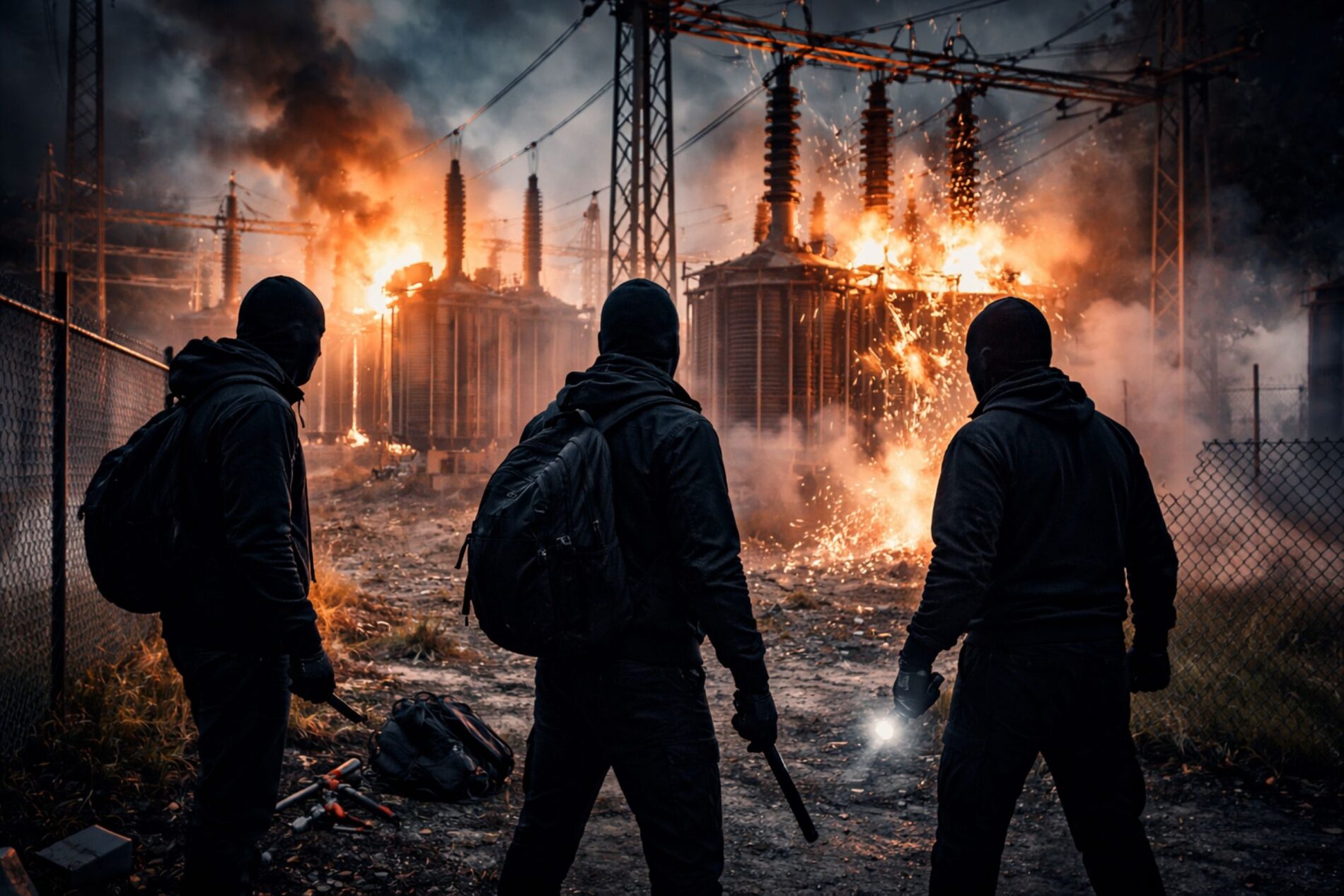
This means that a reliable overview is lacking precisely for a key risk. At the same time, it remains unclear which regions are particularly vulnerable if a component fails or is sabotaged. The ministry nevertheless points to a fundamental planning logic within the grid. According to this logic, the principles for the extra-high and high-voltage grids stipulate “that 100 percent of customers must be connected with n-1 redundancy.”
However, the situation changes with each grid level. According to the federal government, the number of end customers without this redundancy increases with decreasing voltage. This primarily affects medium and low voltage, i.e., the part of the infrastructure that directly supplies households and many businesses. It is precisely at this level that it is determined in a critical situation whether a fault remains localized or spreads.
(n-1) Principle: High Standard, but Not Mandatory Everywhere
The (n-1) principle is considered a core rule of grid planning. It requires that the system remain stable even if a single component fails. If, for example, a transformer or a circuit fails, the supply must continue via alternative routes. The goal is to prevent a disruption from escalating and spreading in a cascading manner.
This standard ensures a high degree of robustness in the transmission network. Nevertheless, there is no complete protection against targeted attacks, as the terrorist attack in Berlin demonstrated. Furthermore, the requirement is not universally mandatory. Below the high-voltage level, (n – 1) planning is not mandatory in the medium and low-voltage networks.
This creates a structural risk. Redundancies at these levels depend more heavily on local infrastructure and operator decisions. Consequently, the security of supply can vary significantly from region to region, even though the impact of a failure on those affected is similarly severe. The Berlin blackout made this clear, as a damaged connection affected large parts of a district in a short period of time.
The attack is attributed to the far-left “Vulkangruppe” (Volcano Group). It led to the longest blackout in Berlin’s post-war history, and at one point, up to 100,000 residents were without electricity and heating. Since then, the debate about protecting critical infrastructure has intensified. At the same time, the question of where critical nodes are located in the network, whose failure would immediately cause major damage, is becoming more prominent.
Government Refers to Operators – Criticism from the Bundestag
The German government’s response focuses on the responsibility of the grid operators. It is the companies’ responsibility to design the electricity grid according to the applicable planning principles. However, it remains unclear how systematically vulnerabilities are identified and how consistently compliance is monitored. These very questions, however, determine whether risks are merely known or actually reduced.
Alaa Alhamwi sharply criticizes the federal government’s stance. “It is disastrous that the federal government apparently has no overview of the vulnerabilities in the German electricity grid. Instead of systematically analyzing them, it is shirking its responsibility and referring the matter to the grid operators,” he told the Tagesspiegel. The Berlin terrorist attack was a warning signal, and the federal government must ensure “resilient and effectively protected electricity grids.”
The conflict thus revolves around responsibility and control. Without knowledge of critical nodes, it is difficult to prioritize protective measures. Without data on the lack of (n-1) security, it is impossible to properly assess risks. Alhamwi therefore warns of the consequences for the country and its population. If the federal government remains inactive, it will jeopardize the “energy security of people and businesses” in Germany.