
The 2026 federal budget allocates €31 billion for energy and climate subsidies, including €17 billion for the former EEG surcharge and €6.5 billion to mitigate grid fees. Since 2023, this funding has been provided through tax revenue instead of a surcharge on electricity bills, because the subsidy commitments continue to tie up funds. The decisive risk factor remains the growing fixed cost structure of grid expansion, levies, and balancing costs, which keeps electricity prices high and puts a strain on Germany’s economic competitiveness.
Financing in the Federal Budget: Changeover Without Relief
In 2004, Environment Minister Jürgen Trittin said that the energy transition would cost a family only “the price of an ice cream cone” per month. By 2021, payments via the EEG surcharge had totaled €478 billion; later, this figure rose to over €500 billion. The financing changed in 2023 and was no longer passed on to electricity prices because policymakers removed the surcharge from the billing process and transferred it to the general budget.
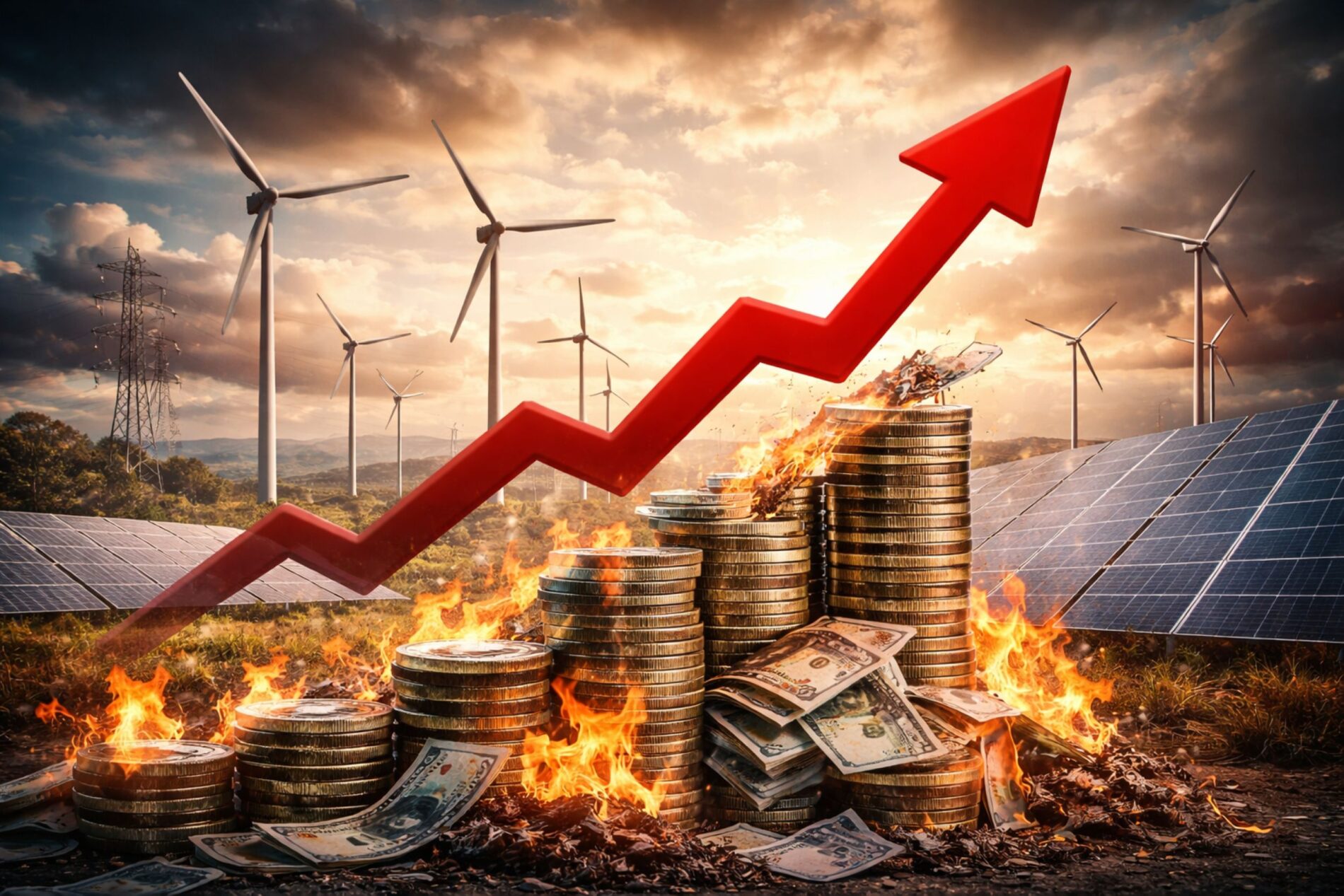
Guaranteed feed-in tariffs for wind and solar power created a gap with market value for years because payments are not tied to the market price. This gap remains costly because the contracts continue for years to come. The government fills it from the budget, so the costs ultimately disappear into the electricity price, and the taxpayer has to foot the bill.
Electricity prices remain high because levies dominate
Households in Germany pay around 39 cents per kilowatt-hour. In France, the price of electricity is about 27 cents, in the USA around 17 cents, and in China about 7 cents. The price remains high even though only about 16 cents go toward procurement. The rest consists of network charges, taxes, levies, and surcharges.
The war in Ukraine made gas more expensive, which is why procurement costs rose sharply at times. Nevertheless, the structural problems persist because households were already paying over 30 cents before 2022. The nuclear phase-out in 2011 shifted the supply situation because reliable baseload power was lost and the need for reserve power increased.
System costs are rising because weather-dependent power generation necessitates balancing
In 2010, power plant capacity was around 160 gigawatts; by 2024, it had reached almost 290 gigawatts. Despite this increase, electricity production fell from 588 to 432 terawatt-hours, a decrease of 27 percent. This occurs because installed capacity does not automatically guarantee reliable generation when wind and solar power are available.
On windless winter nights, feed-in collapses, requiring the system to rely on reserve power plants or imports. Germany was long a net exporter, but in 2024, it imported over 20 terawatt-hours. This indirectly increases financing costs, as balancing, redispatch, and grid reinforcement require additional budgets.
Negative prices reveal the imbalance due to a lack of flexibility
In 2024, there were 457 hours with negative electricity prices on the exchange, compared to 69 hours in 2022. Negative prices arise because feed-in and demand are out of sync, and storage capacity is lacking. Operators still receive compensation, so payments continue even when electricity is practically worthless.
During such periods, Germany sometimes pays its neighbors to absorb surplus electricity. Later, the system often buys it back at a higher price because wind and solar power levels drop. This cycle drives up costs because it triggers double payments.
Climate impact remains controversial because EU rules can shift emissions
The CO₂ emission factor of Germany’s electricity mix was 363 grams per kilowatt-hour in 2024. France’s was 56 grams, because its mix consists of around 70 percent nuclear energy and only about 3 percent fossil fuels. The comparison is politically sensitive because it reflects both price and emission value simultaneously.
The EU controls emissions via a common cap until 2050, which is why released allowances can be used elsewhere. Globally, the energy mix remains fossil-based, as the share of fossil fuels was around 86 percent in 1995 and again at 86 percent in 2024. In 2024, global CO₂ emissions reached 40.8 billion tons, while China approved 78 gigawatts of new coal-fired power plant capacity.
Another cost surge is looming because of the impact of CO₂ pricing and grid infrastructure
The CO₂ tax currently increases the price of gasoline by 15 to 18 cents per liter. The price cap will be lifted in 2027, which is why forecasts predict CO₂ prices could reach up to €400 per ton by 2050. This would hit commuters and businesses hard, as the price per liter could plummet to around €3.
According to the Federal Institute for Geosciences and Natural Resources, Germany has up to 2 trillion cubic meters of natural gas reserves. With an annual consumption of around 85 billion cubic meters, this would be enough to supply the country for over 20 years, as the amount is theoretically sufficient. Financing the energy transition is therefore not just a matter of budgetary constraints, but also a crucial factor in the location decisions for industry and data centers. (KOB)